Loading...
Loading...
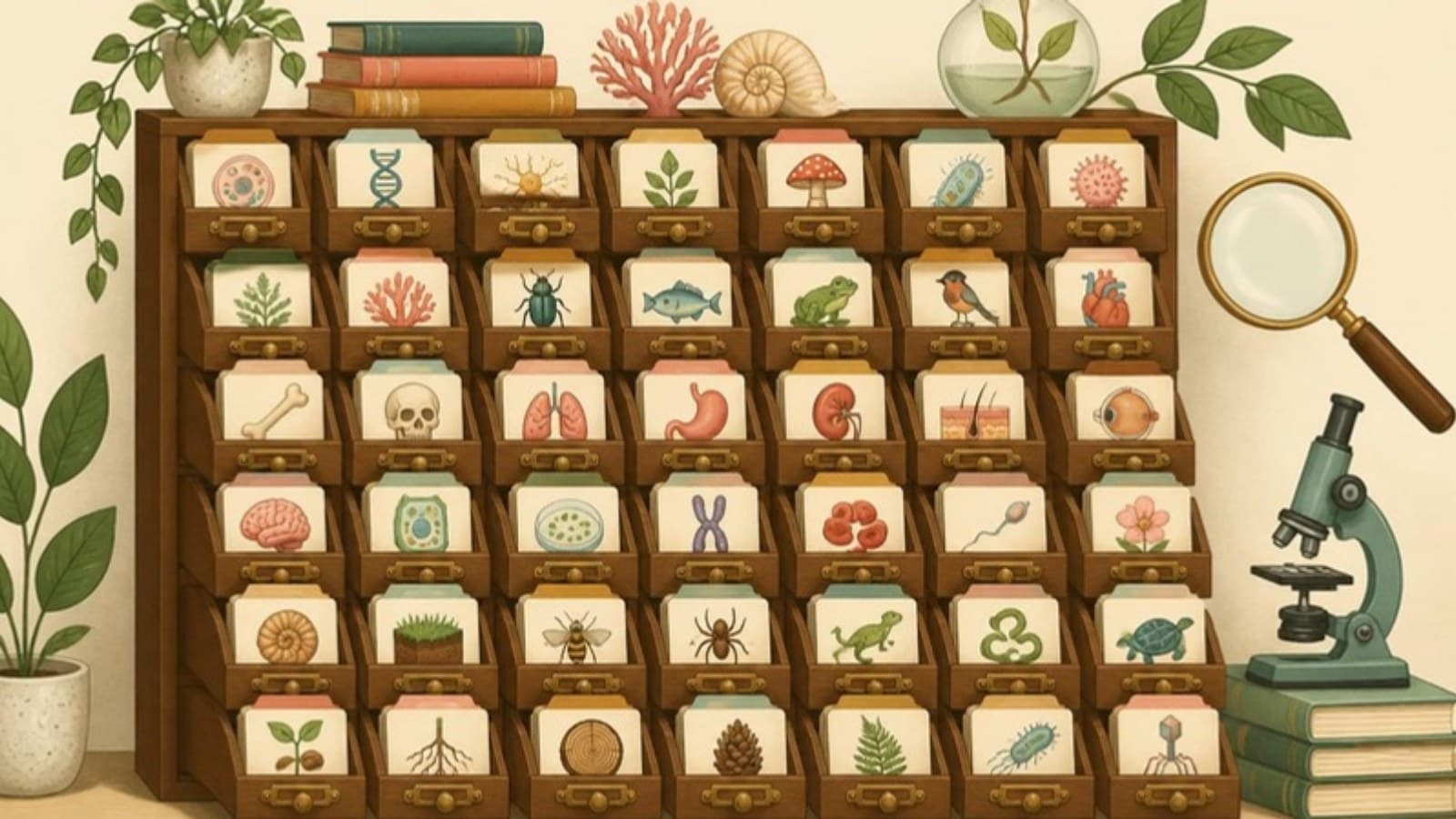
Master the 50 most-tested biology diagrams for NEET. Learn how diagrams are tested, drawing techniques, labeling tricks, and practice strategies used by top scorers.

5 points to remember for NEET
Data point: In NEET Biology 2024, 28 out of 90 questions (31%) either showed diagrams or required diagram-related knowledge.
Yet most students treat diagrams casually. They glance at textbook images, flip the page, and hope they'll remember during the exam. This strategy fails.
When Cerebrum analyzed answer sheets of students scoring 280-300 vs. 330+, we found a stark difference: Top scorers drew every diagram 3-5 times during preparation. Average scorers glanced at diagrams once.
This guide shares the exact 50 diagrams you must master and the drawing strategy that converted weak scorers into top performers.
Why they matter: 2-3 questions/year. Usually involves labeling parts or explaining function.
Why they matter: 4-5 questions/year. Fundamental to understanding cellular processes.
Cerebrum insight: Questions often ask "What organelle lacks a membrane?" or "Identify the organelle where photosynthesis occurs in the given diagram." Mastering structure reveals function.
Why they matter: 5-6 questions/year on molecular basis of inheritance alone.
Common question types:
Photosynthesis & Respiration: 26. Light reactions (photosystem II, electron transport, photosystem I) 27. Calvin cycle (3 phases with molecule counts: 3RuBP → 3PGA → etc.) 28. Glycolysis pathway (glucose → 2 pyruvate, ATP/NADH production) 29. Citric acid cycle (Krebs cycle with all intermediates) 30. Electron transport chain & oxidative phosphorylation
Digestion & Nutrition: 31. Alimentary canal (all regions with glands) 32. Tooth structure (enamel, dentine, pulp, roots) 33. Liver structure (hepatocytes, sinusoids, bile ducts) 34. Pancreatic acinar & islet cells (distinction)
Circulation & Respiration: 35. Heart structure (chambers, septa, valves) 36. Blood circulation pathway (pulmonary vs. systemic circulation) 37. Cardiac cycle diagram (systole vs. diastole, pressure changes) 38. Respiratory system (trachea, bronchi, alveoli, diaphragm) 39. Alveolar structure (capillary network, gas exchange surface)
Nervous & Endocrine: 40. Neuron structure (dendrite, axon, synapse, neurotransmitter) 41. Reflex arc (receptor → sensory neuron → spinal cord → motor neuron → effector) 42. Brain regions & their functions (cerebrum, cerebellum, medulla) 43. Endocrine glands locations (hypothalamus, pituitary, thyroid, pancreas, adrenal, etc.)
Why they matter: 12-15 questions/year combined. Physiology is 30% of NEET.
Critical point: Questions rarely ask "What does the heart do?" Instead: "Identify the structure that prevents backflow of blood" (pointing to valve in diagram).
Why they matter: 8-10 questions/year. Ecology especially relies on visual representation.
What you see: A blank diagram with line pointers, 4-5 options with structure names.
Example: "Identify structure X in the given mitochondrial diagram"
How to solve:
What you see: A labeled diagram with a functional question.
Example: "The structure marked X in the neuron is responsible for..."
How to solve:
What you see: A series of diagrams showing a process; asked to identify which stage or predict the next stage.
Example: "Which phase of meiosis is shown in the diagram where chromosomes are aligned at the metaphase plate?"
How to solve:
What you see: Two diagrams side-by-side (e.g., mitosis vs. meiosis) with a comparison question.
Example: "Both diagrams show cell division. Which is the key difference between them?"
How to solve:
What you see: A diagram with a "given" scenario; ask you to predict outcome.
Example: "If the structure X is damaged, which process would be affected most?" (Diagram shows mitochondrion)
How to solve:
Goal: Identify structure from labeled diagram instantly.
Method:
Time per diagram: 5 minutes × 3 repetitions = 15 minutes total per diagram Total time for 50 diagrams: 12-13 hours spread over 2 weeks
Goal: Draw and label diagrams from memory.
Method:
Important: Don't trace or copy. Free-hand drawing activates deeper brain regions for learning.
Example - Plant Cell Drawing:
Time per diagram: 10 minutes × 3 cycles = 30 minutes Total for 50 diagrams: 25 hours over 3 weeks
Goal: Connect structure to function; apply to new questions.
Method:
Example - Heart Diagram Functional Questions:
Time per diagram: 15 minutes Total for 50 diagrams: 12-13 hours over 2 weeks
Practice break
Reading is prep. Practising is progress.
Free to try · replies within a few hours on WhatsApp
These diagrams appear in 3-5 questions across different question types:
Time investment: 8-10 hours Expected return: 15-20 marks from diagrams
These diagrams appear in 1-3 questions:
Time investment: 10-12 hours Expected return: 12-18 marks
These appear in isolated questions but reinforce understanding:
Time investment: 5-6 hours Expected return: 5-8 marks
Example: From "mitosis diagram," create these questions:
You draw a perfect cell but can't answer "What would happen if mitochondria were removed?" (Complete energy crisis)
Fix: After drawing, immediately write its function and 3 consequences of its damage.
Mixing up:
Fix: For similar diagrams, create a comparison table highlighting differences.
Not tracking how chromosome numbers change through meiosis (2n → n).
Fix: Label every chromosome number in every stage of diagrams.
Looking at textbook diagrams without drawing or testing yourself.
Fix: Don't open your textbook. Draw first. Then check accuracy.
Recommendation: 60% hand-drawn, 40% digital/passive review.
For a 6-month preparation schedule:
| Duration | Focus |
|---|---|
| Month 1 | Learn theory while studying text; observe diagrams simultaneously |
| Month 2 | Tier 1 diagrams: reproduce manually 3x each |
| Month 3 | Tier 2 diagrams: reproduce manually 3x each |
| Month 4 | PYQ-based diagram questions, focus on weak diagrams |
| Month 5 | Full tests, diagram identification under timed conditions |
| Month 6 | Revision: redraw all 50 diagrams from memory once |
Time: 45 minutes. Topic: Mitochondrial Structure
Minutes 1-5: Observe textbook diagram
Minutes 6-10: Cover textbook; draw from memory
Minutes 11-15: Study its function
Minutes 16-20: Problem-solve
Minutes 21-35: PYQ practice
Minutes 36-45: Redraw from memory; final check
Result: After one 45-minute session, you've achieved deep learning of this diagram. Repeat every 2 weeks for spaced repetition.
By mastering just these 50 diagrams, you'll confidently answer 25-30 NEET Biology questions—translating to 75-90 marks gain.
At Cerebrum Biology Academy, we provide detailed diagram study guides, animated process videos, and weekly diagram drawing assignments. Students who follow our diagram mastery program typically improve diagram-based accuracy from 60% to 90%+.
Your biology score isn't limited by your understanding—it's limited by how well you can visually recognize and apply diagram concepts on exam day. Master these 50, and that score unlock is guaranteed.
Fifty diagrams is a lot to hold in memory equally — some come back every year, some almost never do. Message us on WhatsApp at +91 88264 44334 and tell us which unit you're weakest at drawing; we'll tell you which diagrams from that unit have appeared most often in recent NEET papers.
Related reading: NEET Biology Chapter-Wise Resource Hub · Book a Free Demo Class
Related resources

About the author
Dr. Shekhar C. Singh
AIIMS New Delhi alumnus who has taught biology since 2014, from NCERT foundations to the International Biology Olympiad.
Read his full profile →Get personalized guidance from AIIMS experts and achieve your medical college dreams
More from the blog
Master the art of reading NCERT Biology for NEET 2026. Learn the line-by-line strategy that toppers use to score 340+ in Biology. Complete chapter-wise approach included.
12 Jun 2026
Master the art of reading NCERT for NEET Biology. Learn which concepts carry the highest weightage, how to identify exam-critical lines, and practical strategies from AIIMS faculty.
9 Feb 2026
Complete chapter-wise guide for all 38 NEET Biology chapters with weightage, key topics, previous year questions, tips, and important diagrams. Organized by unit for systematic preparation.
9 Feb 2026
Share your thoughts, ask a question, or help another student
Type it below and send it to us on WhatsApp — no sign-up needed.
For NEET Biology, aim for 3-4 hours of focused study daily. Quality matters more than quantity!
Yes! NCERT covers 95% of NEET Biology questions. Master it completely before any reference book.
Human Physiology (20%), Genetics (18%), and Ecology (12%) are the highest-scoring areas.
Need personalized guidance?