Loading...
Loading...
Master 100+ creative biology mnemonics covering taxonomy, cell biology, genetics, human physiology, plant physiology, and ecology. Proven memory tricks to boost your NEET scores.
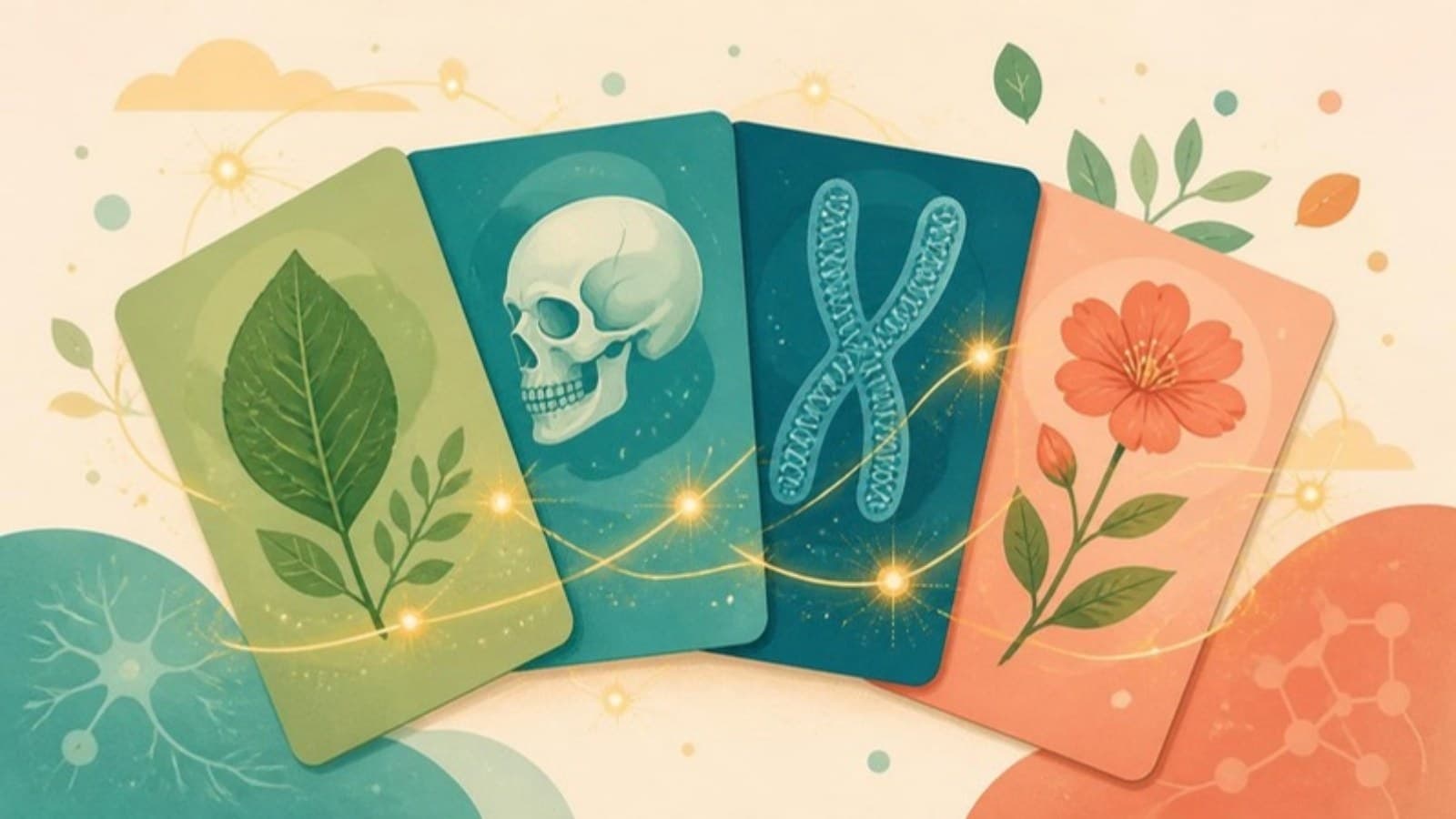

5 points to remember for NEET
Memory is one of the biggest challenges in NEET biology preparation. With hundreds of scientific terms, anatomical structures, and biological processes to remember, students often feel overwhelmed. This is where mnemonics come in—creative memory devices that transform hard-to-remember information into memorable patterns. This comprehensive guide provides 100+ proven mnemonics covering all major NEET biology topics.
Mnemonics leverage the brain's natural ability to remember patterns, stories, and associations better than raw information. Here's why they're so effective:
Now, let's dive into the actual mnemonics!
Mnemonic: "KPCOFGS"
Memory Aid: "Kindly Put Carrot Out For Gray Squirrels"
Mnemonic: "MoFuPrAn"
Memory Aid: "My Friend Prefers Pizza And Nachos"
Mnemonic: "PoCNEARM"
Memory Aid: "Poor Creatures Need Every Article Made Carefully in the Habitat"
Nucleus: "Command Control Center" (contains genetic information)
Mnemonic for Organelles: "MERM"
Mnemonic: "PINE"
Animal cells lack (CAW):
Plant cells have special structures (CVC):
Mnemonic: "LAI"
Mnemonic: "DERP"
DNA has (TLD):
RNA has (URN):
Mnemonic: "DTM" or "DNA to Protein"
Visual Memory: DNA → mRNA → Protein (always this direction, never backward)
Mnemonic: "PSI"
Mnemonic: "MESOL"
Better Mnemonic: "Most Energetic Stomachs Increase Nutrient Levels"
Mnemonic: "MIPIM"
Formula: 2-1-2-3 (reading from front to back) = 16 per jaw × 2 = 32 total
Left Lung (2 lobes): LL Right Lung (3 lobes): RRR
Memory Aid: "Left has Less, Right has Rest"
Mnemonic: "RA-RV-LA-LV"
Blood Flow Path: RA → RV → Lungs → LA → LV → Body → RA (cycle repeats)
Mnemonic: "FTP" (Forebrain, Midbrain, Hindbrain)
Forebrain (CLOHD):
Hindbrain (PMM):
Pancreas Hormones:
Thyroid:
Adrenal:
Mnemonic: "FILT"
Mnemonic: "LLMNB"
Order by abundance: "Never Let Monkeys Eat Bananas" (NLMEB)
Mnemonic: "AAI"
Mnemonic: "HELP"
Mnemonic: "FRP"
Mnemonic: "ACE GEL"
Better version: "AEGC"
Mnemonic: "WOE"
Mnemonic: "PCH"
Mnemonic: "TST DGS"
Mnemonic: "FAN" (during one direction) Then "DNA" (during reverse)
Forward (Nitrogen fixation to Nitrate):
Reverse (Denitrification):
Mnemonic: "CCCPC"
Better: "PICP" (easier to remember)
Practice break
Reading is prep. Practising is progress.
Free to try · replies within a few hours on WhatsApp
Mnemonic: "PMAT"
Full Memory Device: "Please Make Another Two" (cells)
Mnemonic: "PMAT PMAT" (occurs twice)
First Division: P → M → A → T (reductional division) Second Division: P → M → A → T (equational division)
Combined: "Please Make Another Two, Please Make Another Two"
Spermatogenesis: 4 functional sperm cells Oogenesis: 1 egg + 3 polar bodies
Mnemonic: "Boys make 4, Girls make 1"
Mnemonic: "EMD"
Mnemonic: "Z.I.N.C."
Mnemonic: "ADEK"
(Remember: A, D, E, K are the four fat-soluble vitamins)
Mnemonic: "B Complex = B Completely"
Mnemonic: "PQRST"
Original Mnemonic: "All Boys Can Do Everything" (for Animalia divisions)
Your Personal Version: "Alice's Beautiful Cats Dance Everywhere" (if you love cats)
The personalized version will stick better because it's emotionally relevant to you!
A: No! Top NEET scorers use mnemonics extensively. They're efficient memory tools that let you spend time understanding concepts rather than memorizing facts.
A: Using a well-designed mnemonic, you can memorize a list of 5-8 items in 2-3 minutes versus 15-20 minutes of traditional rote learning. The time-saving advantage is significant.
A: This rarely happens because mnemonics are easier to forget than the original information. More importantly, understanding the concept means you can derive the information even if you forget the mnemonic.
A: Absolutely! Personalized mnemonics are more effective. If an existing mnemonic doesn't resonate, create your own. The act of creating helps memory formation.
A: No. Focus on topics with many similar terms (like organelles, hormones, or organisms) or complex sequences (like cycles and pathways). Don't create mnemonics for concepts better understood through visualization.
A: Yes! Many NEET coaching centers publish mnemonic booklets. However, creating your own is more effective. Use existing ones as inspiration and personalize them.
A: If you can recall the information without seeing the mnemonic after 2-3 days, it's working. If you can't, the mnemonic wasn't effective—try a different approach.
A: Write the mnemonic on flashcards, quiz yourself daily, and track which ones you still need to practice. Gradually, they'll shift from short-term to long-term memory.
A: Yes, but personalized ones are more effective. Share to inspire creativity, but encourage friends to create their own versions.
A: Mnemonics are particularly effective for NEET Biology due to the abundance of terminology, classifications, and sequences. They're less useful for conceptual subjects like Physics but still helpful for remembering sequences and formulas.
Mnemonics are powerful tools that can transform your NEET biology preparation from a memory-heavy burden into an efficient, manageable process. The 100+ mnemonics provided in this guide cover the most challenging and frequently asked topics in NEET exams.
Key takeaways:
The most successful NEET students don't memorize everything—they learn concepts deeply and use mnemonics strategically for rapid recall of specific information. Begin implementing these memory devices today, and watch your retention rates skyrocket while your study time becomes more efficient.
Remember: The best mnemonic is the one you create yourself based on your own interests and associations. Use these as templates and build your personalized mnemonic library for unstoppable NEET success!
This list covers a lot of ground, but if there is one chapter where nothing is sticking — a classification, a pathway, a sequence — message us on WhatsApp at +91 88264 44334 and name the chapter. We'll send you memory aids built specifically for it.
Related reading: 50 Essential NEET Biology Mnemonics for Class 12 · Our NEET coaching programme
Related resources

About the author
Dr. Shekhar C. Singh
AIIMS New Delhi alumnus who has taught biology since 2014, from NCERT foundations to the International Biology Olympiad.
Read his full profile →Get personalized guidance from AIIMS experts and achieve your medical college dreams
More from the blog
Build an unshakeable NEET Biology foundation in Class 11. Chapter-wise strategy for Botany and Zoology with NCERT mastery tips from Cerebrum Biology Academy.
9 Feb 2026
From AI-powered doubt solving to adaptive mock tests, technology can supercharge your NEET preparation. Discover the best apps and tools that top scorers use alongside traditional coaching.
5 Feb 2026
Losing motivation during NEET preparation is inevitable. What separates successful aspirants is knowing how to reignite it. Discover 12 proven strategies to stay driven throughout your NEET journey.
5 Feb 2026
Share your thoughts, ask a question, or help another student
Type it below and send it to us on WhatsApp — no sign-up needed.
For NEET Biology, aim for 3-4 hours of focused study daily. Quality matters more than quantity!
Yes! NCERT covers 95% of NEET Biology questions. Master it completely before any reference book.
Human Physiology (20%), Genetics (18%), and Ecology (12%) are the highest-scoring areas.
Need personalized guidance?