Loading...
Loading...
Complete breakdown of NEET 2026 exam pattern, marking scheme, syllabus changes, subject distribution, and how it differs from previous years. Essential guide for all aspirants.

5 points to remember for NEET
The National Eligibility cum Entrance Test (NEET) 2026 is one of India's most competitive medical entrance exams. Understanding the exam pattern is crucial for effective preparation. This comprehensive guide breaks down everything you need to know about NEET 2026's structure, marking scheme, syllabus changes, and how it compares with previous years.
NEET 2026 maintains the following overall structure:
Total Questions: 180 questions Total Duration: 3 hours (180 minutes) Maximum Marks: 720 marks Medium: English, Hindi, Assamese, Bengali, Gujarati, Kannada, Marathi, Odia, Tamil, Telugu, Urdu
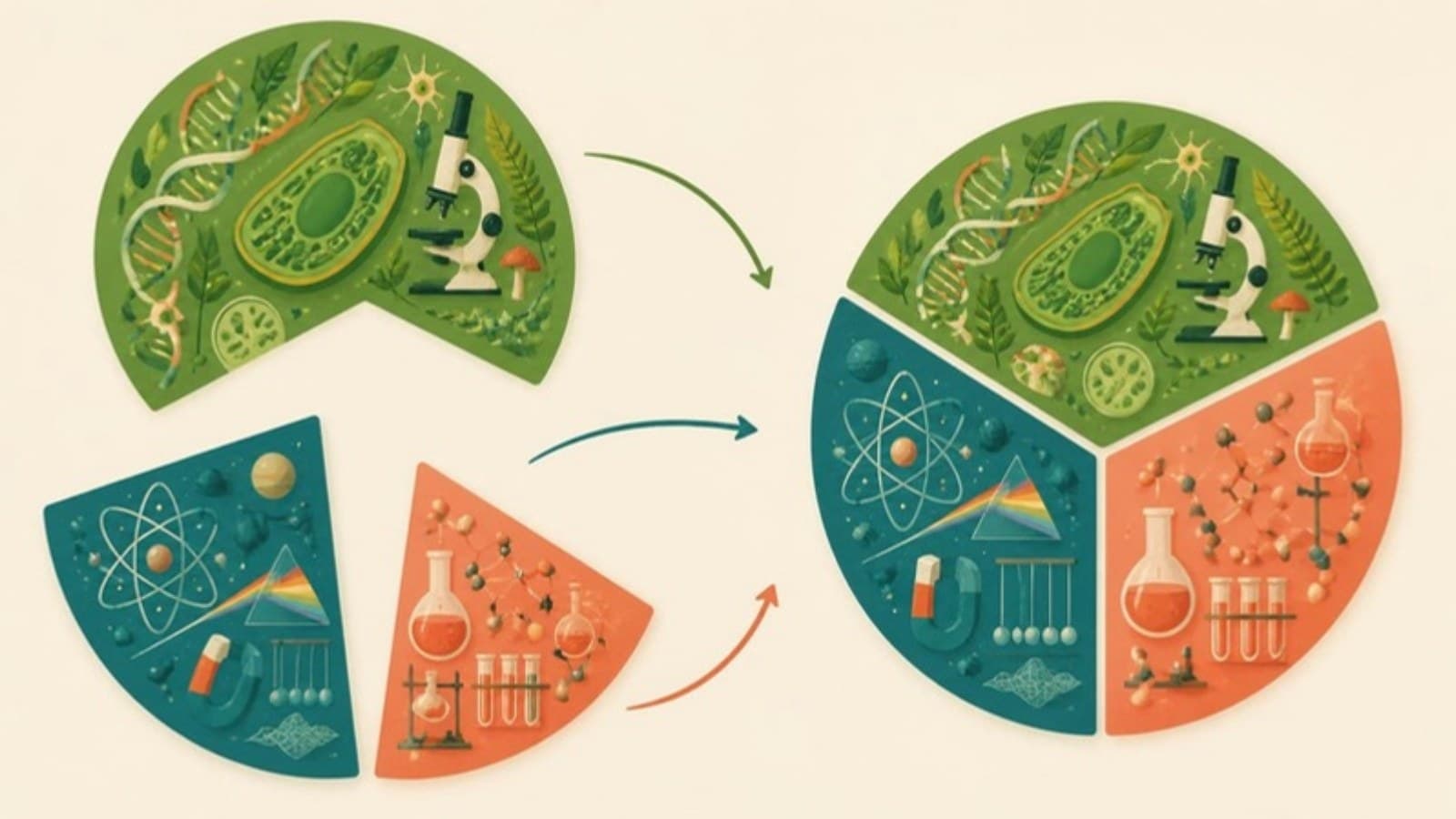
The exam consists of three main sections: Physics, Chemistry, and Biology (Botany + Zoology).
| Section | Total Questions | Marks | Question Type |
|---|---|---|---|
| Physics | 45 | 180 | Multiple Choice (MCQ) |
| Chemistry | 45 | 180 | Multiple Choice (MCQ) |
| Biology (Botany) | 45 | 180 | Multiple Choice (MCQ) |
| Biology (Zoology) | 45 | 180 | Multiple Choice (MCQ) |
| TOTAL | 180 | 720 |
The NEET 2026 marking scheme is straightforward:
This marking scheme emphasizes accuracy over guessing and has remained consistent for several years now.
Physics carries 45 questions totaling 180 marks. The distribution is based on the official NEET syllabus:
Class 11 Physics Topics (approximately 20-22 questions):
Class 12 Physics Topics (approximately 23-25 questions):
Physics is often considered the toughest section due to the requirement for deep conceptual understanding and numerical problem-solving skills.
Chemistry carries 45 questions totaling 180 marks, divided between organic and inorganic chemistry:
Inorganic Chemistry (approximately 18-20 questions):
Organic Chemistry (approximately 15-18 questions):
Physical Chemistry (approximately 7-10 questions):
Chemistry is often the most scoring subject for well-prepared students because questions are more straightforward and theory-based.
Biology is the most important subject for NEET, carrying 45 questions each in Botany and Zoology:
Botany (180 marks):
Zoology (180 marks):
The National Testing Agency (NTA) periodically removes certain topics from the NEET syllabus. For NEET 2026, the following topics have been deleted:
Physics (Class 12):
Chemistry (Class 11):
Chemistry (Class 12):
Biology:
It's crucial to understand that deleted topics will NOT appear in NEET 2026. However, if you're studying from comprehensive textbooks, ensure you're focusing only on the official NTA syllabus to avoid wasting time on irrelevant content.
| Aspect | NEET 2025 | NEET 2026 |
|---|---|---|
| Total Questions | 180 | 180 |
| Total Marks | 720 | 720 |
| Duration | 3 hours | 3 hours |
| Marking Scheme | +4, -1, 0 | +4, -1, 0 |
| Number of Attempts | First year of two-attempts rule | Second year |
| Difficulty | Moderate to Difficult | Expected Similar |
With 180 minutes for 180 questions, you have approximately 1 minute per question on average. However, questions vary in difficulty and require different time allocations:
Based on NEET papers from 2022-2025:
Practice break
Reading is prep. Practising is progress.
Free to try · replies within a few hours on WhatsApp
| Percentile | Expected Marks |
|---|---|
| 99th percentile | 650-680 |
| 95th percentile | 580-620 |
| 90th percentile | 520-560 |
| 80th percentile | 440-480 |
| 50th percentile | 240-280 |
These are approximate benchmarks. Actual cutoffs vary by year based on difficulty and number of applicants.
A: No significant changes have been made to the overall exam pattern. NEET 2026 maintains the same 180-question, 720-mark, 3-hour format that has been consistent since 2020. However, always check the official NTA website for any last-minute updates.
A: For every incorrect answer, 1 mark is deducted. Unanswered questions receive 0 marks (no penalty). This means guessing has a 75% risk of losing marks compared to leaving a question blank.
A: Yes, Biology (both Botany and Zoology combined) accounts for exactly half of the total NEET marks (360 out of 720). This makes it the most critical subject for securing a good rank, especially since students typically find it more scorable than Physics.
A: High-weightage chapters include:
A: On average, 1 minute per question. However, allocate more time for numerical problems and less for recall-based questions. During actual exam, spend 30-40 seconds on easy questions and 1.5-2 minutes on difficult ones.
A: While you can prioritize high-weightage topics, don't completely ignore any topic. Some low-weightage chapters occasionally have questions, and skipping them entirely could cost you precious marks.
A: Only guess if you can eliminate 2-3 options with confidence. Otherwise, leave the question blank. The psychological aspect of maintaining accuracy is more important than attempting more questions blindly.
A: Choose the medium you're most comfortable with. There's no advantage or disadvantage to any medium. Your clarity of concepts matters more than the language.
A: Deleted topics will not appear in new questions. However, don't waste time on them. Focus entirely on the current official syllabus published by NTA.
Understanding the NEET 2026 exam pattern is your first step toward effective preparation. The exam maintains a predictable structure that has proven consistent over years, allowing you to plan your study schedule strategically. Remember that while the pattern is fixed, what matters most is your preparation quality, consistency, and smart strategy based on chapter weightages.
The key takeaway: Know your exam pattern, understand the weightages, practice intelligently, and maintain high accuracy. Follow a systematic approach, focus on high-value topics without neglecting others, and you'll be well-positioned for a competitive NEET 2026 score.
Start your preparation today, stay disciplined, and believe in your potential to succeed!
Knowing the pattern is step one — the useful part is adjusting your section-wise time allocation and attempt strategy around it. message us on WhatsApp at +91 88264 44334 and tell us your current weak section, and we'll tell you how this pattern should change your approach to it.
Related reading: NEET 2026 Difficulty & Cutoff Prediction · NEET 2026 Syllabus: Complete Guide · NEET coaching
Related resources

About the author
Dr. Shekhar C. Singh
AIIMS New Delhi alumnus who has taught biology since 2014, from NCERT foundations to the International Biology Olympiad.
Read his full profile →Get personalized guidance from AIIMS experts and achieve your medical college dreams
More from the blog
Comprehensive comparison of top NEET coaching centers in Delhi NCR 2026. Evaluate coaching approaches, batch sizes, faculty credentials, results, fees, and what to look for in NEET coaching.
9 Feb 2026
Dr. Shekhar analyzes 5 major trends reshaping NEET coaching — AI integration, hybrid learning, small batches, regional expansion, and outcome-based pricing. Strategic forecast for 2026-2030.
9 Feb 2026
A detailed, month-by-month strategy to score 340+ in NEET Biology from an AIIMS faculty member. Includes NCERT-first approach, PYQ analysis, diagram practice tips, and mock test strategy.
9 Feb 2026
Share your thoughts, ask a question, or help another student
Type it below and send it to us on WhatsApp — no sign-up needed.
For NEET Biology, aim for 3-4 hours of focused study daily. Quality matters more than quantity!
Yes! NCERT covers 95% of NEET Biology questions. Master it completely before any reference book.
Human Physiology (20%), Genetics (18%), and Ecology (12%) are the highest-scoring areas.
Need personalized guidance?