Loading...
Loading...
title: NEET Evolution Weightage 2026 — Origin of Life & Mechanisms Analysis. Complete weightage analysis, question patterns, and chapter-wise strategy for NEET 2026 Biology preparation.


5 points to remember for NEET
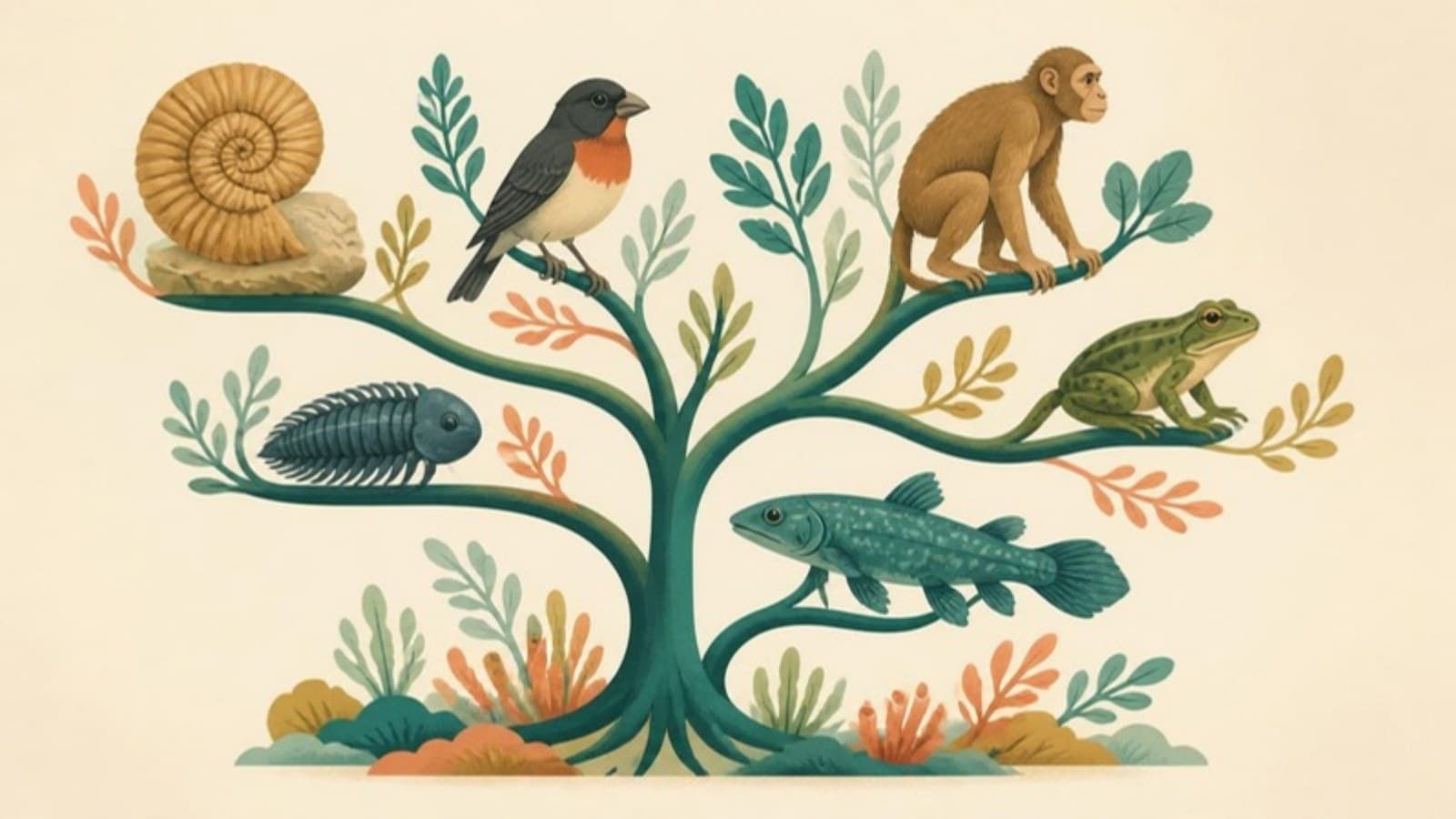
Evolution is a medium-weightage chapter (4-5 marks annually) that serves as a reliable scoring section for well-prepared students. Unlike chapters with diverse sub-topics, Evolution follows a clear progression: Origin of Life → Evidence for Evolution → Theories of Evolution → Population Genetics → Human Evolution. This logical structure makes it easier to organize study materials.
The chapter is conceptually demanding but low on calculation-heavy topics, making it ideal for visual learners and those who excel at comparative reasoning. With targeted preparation over 3-4 weeks, students can confidently secure 4-5 marks in this section.
| Year | Total Questions | Origin/Evidence | Evolutionary Theories | Hardy-Weinberg | Human Evolution | Avg Difficulty |
|---|---|---|---|---|---|---|
| 2019 | 2 | 1 (Evidences) | 1 (Darwin) | 0 | 0 | Easy |
| 2020 | 2 | 1 (Oparin-Haldane) | 1 (Natural selection) | 0 | 0 | Easy-Medium |
| 2021 | 2 | 1 (Miller-Urey) | 0 | 0 | 1 (Human evolution) | Medium |
| 2022 | 2 | 1 (Evidences) | 1 (Darwin vs. Lamarck) | 0 | 0 | Medium |
| 2023 | 3 | 1 (Origin of life) | 1 (Natural selection) | 1 (HW equilibrium) | 0 | Medium |
| 2024 | 2 | 1 (Fossils/Dating) | 1 (Adaptation) | 0 | 0 | Medium-Hard |
| 2025 | 2 | 0 | 1 (Darwin's finches) | 0 | 1 (Human evolution) | Medium |
| Total | 15 | 6 | 6 | 1 | 2 | Medium |
Critical Insight: Origin of Life + Evidences account for 40% of questions (6/15); Darwin's Theory accounts for 40% (6/15). Hardy-Weinberg and Human Evolution are emerging high-yield topics.
The Oparin-Haldane hypothesis, proposed independently in the 1920s-1930s, states that life originated from non-living chemical substances under the conditions of the primitive Earth. This is tested in nearly 50% of evolution questions.
Key Assumptions:
Proposed Stages of Life Origin:
Chemical Evolution (Abiogenesis): Inorganic compounds → organic molecules
Protobionts Formation: Organic molecules → self-replicating systems
First Life Forms: RNA world hypothesis
NEET Question Pattern 1: "What was the composition of the primitive Earth's atmosphere?"
NEET Question Pattern 2: "Which stage came first in chemical evolution?"
The Miller-Urey experiment provided the first laboratory evidence that organic compounds could form from inorganic substances under primitive Earth conditions. This has appeared in 2 out of 7 NEET exams.
Experimental Setup:
Key Results:
NEET Question Pattern 1: "Miller-Urey experiment proved which concept?"
NEET Question Pattern 2: "What would happen if oxygen were present in Miller-Urey apparatus?"
Homologous structures are anatomically similar organs with different functions, indicating common ancestry.
Classic Examples:
Forelimbs: Human arm (manipulation) vs. Bat wing (flight) vs. Horse leg (running) vs. Whale flipper (swimming)
Embryonic Features: Gill slits in human embryo (present in fish as functional gills)
NEET Question Pattern: "Which feature in humans is homologous to fish gills?"
Analogous structures are functionally similar but structurally different, indicating separate evolutionary paths (NOT common ancestry).
Classic Examples:
NEET Distinction Question: "Bird wings and insect wings are examples of?"
Vestigial structures are reduced, non-functional remnants of once-functional organs in ancestors.
Examples:
NEET Question Pattern: "What do vestigial structures indicate?"
Fossils provide direct evidence of evolutionary change over time.
Types of Evidence:
Transitional Fossils: Intermediate forms showing evolutionary transitions
Radiometric Dating: Determines fossil ages
Fossil Sequencing: Reveals evolutionary progression
NEET Question Pattern: "Archaeopteryx is considered a transitional fossil because it shows both ** and ** characteristics."
DNA and protein similarities indicate evolutionary relationships.
Types of Molecular Evidence:
DNA Homology: Species with similar DNA sequences are more closely related
Protein Similarity: Amino acid sequences in homologous proteins
DNA-DNA Hybridization: Measures DNA base-pair matching between species
NEET Question Pattern: "Human and chimpanzee DNA similarity (98%) indicates __."
Charles Darwin's theory, published in 1859, is THE most important evolutionary concept. Appears in 40% of evolution questions.
Key Tenets:
Example: Antibiotic Resistance in Bacteria
NEET Question Pattern 1: "Natural selection acts on ** and leads to ** evolution."
NEET Question Pattern 2: "Antibiotic resistance in bacteria is an example of ** because **."
Jean-Baptiste Lamarck proposed that traits acquired during life could be inherited. This theory is OUTDATED but appears in 20% of evolution questions for comparison.
Lamarck's Proposed Mechanism:
Why Lamarck's Theory is Wrong:
Critical Comparison Table:
| Feature | Darwin's Natural Selection | Lamarck's Acquired Characteristics |
|---|---|---|
| Source of Variation | Random pre-existing variation in population | Need-based trait development |
| Selection Pressure | Environment selects favorable variants | Organism develops traits for need |
| Mechanism | Differential survival + reproduction | Use/disuse of organs |
| Heritability | Genetic (inheritable) | Non-genetic (NOT inheritable) |
| Time Scale | Gradual, but can be rapid with pressure | Gradual |
| Evidence | Well-supported; antibiotic resistance | NO scientific support |
| Example | Bacteria antibiotic resistance | This doesn't happen in biology |
NEET Question Pattern: "Which is a Lamarckian vs. Darwinian explanation?"
Adaptive radiation is the evolution of multiple species from a common ancestor to fill different ecological niches.
Classic Example: Darwin's Finches (Galápagos Islands)
NEET Question Pattern: "Darwin's finches demonstrate ** evolution because **."
The Hardy-Weinberg principle states that allele frequencies in a population remain constant across generations IF certain conditions are met. This appears in 10% of evolution questions.
The Equation: p² + 2pq + q² = 1
Example Calculation:
Conditions for Hardy-Weinberg Equilibrium:
In Real Populations: These conditions are NEVER perfectly met; evolution occurs because conditions are violated.
NEET Question Pattern 1: "If allele frequencies don't change, the population is in __ equilibrium."
NEET Question Pattern 2: "Which condition, if violated, would cause allele frequency change?"
Practice break
Reading is prep. Practising is progress.
Free to try · replies within a few hours on WhatsApp
Human evolution is a relatively new high-yield topic (appeared in 2021, 2025 NEET exams). Understanding the sequence and key features of each species is essential.
| Species | Estimated Time | Key Features | Brain Size | Notable Characteristics |
|---|---|---|---|---|
| Australopithecus afarensis | 3.9-2.9 MYA | Bipedal, ape-like face, small brain | 375-550 cc | "Lucy" fossil; first upright walker |
| Australopithecus africanus | 3.3-2.3 MYA | Fully bipedal, gracile build | 420-500 cc | Gracile features; thought to be human ancestor |
| Homo habilis | 2.4-1.4 MYA | First to make tools (stone tools) | 600-700 cc | "Handy man"; tool use = marker of Homo |
| Homo erectus | 1.9-0.1 MYA | Larger brain, tool sophistication, fire use | 850-1100 cc | Traveled beyond Africa; used fire |
| Homo neanderthalensis | 400,000-40,000 YA | Stocky, adapted to cold, large brain | 1200-1600 cc | "Neanderthal"; lived in Europe; hunted large game |
| Homo sapiens (modern humans) | 300,000 YA-present | Gracile, large brain, complex language, art | 1350-1400 cc | Cognitive revolution; symbolic thinking |
| Homo sapiens neanderthalensis | 100,000-30,000 YA | Overlap period; possible interbreeding | — | Neanderthals coexisted with humans; 1-4% human DNA from interbreeding |
Key Milestones:
NEET Question Pattern 1: "Which hominid first used tools?"
NEET Question Pattern 2: "Arrange these in evolutionary order: Homo erectus, Homo sapiens, Homo habilis, Australopithecus"
NEET Question Pattern 3: "Which feature was most important for human evolution?"
| Topic | Questions (2019-2025) | Priority |
|---|---|---|
| Origin of Life (Oparin-Haldane, Miller-Urey) | 5 | Very High |
| Evidences of Evolution (fossils, anatomy, molecular) | 4 | High |
| Darwin's Theory of Natural Selection | 4 | High |
| Darwin vs. Lamarck Comparison | 2 | Medium-High |
| Hardy-Weinberg Equilibrium | 1 | Medium |
| Human Evolution Timeline | 2 | Medium-High |
| Adaptive Radiation | 1 | Medium |
Evolution questions split into two categories:
Wrong Thinking: "Organisms evolve to adapt to environment" (implies intentionality) Correct Understanding: "Environments select for already-existing variation" (natural selection is mechanism, not goal)
Wrong Answer: "Long-necked giraffes developed long necks by stretching" Correct Answer: "Giraffes with longer necks (pre-existing variation) had advantage; reproduced more; population shifted"
Common Mistake: Saying bird and insect wings are homologous (they're analogous) Correct: Bird and bat wings are homologous (different function, common origin); bird and insect wings are analogous (same function, different origin)
Wrong: "If a population is in HW equilibrium, no evolution occurs" Right: "If HW conditions are met, allele frequencies don't change; but in real populations, these conditions are violated, so evolution occurs"
Wrong: "Carbon-14 dating works for fossils 1 million years old" Correct: "C-14 dating works for <50,000 years; use K-40 or other radiometric methods for older fossils"
Q1: Is evolution more about memorization or understanding? A: 60% conceptual understanding, 40% factual recall. Understand WHY organisms evolve (natural selection), not just THAT they evolve.
Q2: Will NEET ask calculation problems on Hardy-Weinberg? A: Rarely. Questions are conceptual: "What does HW equilibrium indicate?" not "Calculate p² if p = 0.6." Focus on understanding conditions and significance.
Q3: How important is the exact timeline of human evolution? A: Medium importance. Know the sequence (Australopithecus → Homo habilis → Homo erectus → Homo sapiens) and rough dates (millions of years ago). Exact dates to the hundred-thousand years are less critical.
Q4: Will NEET test CRISPR or modern genetic engineering in evolution? A: Unlikely in 2026. Evolution focuses on natural processes, not artificial genetic modification. Biotechnology chapter covers CRISPR.
Q5: Are there any recent evolutionary discoveries expected in NEET 2026? A: Unlikely. NEET curriculum is stable; new discoveries (like recent Homo naledi fossil) take years to enter curriculum. Stick to established topics.
Q6: How do I distinguish between natural selection and genetic drift? A: Natural Selection: Directional, non-random (beneficial traits increase); Genetic Drift: Random (due to chance, small population size). Genetic drift is not asked as often; natural selection is primary focus.
Q7: Can evolution and religion coexist in NEET answers? A: NEET is a science exam. Answer based on scientific evidence (fossils, DNA, natural selection), not religious beliefs. Science and personal beliefs are separate.
Q8: Is the "missing link" concept still relevant for NEET? A: Somewhat outdated. Transitional fossils (like Archaeopteryx) are called "transitional fossils," not "missing links." Know the term shift, but focus on actual transitional forms.
For comprehensive Evolution study materials:
Dr. Shekhar is the Founder & Senior Faculty at Cerebrum, specializing in NEET Biology chapter analysis. With 15+ years of NEET exam pattern research, he provides data-driven study strategies for maximum score optimization.
It's a smaller chapter, so the question is really whether the marks it carries justify a separate slot in your final revision. Message us on WhatsApp at +91 88264 44334 and we'll send you exactly how many marks this chapter has carried in each of the last few NEET papers, so you can decide for yourself.
Related reading: Evolution - Origin of Life & Hardy-Weinberg Notes · Class 12 Biology Coaching
Related resources

About the author
Dr. Shekhar C. Singh
AIIMS New Delhi alumnus who has taught biology since 2014, from NCERT foundations to the International Biology Olympiad.
Read his full profile →Get personalized guidance from AIIMS experts and achieve your medical college dreams
More from the blog
Complete NEET notes on Evolution covering Origin of Life, Oparin-Haldane theory, Miller-Urey experiment, Darwin vs Lamarck, Hardy-Weinberg principle, adaptive radiation, and human evolution with PYQs and MCQs.
2 Mar 2026
title: NEET Biotechnology Weightage 2026 — Principles & Applications Analysis. Complete weightage analysis, question patterns, and chapter-wise strategy for NEET 2026 Biology preparation.
7 Feb 2026
title: NEET Cell Biology Weightage 2026 — Cell Structure, Biomolecules & Division. Complete weightage analysis, question patterns, and chapter-wise strategy for NEET 2026 Biology preparation.
7 Feb 2026
Share your thoughts, ask a question, or help another student
Type it below and send it to us on WhatsApp — no sign-up needed.
For NEET Biology, aim for 3-4 hours of focused study daily. Quality matters more than quantity!
Yes! NCERT covers 95% of NEET Biology questions. Master it completely before any reference book.
Human Physiology (20%), Genetics (18%), and Ecology (12%) are the highest-scoring areas.
Need personalized guidance?