Loading...
Loading...
Master Plant Kingdom for NEET 2026 with comprehensive notes on algae, bryophytes, pteridophytes, gymnosperms, and angiosperms. NCERT-aligned content with diagrams and PYQs.

5 points to remember for NEET
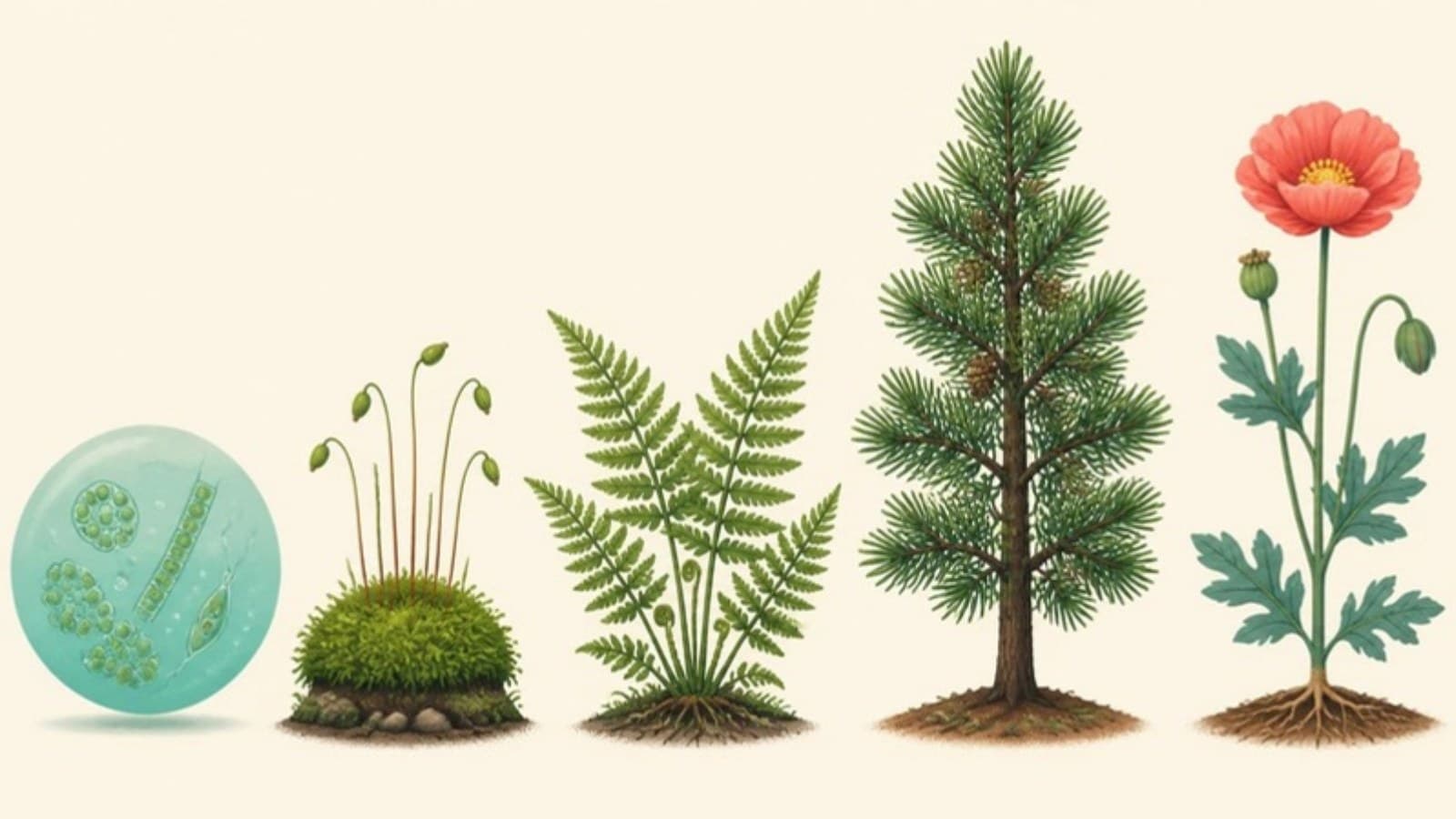
Plant Kingdom is a high-weightage chapter from Diversity of Living Organisms, contributing 4-6 questions in NEET annually. This guide covers all major plant groups with their characteristics.
| Group | Vascular Tissue | Seeds | Examples |
|---|---|---|---|
| Algae | Absent | Absent | Spirogyra, Ulva |
| Bryophytes | Absent | Absent | Mosses, Liverworts |
| Pteridophytes | Present | Absent | Ferns, Selaginella |
| Gymnosperms | Present | Naked | Pinus, Cycas |
| Angiosperms | Present | Enclosed | All flowering plants |
| Feature | Description |
|---|---|
| Pigments | Chlorophyll a, b; Carotenoids |
| Storage | Starch |
| Cell wall | Cellulose |
| Habitat | Fresh water, marine |
| Examples | Chlamydomonas, Spirogyra, Ulva, Volvox |
Key Examples:
| Feature | Description |
|---|---|
| Pigments | Chlorophyll a, c; Fucoxanthin (brown) |
| Storage | Laminarin, Mannitol |
| Cell wall | Cellulose + Algin |
| Habitat | Marine (mostly) |
| Examples | Fucus, Sargassum, Laminaria, Ectocarpus |
Key Features:
| Feature | Description |
|---|---|
| Pigments | Chlorophyll a, d; Phycoerythrin (red), Phycocyanin (blue) |
| Storage | Floridean starch |
| Cell wall | Cellulose + Pectin + Polysulfate esters |
| Habitat | Marine, warm waters, deeper zones |
| Examples | Polysiphonia, Porphyra, Gelidium, Gracilaria |
Economic Importance:
| Type | Method |
|---|---|
| Vegetative | Fragmentation, cell division |
| Asexual | Spores (zoospores, aplanospores) |
| Sexual | Isogamy, Anisogamy, Oogamy |
Types of Sexual Reproduction:
| Feature | Description |
|---|---|
| Body | Thalloid or leafy |
| Dorsiventral | Yes |
| Rhizoids | Unicellular |
| Asexual | Gemmae in gemma cups |
| Examples | Marchantia, Riccia |
Marchantia:
| Feature | Description |
|---|---|
| Body | Leafy gametophyte |
| Rhizoids | Multicellular, branched |
| Protonema | Juvenile stage (thread-like) |
| Examples | Funaria, Polytrichum, Sphagnum |
Life Cycle of Moss:
Sphagnum (Peat Moss):
| Feature | Description |
|---|---|
| Leaves | Absent or scale-like |
| Roots | Absent (rhizoids) |
| Examples | Psilotum, Tmesipteris |
| Feature | Description |
|---|---|
| Leaves | Microphylls (small, single-veined) |
| Strobili | Present (cone-like structures) |
| Examples | Lycopodium, Selaginella |
Selaginella:
| Feature | Description |
|---|---|
| Stem | Jointed, ribbed, hollow |
| Leaves | Whorled, reduced |
| Examples | Equisetum |
Equisetum:
| Feature | Description |
|---|---|
| Leaves | Megaphylls (large, compound) |
| Fronds | Circinate vernation (coiled young leaves) |
| Sori | Clusters of sporangia on leaves |
| Examples | Pteris, Dryopteris, Adiantum |
| Feature | Description |
|---|---|
| Habit | Palm-like |
| Leaves | Pinnately compound |
| Trunk | Unbranched |
| Examples | Cycas, Zamia |
Cycas:
| Feature | Description |
|---|---|
| Habit | Evergreen trees |
| Leaves | Needle-like or scale-like |
| Cones | Male and female cones |
| Examples | Pinus, Cedrus, Picea, Abies |
Pinus (Pine):
Practice break
Reading is prep. Practising is progress.
Free to try · replies within a few hours on WhatsApp
| Feature | Description |
|---|---|
| Features | Most advanced gymnosperms |
| Vessel elements | Present (like angiosperms) |
| Examples | Gnetum, Ephedra, Welwitschia |
Ephedra:
| Feature | Description |
|---|---|
| Cotyledons | Two |
| Leaf venation | Reticulate |
| Root system | Tap root |
| Vascular bundles | Arranged in ring |
| Secondary growth | Present |
| Flower parts | In multiples of 4 or 5 |
| Examples | Pea, Mango, Rose |
| Feature | Description |
|---|---|
| Cotyledons | One |
| Leaf venation | Parallel |
| Root system | Fibrous |
| Vascular bundles | Scattered |
| Secondary growth | Absent |
| Flower parts | In multiples of 3 |
| Examples | Rice, Wheat, Maize, Bamboo |
Unique to angiosperms:
| Plant Group | Dominant Generation | Gametophyte | Sporophyte |
|---|---|---|---|
| Algae | Variable | Independent | Independent |
| Bryophytes | Gametophyte (n) | Independent | Dependent |
| Pteridophytes | Sporophyte (2n) | Independent (prothallus) | Independent |
| Gymnosperms | Sporophyte (2n) | Reduced, dependent | Independent |
| Angiosperms | Sporophyte (2n) | Highly reduced | Independent |
Trend: Gametophyte progressively reduces; Sporophyte becomes dominant.
Q1 (NEET 2023): Phycoerythrin is found in:
Q2 (NEET 2022): Which of the following is heterosporous pteridophyte?
Q3 (NEET 2021): Dominant generation in bryophytes is:
Q4 (NEET 2020): First vascular plants were:
Q5 (NEET 2019): Double fertilization occurs in:
Q: Why are bryophytes called amphibians of the plant kingdom? A: Bryophytes live on land but require water for sexual reproduction. Their sperm are flagellated and must swim through water to reach the egg, just like amphibians depend on water for reproduction.
Q: What is the significance of heterospory? A: Heterospory is an evolutionary advancement toward seed formation. Megaspores are retained on the parent plant and develop into female gametophyte, eventually leading to seed habit in gymnosperms and angiosperms.
Q: Why don't gymnosperms and angiosperms need water for fertilization? A: They have pollen tubes. Pollen grains land near ovules, germinate, and the pollen tube delivers sperm directly to the egg, eliminating the need for water.
Q: What makes angiosperms the most successful plant group? A: Angiosperms have several advantages: (1) enclosed seeds protected by fruits, (2) double fertilization providing endosperm for embryo nutrition, (3) flowers attracting pollinators for efficient reproduction, (4) diverse adaptations to various habitats.
Q: Why are red algae found at greater depths than other algae? A: Red algae contain phycoerythrin, which absorbs blue and green light that penetrates deeper into water. This allows them to photosynthesize at depths where other algae cannot survive.
Algae, bryophytes, pteridophytes, gymnosperms and angiosperms are usually revised as one long list, which is why the group-to-group distinctions blur first. Message us on WhatsApp at +91 88264 44334 with the two plant groups you keep confusing, and we'll send the exact features NEET has used to tell them apart.
Related reading: Biological Classification - Five Kingdom Notes · NEET Plant Morphology & Anatomy Weightage Analysis · Class 11 Biology Coaching
Related resources

About the author
Dr. Shekhar C. Singh
AIIMS New Delhi alumnus who has taught biology since 2014, from NCERT foundations to the International Biology Olympiad.
Read his full profile →Get personalized guidance from AIIMS experts and achieve your medical college dreams
More from the blog
Master Animal Kingdom classification for NEET 2026 with this complete guide covering all non-chordate and chordate phyla, basis of classification, vertebrate classes, mnemonics, PYQs, and 12 practice MCQs aligned with NCERT.
2 Mar 2026
Master Cell Division for NEET 2026 with comprehensive notes on cell cycle, mitosis, meiosis, and their significance. NCERT-aligned content with diagrams and previous year questions.
12 Jun 2026
Master Cell Biology for NEET 2026 with comprehensive notes covering cell theory, prokaryotic vs eukaryotic cells, cell organelles, and their functions. NCERT-based content with previous year questions.
12 Jun 2026
Share your thoughts, ask a question, or help another student
Type it below and send it to us on WhatsApp — no sign-up needed.
For NEET Biology, aim for 3-4 hours of focused study daily. Quality matters more than quantity!
Yes! NCERT covers 95% of NEET Biology questions. Master it completely before any reference book.
Human Physiology (20%), Genetics (18%), and Ecology (12%) are the highest-scoring areas.
Need personalized guidance?