Loading...
Loading...
Complete Biotechnology guide for NEET simplified: Principles & Processes (genetic engineering, PCR, cloning), Applications (Bt cotton, insulin, gene therapy), and step-by-step techniques. Score 4-6 questions = 16-24 marks.
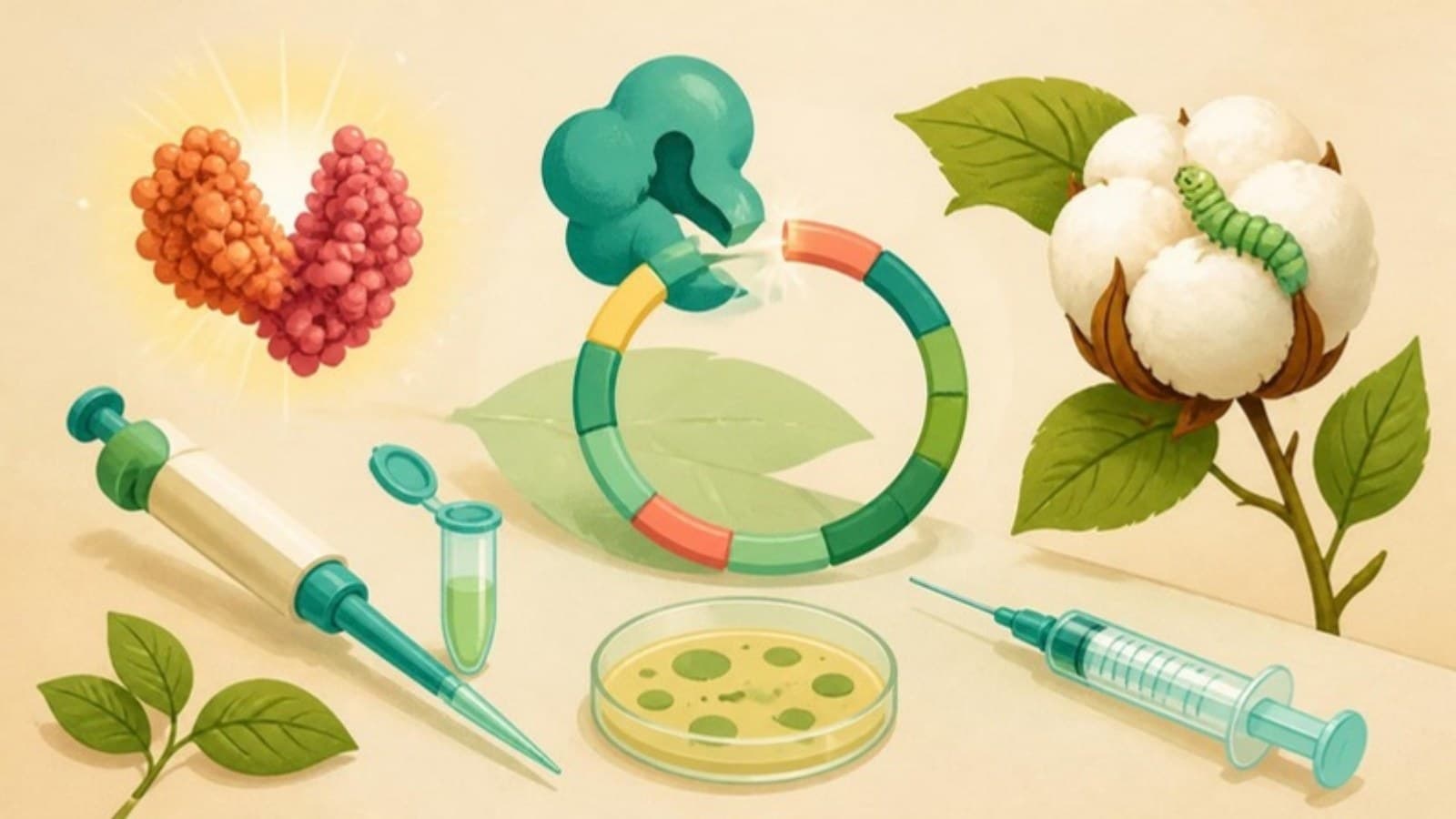

5 points to remember for NEET
Question: Which NEET chapter has:
Answer: Biotechnology (NCERT Class 12, Chapters 11 & 12)
| Aspect | Data |
|---|---|
| Average Questions | 4-6 per year |
| Marks | 16-24 (out of 360 Biology marks) |
| NCERT Pages | 40-45 pages (Ch 11: 22 pages, Ch 12: 18 pages) |
| Time Investment | 20-25 hours (NCERT + practice) |
| ROI | 0.64-0.96 marks per hour (HIGH) |
| Difficulty | Medium (60% questions are direct NCERT) |
Key Insight: Biotechnology gives you 16-24 marks for 20-25 hours of study. That's one of the BEST ROI in NEET Biology.
Common Complaints:
Reality: Biotechnology is SIMPLE if you understand the 3-Step Framework:
This blog simplifies all 3 steps.
Biotechnology: Using living organisms (or their parts) to make useful products or solve problems.
Simple Examples:
Pillar 1: Genetic Engineering
Pillar 2: Bioprocess Engineering
NEET Focus: 80% questions are on Pillar 1 (Genetic Engineering), 20% on Pillar 2 (Bioprocessing).
Concept: Combining DNA from two different sources (e.g., human DNA + bacterial DNA) to create new genetic combinations.
Analogy: It's like copy-pasting a paragraph from one document (human DNA) into another document (bacterial DNA).
Why Useful?
Key Terms:
Concept: Maintaining sterile conditions to prevent contamination.
Why Important?
Example: All bioreactors, Petri dishes, media are sterilized before use.
NEET Tip: Not heavily asked, but know the concept.
Concept: Ensuring that only the desired gene is expressed (not other unwanted genes).
How?
Function: Cut DNA at specific sequences (called recognition sites).
Analogy: Think of DNA as a long ribbon. Restriction enzymes are scissors that cut the ribbon at specific patterns (e.g., every time they see "GAATTC", they cut).
Example: EcoRI (most commonly asked in NEET)
| Feature | Details |
|---|---|
| Full Name | EcoRI (isolated from E. coli strain RY13) |
| Recognition Sequence | 5'-GAATTC-3' (reads same on both strands = palindrome) |
| Cut Type | Staggered cut (creates sticky ends) |
| Sticky Ends | Overhanging single-stranded DNA tails (can bind to complementary DNA) |
Why Sticky Ends Are Important?
| Enzyme | Source | Recognition Site | Cut Type |
|---|---|---|---|
| EcoRI | E. coli | GAATTC | Staggered (sticky ends) |
| BamHI | Bacillus amyloliquefaciens | GGATCC | Staggered (sticky ends) |
| Pst I | Providencia stuartii | CTGCAG | Staggered (sticky ends) |
| Hind III | Haemophilus influenzae | AAGCTT | Staggered (sticky ends) |
NEET Tip: You don't need to memorize all recognition sequences. Just know:
Example: EcoRI
NEET Question Type: "Which restriction enzyme is isolated from E. coli?" Answer: EcoRI
Function: Carry foreign DNA into host cells.
Analogy: Vectors are like delivery trucks that transport a package (foreign DNA) into a warehouse (host cell).
A) Plasmids (Most Common)
| Feature | Details |
|---|---|
| Definition | Small, circular, extrachromosomal DNA in bacteria |
| Size | 1-200 kb (kilobase pairs) |
| Replication | Independent of chromosomal DNA (autonomous replication) |
| Example | pBR322, pUC19 (commonly used in labs) |
Why Plasmids Are Good Vectors?
B) Bacteriophage (Viral Vectors)
| Feature | Details |
|---|---|
| Definition | Viruses that infect bacteria |
| Example | λ (Lambda) phage |
| Advantage | Can carry larger DNA fragments (up to 25 kb) |
C) Cosmids
| Feature | Details |
|---|---|
| Definition | Hybrid of plasmid + phage |
| Advantage | Can carry even larger DNA (35-45 kb) |
NEET Focus: 90% questions are about plasmids. Know bacteriophage as an alternative, but no deep details needed.
NEET frequently asks: "What are the features of an ideal cloning vector?"
Answer (5 features):
Most Common Hosts:
NEET Tip: E. coli is the default host. If question doesn't specify, assume E. coli.
Function: Joins DNA fragments together (seals the gap between sugar-phosphate backbones).
Analogy: If restriction enzymes are scissors (cut DNA), DNA ligase is glue (joins DNA).
How It Works:
NEET Question Type: "Which enzyme is used to join DNA fragments in recombinant DNA technology?" Answer: DNA Ligase
Goal: Extract pure DNA from organism (human, plant, bacteria).
Methods:
NEET Tip: Know the enzymes:
Goal: Cut both foreign DNA (gene of interest) and vector DNA using the SAME restriction enzyme.
Why Same Enzyme?
Example:
Goal: Make millions of copies of the desired gene.
Why Needed?
The 3 Steps of PCR (⭐ MOST ASKED IN NEET)
| Step | Temperature | Duration | What Happens | Enzyme/Primer |
|---|---|---|---|---|
| 1. Denaturation | 94-96°C | 15-30 sec | Double-stranded DNA separates into single strands (hydrogen bonds break) | Heat only |
| 2. Annealing | 50-60°C (usually 55°C) | 20-40 sec | Primers bind to complementary sequences on single-stranded DNA | Primers (short DNA sequences) |
| 3. Extension | 72°C | 30-60 sec | Taq Polymerase adds nucleotides to primers, synthesizing new DNA strand | Taq Polymerase (from Thermus aquaticus) |
Key Points:
NEET Questions:
Goal: Insert foreign DNA into vector using DNA ligase.
Process:
Goal: Introduce recombinant DNA into host cells (e.g., E. coli).
Methods:
A) Heat Shock Method
B) Electroporation
C) Microinjection (for eukaryotic cells)
NEET Focus: Know heat shock method (most common for bacteria).
Goal: Identify cells that have successfully taken up recombinant DNA.
Method 1: Selectable Markers
Method 2: Insertional Inactivation
NEET Question: "In insertional inactivation, recombinant colonies appear _" Answer: White (non-recombinant colonies are blue)
Problem: Cotton bollworms (pest) destroy cotton crops → Huge crop loss
Solution: Insert cry gene from Bacillus thuringiensis (Bt) into cotton plants
How It Works:
Key Points:
NEET Questions:
Problem: Diabetic patients need insulin. Earlier sources:
Solution: Genetically engineer bacteria to produce human insulin
Process (Eli Lilly, 1983 - First rDNA drug approved by FDA):
Key Points:
NEET Questions:
Practice break
Reading is prep. Practising is progress.
Free to try · replies within a few hours on WhatsApp
Definition: Treating genetic diseases by inserting functional genes into patient's cells.
Disease: Adenosine Deaminase (ADA) Deficiency
Gene Therapy Approach:
Step 1: Remove lymphocytes from patient's blood Step 2: Culture lymphocytes in vitro Step 3: Insert functional ADA gene into lymphocytes using retroviral vector Step 4: Return genetically modified lymphocytes to patient's blood Step 5: Modified lymphocytes produce ADA enzyme → Toxins are broken down → Immunity restored
Limitation: Not permanent (lymphocytes have limited lifespan) → Need repeated treatment
Permanent Solution (Experimental):
NEET Questions:
Application: Detecting diseases (infections, genetic disorders, cancers) by detecting DNA/RNA.
Examples:
1. ELISA (Enzyme-Linked Immunosorbent Assay)
2. PCR-Based Diagnosis
3. DNA Fingerprinting
NEET Tip: Know ELISA and PCR applications (lightly covered, 1-2 questions max).
Definition: Using biological resources (plants, genes, traditional knowledge) without authorization or compensation to the source country.
Example:
Indian Protection: Indian Patent Act, 2002 - Prevents patenting of traditional knowledge
NEET Tip: Know definition and 1 example.
Concern: Genetically modified organisms (GMOs) may have unintended effects:
Regulation: Genetic Engineering Approval Committee (GEAC) in India - Approves GM crops, monitors safety
NEET Tip: Know GEAC and concerns about GMOs (1-2 questions).
PCR: Makes millions of copies of DNA in vitro (test tube) Gene Cloning: Inserts gene into vector → Transfers into host → Host produces protein
NEET Trap: "PCR is used for producing large quantities of proteins" → FALSE (PCR only amplifies DNA, doesn't produce proteins)
Wrong Answer: "Taq Polymerase is from E. coli" Correct Answer: "Taq Polymerase is from Thermus aquaticus" (thermophilic bacterium)
Why Taq? Thermus aquaticus → Taq
Wrong Answer: "cry protein directly kills insects" Correct Answer: "cry protein is a protoxin → Activated in insect's alkaline gut → Creates pores in gut cells → Insect dies"
NEET Trap: "Why is Bt cotton safe for humans?" → "Human gut is acidic, cry protein is not activated"
Wrong Answer: "Insulin has A, B, C chains (all functional)" Correct Answer: "Insulin has only A and B chains (functional). C-peptide is removed during processing."
| Enzyme | Source Organism | Recognition Site |
|---|---|---|
| EcoRI | E. coli RY13 | GAATTC |
| BamHI | B. amyloliquefaciens | GGATCC |
| Hind III | H. influenzae | AAGCTT |
| Pst I | P. stuartii | CTGCAG |
| Type | Size | Example | Use |
|---|---|---|---|
| Plasmid | 1-200 kb | pBR322 | Small genes |
| Bacteriophage | Up to 25 kb | λ (Lambda) phage | Medium genes |
| Cosmid | 35-45 kb | Hybrid of plasmid + phage | Large genes |
| Step | Temperature | What Happens |
|---|---|---|
| Denaturation | 94-96°C | DNA strands separate |
| Annealing | 50-60°C (55°C) | Primers bind to DNA |
| Extension | 72°C | Taq Polymerase synthesizes DNA |
| Application | Gene/Product | Organism | Disease/Use |
|---|---|---|---|
| Bt Cotton | cry gene | Bacillus thuringiensis | Pest resistance (bollworms) |
| Insulin | Human insulin gene | E. coli | Diabetes treatment |
| Gene Therapy | ADA gene | Retrovirus vector | ADA deficiency (SCID) |
| Vaccines | Hepatitis B surface antigen | Yeast | Hepatitis B prevention |
| Chapter | Pages | Priority | Questions (Avg.) | Time Investment |
|---|---|---|---|---|
| Chapter 11: Principles and Processes | 22 pages | HIGH | 2-3 Q (8-12 marks) | 12-15 hours |
| Chapter 12: Applications | 18 pages | HIGH | 2-3 Q (8-12 marks) | 8-10 hours |
| TOTAL | 40 pages | - | 4-6 Q (16-24 marks) | 20-25 hours |
From Chapter 11 (Principles & Processes):
From Chapter 12 (Applications):
Answer: YES. High ROI (0.64-0.96 marks per hour).
Why?
Reality Check: Students who skip Biotechnology lose 16-24 marks (easily avoidable).
Answer: NO. NCERT is sufficient.
Why?
Exception: If you've mastered NCERT and want extra practice, use chapter-wise MCQs.
Answer: PCR, Bt cotton, Insulin production, Restriction enzymes, Gene therapy (ADA)
Data (2020-2025 NEET papers):
Strategy: Master these 5 topics → Secure 12-16 marks (out of 16-24 total).
Answer: Use mnemonics and practice.
Mnemonic for PCR:
Practice: Draw the 6-step cloning process 5 times (hand-draw, label enzymes at each step).
Answer: YES, but lightly (1 question in 3-4 years).
What to Know:
Time Investment: 1-2 hours (read NCERT once, solve 5 MCQs).
Day 1-2 (4 hours): Restriction Enzymes + Vectors
Day 3-4 (4 hours): PCR + Gel Electrophoresis
Day 5-7 (4 hours): Cloning Process (6 steps)
Day 8-9 (3 hours): Bt Cotton + GM Crops
Day 10-11 (3 hours): Insulin + Gene Therapy
Day 12-14 (2 hours): Biosafety + Biopiracy + Revision
Total Time: 20 hours Expected Outcome: 12-16 correct answers out of 16-24 marks (75-80% accuracy)
At Cerebrum Biology Academy, we offer a Biotechnology Crash Course (10 hours live + recorded).
✅ All Techniques Simplified (PCR, cloning, gel electrophoresis) ✅ Applications Deep Dive (Bt cotton, insulin, gene therapy with diagrams) ✅ Mnemonic Techniques (remember enzymes, temperatures, steps) ✅ 100 High-Yield MCQs (previous year NEET + Cerebrum) ✅ Diagram Practice (draw all 10 critical diagrams)
"I was scared of Biotechnology (too many terms). Cerebrum's crash course simplified everything. I scored 20/24 marks in Biotechnology in NEET 2025." - Meera Joshi, AIR 2341
📞 Call: +91-8826444334 (Ask for Biotechnology Crash Course) 📧 Email: biotech@cerebrumbiologyacademy.com 🌐 Website: www.cerebrumbiologyacademy.com/biotechnology
Course Duration: 10 hours (5 sessions × 2 hours) Investment: ₹999 (includes recorded lectures + 100 MCQs + diagram workbook)
About the Author
Dr. Shekhar is an AIIMS New Delhi Alumnus (AIR 84, NEET 2015), Founder & Chief Educator at Cerebrum Biology Academy. Dr. Shekhar scored 355/360 in NEET Biology, with 24/24 in Biotechnology questions. He has simplified Biotechnology for 2000+ students, making it one of the easiest scoring chapters.
Last updated: February 10, 2026
Vectors, PCR, restriction enzymes, and the gene-cloning steps are where most students lose marks in this chapter even after reading it twice. Message us on WhatsApp at +91 88264 44334 and tell us which one is still fuzzy — we'll walk you through it directly.
Related reading: Genetics & Molecular Biology for NEET: Complete Guide · Our NEET coaching programme
Related resources

About the author
Dr. Shekhar C. Singh
AIIMS New Delhi alumnus who has taught biology since 2014, from NCERT foundations to the International Biology Olympiad.
Read his full profile →Get personalized guidance from AIIMS experts and achieve your medical college dreams
More from the blog
Master Human Physiology - the highest-scoring NEET Biology chapter (12-15 questions = 48-60 marks). Complete system-wise breakdown, diagrams, NCERT strategy, and scoring tips.
11 Feb 2026
Master the differences between photosynthesis and respiration with detailed comparison charts, equations, and practice questions for NEET success.
10 Feb 2024
Master Genetics & Molecular Biology - score 8-12 questions (32-48 marks) in NEET. Complete breakdown of DNA replication, transcription, translation, Mendelian genetics, and molecular basis of inheritance.
10 Feb 2026
Share your thoughts, ask a question, or help another student
Type it below and send it to us on WhatsApp — no sign-up needed.
For NEET Biology, aim for 3-4 hours of focused study daily. Quality matters more than quantity!
Yes! NCERT covers 95% of NEET Biology questions. Master it completely before any reference book.
Human Physiology (20%), Genetics (18%), and Ecology (12%) are the highest-scoring areas.
Need personalized guidance?