Loading...
Loading...
Master Genetics & Molecular Biology - score 8-12 questions (32-48 marks) in NEET. Complete breakdown of DNA replication, transcription, translation, Mendelian genetics, and molecular basis of inheritance.

5 points to remember for NEET
If Human Physiology is the highest-scoring chapter in NEET Biology, Genetics & Molecular Biology is the second-highest. Together, these two units alone can get you 80-100 marks in Biology.
| Topic Area | Typical Questions | Marks Range | Difficulty |
|---|---|---|---|
| Molecular Basis of Inheritance | 4-6 questions | 16-24 marks | Medium-High |
| Principles of Inheritance & Variation | 4-6 questions | 16-24 marks | Medium |
| TOTAL | 8-12 questions | 32-48 marks | High ROI |
Key insight: Unlike other chapters where questions are factual recall, Genetics has problem-solving questions (Punnett squares, pedigree analysis, crosses). If you master the logic, these become the EASIEST marks to secure.
5 Reasons Genetics is High-ROI:
AIIMS Topper Insight: "I scored 100% in Genetics questions in NEET 2025 simply by practicing NCERT diagrams 10 times and solving 100 genetic crosses. No reference book needed." - Dr. Shekhar
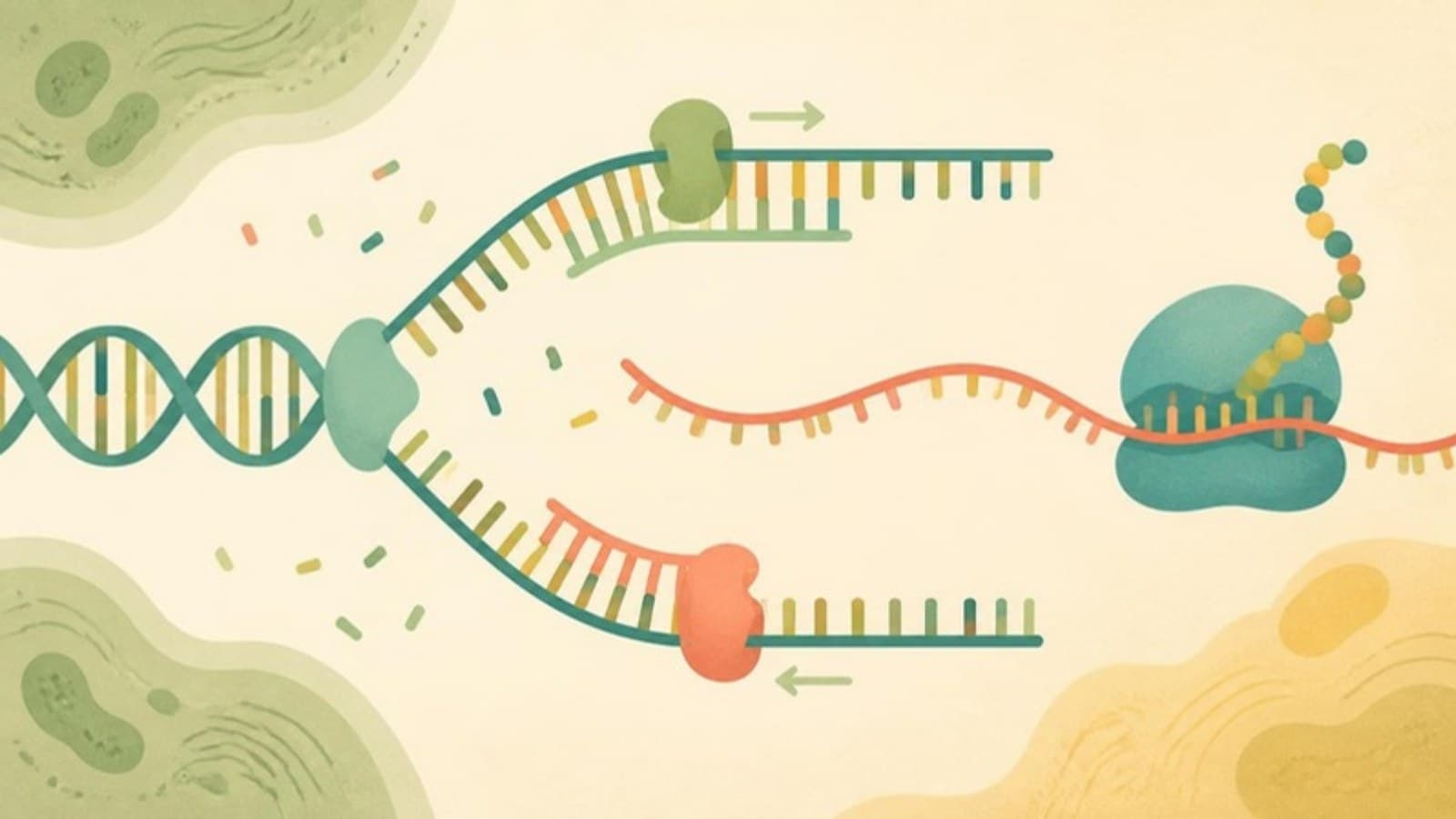
This is the foundation of molecular biology. Every question ultimately tests your understanding of this flow.
DNA (Gene)
   ↓ [Replication] → More DNA (Cell division)
   ↓ [Transcription] → mRNA
   ↓ [Translation] → Protein
   ↓
Functional Trait
NEET Focus: Questions test:
Definition: Each new DNA molecule has one OLD strand (template) and one NEW strand (synthesized).
Proof: Meselson-Stahl experiment (1958) using ¹⁵N-labeled DNA.
| Step | Enzyme/Protein | Function | NEET Tip |
|---|---|---|---|
| 1. Initiation | Helicase | Unwinds DNA double helix at origin of replication (oriC) | Always asked: "Which enzyme unwinds DNA?" Answer: Helicase |
| 2. Primer Binding | Primase | Synthesizes short RNA primer (10-60 nucleotides) | DNA Polymerase CANNOT start synthesis without a primer |
| 3. Elongation | DNA Polymerase III | Adds nucleotides in 5' → 3' direction | NEVER 3' → 5'! This is asked repeatedly |
| 4. Leading Strand | DNA Pol III | Continuous synthesis (single primer) | Easy to synthesize |
| 5. Lagging Strand | DNA Pol III | Discontinuous synthesis → Okazaki fragments (1000-2000 nucleotides) | Each fragment needs a separate primer |
| 6. Primer Removal | DNA Polymerase I | Removes RNA primers, fills gaps with DNA | Pol I has 5' → 3' exonuclease activity |
| 7. Ligation | DNA Ligase | Joins Okazaki fragments on lagging strand | Creates phosphodiester bonds |
Replication Fork (NCERT Class 12, Chapter 6, Figure 6.4):
Q1: Which enzyme joins Okazaki fragments? Answer: DNA Ligase
Q2: DNA replication is semi-conservative. What does this mean? Answer: Each new DNA has one parental strand and one newly synthesized strand.
Q3: In which direction does DNA Polymerase synthesize DNA? Answer: 5' → 3' direction only (never 3' → 5')
Q4: Why is the lagging strand synthesized discontinuously? Answer: DNA Polymerase can only synthesize in 5' → 3' direction, so the lagging strand (running 3' → 5') must be synthesized in short fragments (Okazaki fragments) backwards.
Transcription: Process of synthesizing RNA from a DNA template.
| Stage | Events | Key Points |
|---|---|---|
| 1. Initiation | RNA Polymerase binds to Promoter region (TATA box in eukaryotes) | Promoter = where transcription starts |
| Transcription factors help RNA Pol bind | σ (sigma) factor in prokaryotes | |
| 2. Elongation | RNA Polymerase moves along DNA template (3' → 5' direction) | Synthesizes RNA in 5' → 3' direction |
| Adds complementary RNA nucleotides (A-U, G-C) | Uracil (U) replaces Thymine (T) in RNA | |
| 3. Termination | RNA Polymerase reaches Terminator sequence | In prokaryotes: Rho-dependent or Rho-independent |
| mRNA is released | In eukaryotes: Cleavage and polyadenylation |
After transcription, the primary transcript (pre-mRNA) undergoes 3 modifications:
NEET Focus: Prokaryotic mRNA does NOT undergo splicing (no introns). Eukaryotic mRNA has introns and exons.
Transcription Unit (NCERT Class 12, Chapter 6, Figure 6.11):
Q1: Which enzyme synthesizes mRNA from DNA? Answer: RNA Polymerase
Q2: What is the function of the promoter in transcription? Answer: Binding site for RNA Polymerase to initiate transcription
Q3: What is splicing? Answer: Removal of introns and joining of exons in eukaryotic mRNA
Q4: Which modification protects mRNA from degradation? Answer: 5' capping (7-methylguanosine cap)
Translation: Process of synthesizing proteins from mRNA template.
Special Codons:
Function: Brings the correct amino acid to the ribosome based on codon-anticodon pairing.
| Stage | Events | Key Points |
|---|---|---|
| 1. Initiation | Small ribosomal subunit binds to mRNA at start codon (AUG) | Requires initiation factors |
| First tRNA (with Methionine) binds to AUG | fMet-tRNA in prokaryotes, Met-tRNA in eukaryotes | |
| Large ribosomal subunit joins | Ribosome has 3 sites: A, P, E | |
| 2. Elongation | tRNA enters A site (aminoacyl site) with amino acid | Codon-anticodon recognition |
| Peptide bond forms between amino acids (peptidyl transferase activity) | Ribosome catalyzes bond formation | |
| tRNA moves to P site (peptidyl site), old tRNA exits via E site (exit) | Translocation step | |
| Ribosome moves 3 nucleotides forward (1 codon) | Elongation continues until stop codon | |
| 3. Termination | Ribosome reaches stop codon (UAA, UAG, UGA) | No tRNA for stop codons |
| Release factors bind to stop codon | Triggers polypeptide release | |
| Ribosome dissociates into subunits | Translation complete |
NEET Tip: S = Svedberg unit (sedimentation coefficient). 50S + 30S ≠ 80S (they don't add up arithmetically).
tRNA Structure (NCERT Class 12, Chapter 6, Figure 6.12):
Q1: What is the function of tRNA? Answer: Brings amino acids to the ribosome during translation
Q2: What is the start codon? Answer: AUG (codes for Methionine)
Q3: Name the stop codons. Answer: UAA, UAG, UGA
Q4: Which site of the ribosome holds the growing polypeptide chain? Answer: P site (peptidyl site)
Q5: How many amino acids are coded by 64 codons? Answer: 20 amino acids (genetic code is degenerate/redundant)
Definition: A cluster of genes under the control of a single promoter (in prokaryotes).
Lac Operon (NCERT Class 12, Chapter 6, most important operon for NEET):
| Component | Function |
|---|---|
| i gene (Regulatory gene) | Codes for Repressor protein |
| Promoter (P) | RNA Polymerase binding site |
| Operator (O) | Repressor protein binding site (blocks RNA Pol) |
| Structural genes | z (β-galactosidase), y (Permease), a (Transacetylase) |
Case 1: Lactose ABSENT (Operon OFF)
Case 2: Lactose PRESENT (Operon ON)
NEET Tip: Lac operon is an example of negative regulation (repressor protein blocks transcription).
Lac Operon Diagram (NCERT Class 12, Chapter 6, Figure 6.14 & 6.15):
Q1: What is the function of the repressor protein in lac operon? Answer: Binds to the operator and prevents transcription when lactose is absent
Q2: What induces the lac operon? Answer: Lactose (or allolactose)
Q3: Which gene codes for β-galactosidase? Answer: z gene
Q4: Is lac operon inducible or repressible? Answer: Inducible (turned ON by lactose)
| Law | Statement | Example |
|---|---|---|
| 1. Law of Dominance | In a heterozygote, one allele (dominant) masks the other (recessive) | Tt (Tall) - T dominates over t |
| 2. Law of Segregation | Alleles separate during gamete formation (each gamete gets one allele) | Tt → Gametes: T or t (50% each) |
| 3. Law of Independent Assortment | Alleles of different genes assort independently during gamete formation | TtRr → Gametes: TR, Tr, tR, tr (equal probability) |
Example: Tall (T) × Short (t)
P Generation: TT (Tall) × tt (Short) F₁ Generation: 100% Tt (Tall) - Law of Dominance F₂ Generation (F₁ × F₁):
Key Insight: The 3:1 ratio proves the Law of Segregation.
Example: Round Yellow (RRYY) × Wrinkled Green (rryy)
P Generation: RRYY × rryy F₁ Generation: 100% RrYy (Round Yellow) F₂ Generation (F₁ × F₁):
Key Insight: The 9:3:3:1 ratio proves the Law of Independent Assortment.
| Type | Definition | Purpose |
|---|---|---|
| Test Cross | Cross between F₁ hybrid and homozygous recessive parent | Determine genotype of F₁ (Tt × tt) |
| Back Cross | Cross between F₁ hybrid and either parent | Can be with dominant or recessive parent |
Test Cross Results:
Definition: Neither allele is completely dominant; heterozygote shows intermediate phenotype.
Example: Snapdragon flower color
F₂ ratio: 1 Red : 2 Pink : 1 White (1:2:1) - Phenotypic ratio = Genotypic ratio
Definition: Both alleles are expressed equally in the heterozygote.
Example: ABO Blood Groups
NEET Tip: ABO blood group genetics is asked in EVERY NEET paper.
Q1: In a monohybrid cross, what is the phenotypic ratio in F₂? Answer: 3:1
Q2: What is the genotypic ratio in F₂ of a monohybrid cross? Answer: 1:2:1 (1 homozygous dominant : 2 heterozygous : 1 homozygous recessive)
Q3: What is the purpose of a test cross? Answer: To determine the genotype of an organism with dominant phenotype
Q4: What type of dominance is seen in snapdragon flowers? Answer: Incomplete dominance (Pink = intermediate phenotype)
Q5: What is the phenotypic ratio in a dihybrid cross F₂? Answer: 9:3:3:1
| System | Organisms | Determination |
|---|---|---|
| XY | Humans, Drosophila, most mammals | Male = XY, Female = XX |
| ZW | Birds, some butterflies | Male = ZZ, Female = ZW |
| XO | Grasshoppers, some insects | Male = XO (one X), Female = XX |
NEET Focus: Human sex determination (XY system) and sex-linked inheritance.
Example: Color blindness, Hemophilia (both X-linked recessive)
Notation:
Cross: Normal woman (carrier) × Normal man
Key Insight: Males are more affected by X-linked recessive disorders because they have only one X chromosome (hemizygous).
Symbols:
Common Patterns:
Q1: What is the sex chromosome composition of a human male? Answer: XY
Q2: Which parent determines the sex of the child in humans? Answer: Father (contributes X or Y chromosome)
Q3: Why are males more affected by hemophilia? Answer: Hemophilia is X-linked recessive. Males have only one X chromosome, so one recessive allele causes the disease.
Q4: What is linkage? Answer: Genes located on the same chromosome that tend to be inherited together
Organism: Streptococcus pneumoniae
Observations:
Conclusion: Some "transforming principle" from dead S cells transformed R cells to virulent S cells.
Question: What is the transforming principle?
Method:
Conclusion: DNA is the transforming principle (genetic material).
Organism: Bacteriophage (T2 phage) infecting E. coli
Method:
Results:
Conclusion: DNA, not protein, is the genetic material injected into bacteria.
NEET Tip: This is the most asked experiment. Remember: ³²P = DNA (inside), ³⁵S = Protein (outside).
Practice break
Reading is prep. Practising is progress.
Free to try · replies within a few hours on WhatsApp
Beyond NEET: The Central Dogma (DNA → RNA → Protein) isn't just textbook theory. It's the foundation of modern medicine and biotechnology.
Real-world examples:
Career relevance: In medical school Biochemistry (Year 1), you'll study these exact processes in clinical context - genetic diseases (sickle cell = single DNA mutation → abnormal hemoglobin protein), antibiotic resistance (bacteria mutate DNA → new protein → drug resistance), and personalized medicine (DNA sequencing → predict disease risk).
Current research: Gene therapy for inherited blindness (Luxturna), sickle cell disease cure (2023), and cancer vaccines all depend on manipulating the Central Dogma pathway.
Q1: Who discovered the transforming principle? Answer: Griffith (1928)
Q2: Who proved that DNA is the transforming principle? Answer: Avery, MacLeod, and McCarty (1944)
Q3: In Hershey-Chase experiment, which radioactive isotope was used to label DNA? Answer: ³²P (Phosphorus-32)
Q4: What was the conclusion of Hershey-Chase experiment? Answer: DNA is the genetic material, not protein
Focus: DNA structure, replication, Central Dogma
Practice:
Focus: Translation, Genetic code, Lac operon
Practice:
Focus: Genetic crosses, problem-solving
Practice:
Focus: Linkage, sex determination, experiments
Practice:
| # | Diagram | NCERT Reference | Practice Goal |
|---|---|---|---|
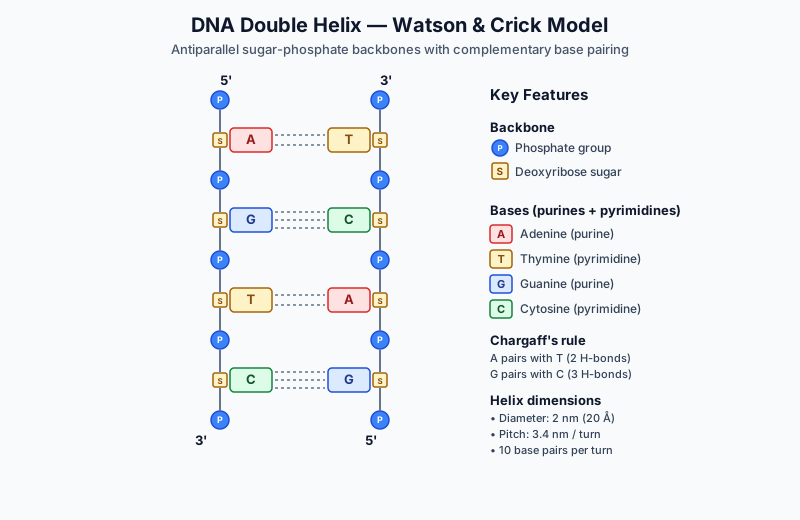
| 1 | DNA Double Helix | Class 12, Ch 6, Fig 6.3 | 5 times |
| 2 | DNA Replication Fork | Class 12, Ch 6, Fig 6.4 | 10 times |
| 3 | Transcription Unit | Class 12, Ch 6, Fig 6.11 | 10 times |
| 4 | mRNA Processing | Class 12, Ch 6, Fig 6.9 | 5 times |
| 5 | tRNA Structure (Cloverleaf) | Class 12, Ch 6, Fig 6.12 | 10 times |
| 6 | Translation (Ribosome) | Class 12, Ch 6, Fig 6.13 | 5 times |
| 7 | Lac Operon (ON/OFF) | Class 12, Ch 6, Fig 6.14-6.15 | 10 times |
| 8 | Monohybrid Cross (Punnett Square) | Class 12, Ch 5, Fig 5.2 | 20 problems |
| 9 | Dihybrid Cross (Punnett Square) | Class 12, Ch 5, Fig 5.5 | 20 problems |
| 10 | Pedigree Chart | Class 12, Ch 5, Fig 5.8 | Analyze 10 pedigrees |
Diagram Practice Routine:
Wrong: "DNA is synthesized in 3' → 5' direction" Correct: DNA is always synthesized in 5' → 3' direction (by DNA Polymerase)
NEET Trap: Questions will give options with both directions. Remember: 5' → 3' is correct.
Template Strand (Antisense):
Coding Strand (Sense):
NEET Tip: If question gives coding strand sequence, convert T to U to get mRNA.
Start Codon: AUG (only one) Stop Codons: UAA, UAG, UGA (three - memorize as "U Are Annoying, U Are Gross, U Go Away")
NEET Trap: Questions ask "Which is NOT a stop codon?" - AUG is NOT a stop codon.
Common Error: "Repressor protein binds to promoter" Correct: Repressor binds to Operator (not promoter). RNA Polymerase binds to promoter.
Monohybrid F₂:
Dihybrid F₂:
Test Cross:
NEET Trap: Questions swap ratios. Read carefully!
Common Error: "Daughters inherit X chromosome only from mother" Correct: Daughters inherit one X from mother, one X from father (XX)
Sons: Inherit X from mother, Y from father (XY)
Why: Genetic crosses (monohybrid, dihybrid, sex-linked) are the EASIEST marks if you know the method.
Action Plan:
Time Investment: 2-3 hours total. Return: 3-4 guaranteed correct answers = 12-16 marks.
Create a table and memorize:
| Process | Enzyme/Protein | Function |
|---|---|---|
| Replication | Helicase | Unwinds DNA |
| Primase | Synthesizes RNA primer | |
| DNA Pol III | Adds nucleotides (5' → 3') | |
| DNA Pol I | Removes primers, fills gaps | |
| DNA Ligase | Joins Okazaki fragments | |
| Transcription | RNA Polymerase | Synthesizes mRNA from DNA |
| Spliceosome | Removes introns (splicing) | |
| Translation | Aminoacyl-tRNA synthetase | Attaches amino acid to tRNA |
| Peptidyl transferase | Forms peptide bond (ribosome) | |
| Release factors | Terminates translation at stop codon |
Time Investment: 1 hour. Return: 2-3 questions = 8-12 marks.
Critical Diagrams (10 total - listed in Part 10):
Practice Routine:
Time Investment: 15 min/day × 20 days = 5 hours. Return: 2-4 diagram-based questions = 8-16 marks.
Only 3 experiments are repeatedly asked:
Time Investment: 30 minutes. Return: 1-2 questions = 4-8 marks.
Target Pages: NCERT Class 12 Biology
Time Investment: 8-10 hours (2 chapters). Return: 4-6 conceptual questions = 16-24 marks.
Q1: The enzyme that joins Okazaki fragments during DNA replication is: (a) DNA Polymerase I (b) DNA Polymerase III (c) DNA Ligase (d) Helicase Answer: (c) DNA Ligase
Q2: In Hershey-Chase experiment, ³²P was used to label: (a) Proteins (b) DNA (c) RNA (d) Carbohydrates Answer: (b) DNA
Q3: The genetic code is said to be degenerate because: (a) One codon codes for multiple amino acids (b) Multiple codons code for one amino acid (c) Some amino acids have no codons (d) Some codons are non-functional Answer: (b) Multiple codons code for one amino acid
Q4: In lac operon, the repressor protein is coded by: (a) z gene (b) y gene (c) i gene (d) a gene Answer: (c) i gene
Q5: The phenotypic ratio of a dihybrid cross in F₂ generation is: (a) 3:1 (b) 1:2:1 (c) 9:3:3:1 (d) 1:1:1:1 Answer: (c) 9:3:3:1
Answer: NO. NCERT Class 12 (Chapters 5 and 6) is sufficient for 90% questions. Focus on:
Only if you've mastered NCERT and want extra practice, use:
Answer: 8-12 questions (32-48 marks) combined from:
This is the second-highest scoring unit after Human Physiology.
The 6-Step Speed Method (tested on 500+ students):
Total Time: Monohybrid (2×2) = 60 seconds, Dihybrid (4×4) = 2 minutes
Practice Schedule to Build Speed:
Accuracy Benchmarks:
Mnemonic for DNA Replication: "Happy People Prepare Perfect Lunch"
Transcription: Only one enzyme - RNA Polymerase (easy!)
Translation: Focus on Aminoacyl-tRNA synthetase (charges tRNA with amino acid) and Peptidyl transferase (forms peptide bond).
5-Step Method:
Target: 10 critical diagrams × 10 practice sessions each = 100 total diagrams drawn.
Time: 15-20 minutes per day for 20 days.
80% marks come from:
Focus 80% of your time on these 5 topics → Guaranteed 30-35 marks.
Week 1: DNA Replication + Transcription Week 2: Translation + Genetic Code + Lac Operon Week 3: Mendelian Genetics (50 problems) Week 4: Chromosomal Basis + Revision + Mock Tests
Daily Time Investment: 2-3 hours for Genetics + Molecular Biology.
Expected Outcome: 8-10 correct answers out of 12 questions = 32-40 marks (80-85% accuracy).
At Cerebrum Biology Academy, we've helped 500+ NEET aspirants master Genetics & Molecular Biology through:
✅ Live Problem-Solving Sessions - 100 genetic crosses solved step-by-step ✅ Diagram Mastery Workshops - Draw all 10 critical diagrams with expert feedback ✅ Enzyme Memorization Drills - Never forget Helicase, Ligase, RNA Pol again ✅ NCERT Line-by-Line Classes - Chapters 5 & 6 covered exhaustively ✅ Weekly Mock Tests - 20 Genetics MCQs with detailed solutions
"I was terrified of dihybrid crosses - specifically the 9:3:3:1 ratio. I kept getting confused about which trait combination gives which phenotype. In my first 10 mock tests, I got 6 out of 10 dihybrid questions WRONG because I'd mix up the Punnett square order.
Dr. Shekhar taught me the systematic method: (1) Write gametes in order: RRYY gives RY, RY, RY, RY. (2) Make 4×4 grid methodically, row by row. (3) Count phenotypes using 'both dominant' = 9, 'one dominant' = 3+3, 'both recessive' = 1.
I practiced 50 dihybrid crosses over 2 weeks using this exact method. In NEET 2025, they asked a dihybrid cross with seed shape and color - took me exactly 2 minutes to solve. Got 5 out of 6 genetics cross questions correct. Final Genetics score: 40/48 marks (83% accuracy)!" - Priya Sharma, NEET 2025, AIR 452, JIPMER Puducherry
"DNA replication fork diagram was my nightmare. I'd label DNA Polymerase I and III in the wrong positions. Confused leading strand vs lagging strand direction. Got this question wrong 3 times in National-chain test series.
Dr. Shekhar's trick: 'Leading strand is EASY - continuous like a highway. Lagging strand is DIFFICULT - stop-and-go like city traffic (Okazaki fragments).' I drew the replication fork 15 times over 1 week, each time saying this out loud. Also labeled all 5 enzymes (Helicase, Primase, Pol III, Pol I, Ligase) in proper sequence.
In NEET 2025, they asked: 'Which enzyme joins Okazaki fragments?' - instant answer: DNA Ligase. Another question showed replication fork diagram: 'Identify structure X' - it was lagging strand, correctly marked. Got 100% (6/6 questions) in all DNA replication questions." - Rahul Gupta, NEET 2025, AIR 1,204, KGMC Lucknow
📞 Call: +91-8826444334 📧 Email: contact@cerebrumbiologyacademy.com 🌐 Website: www.cerebrumbiologyacademy.com
Special Offer: Enroll in our Intensive NEET Biology Course and get the Genetics Mastery Workbook (100 problems + solutions) FREE!
About the Author
Dr. Shekhar is an AIIMS New Delhi Alumnus, Founder & Chief Educator at Cerebrum Biology Academy. With 10+ years of NEET teaching experience, Dr. Shekhar has guided 2000+ students to NEET success, including 50+ AIR Top 500 rankers. His teaching philosophy: "Master the logic, not just the facts."
Last updated: February 10, 2026
Dihybrid crosses, pedigree analysis, and the DNA replication enzymes are the three places most students lose marks in this chapter. Message us on WhatsApp at +91 88264 44334 and tell us which one — we'll work through a few with you.
Related reading: Biotechnology for NEET Simplified · Our Class 12 programme
Related resources

About the author
Dr. Shekhar C. Singh
AIIMS New Delhi alumnus who has taught biology since 2014, from NCERT foundations to the International Biology Olympiad.
Read his full profile →Get personalized guidance from AIIMS experts and achieve your medical college dreams
More from the blog
Master Human Physiology - the highest-scoring NEET Biology chapter (12-15 questions = 48-60 marks). Complete system-wise breakdown, diagrams, NCERT strategy, and scoring tips.
11 Feb 2026
Complete Biotechnology guide for NEET simplified: Principles & Processes (genetic engineering, PCR, cloning), Applications (Bt cotton, insulin, gene therapy), and step-by-step techniques. Score 4-6 questions = 16-24 marks.
10 Feb 2026
Master the differences between photosynthesis and respiration with detailed comparison charts, equations, and practice questions for NEET success.
10 Feb 2024
Share your thoughts, ask a question, or help another student
Type it below and send it to us on WhatsApp — no sign-up needed.
For NEET Biology, aim for 3-4 hours of focused study daily. Quality matters more than quantity!
Yes! NCERT covers 95% of NEET Biology questions. Master it completely before any reference book.
Human Physiology (20%), Genetics (18%), and Ecology (12%) are the highest-scoring areas.
Need personalized guidance?