Loading...
Loading...
Master Ecology for NEET 2026 with this comprehensive guide covering organisms and environment, population ecology, ecosystem structure, biodiversity conservation, and environmental issues. NCERT-aligned with PYQs and 12 practice MCQs.

6 points to remember for NEET
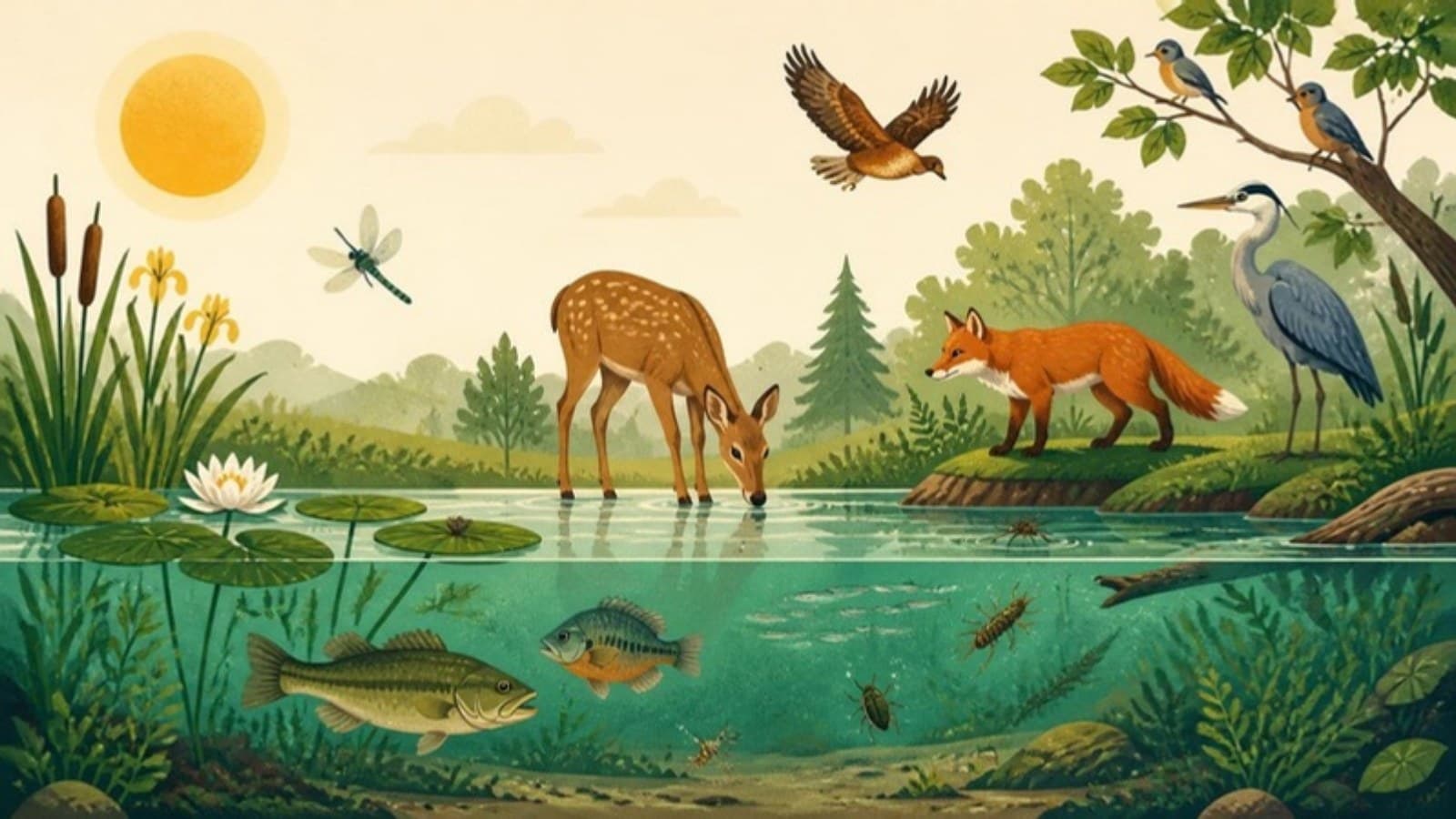
Ecology is the highest-scoring unit in NEET Biology, consistently contributing 10-12 questions every year. It spans four chapters from Class 12 NCERT: Organisms and Populations, Ecosystem, Biodiversity and Conservation, and Environmental Issues. This guide covers all four chapters in a single, exam-ready resource aligned entirely with NCERT.
Ecology (coined by Ernst Haeckel) is the study of interactions between organisms and their environment. The environment consists of abiotic (non-living) and biotic (living) components.
| Abiotic Factor | Description | Example |
|---|---|---|
| Temperature | Most critical factor; affects enzyme activity | Eurythermal (wide range) vs Stenothermal (narrow range) |
| Water | Availability determines distribution of organisms | Xerophytes (dry), Mesophytes (moderate), Hydrophytes (aquatic) |
| Light | Drives photosynthesis; affects photoperiodism | Sciophytes (shade-loving) vs Heliophytes (sun-loving) |
| Soil | pH, mineral composition, water holding capacity | Sandy, clayey, loamy soils |
| Humidity | Water vapour content of air | Tropical forests (high) vs deserts (low) |
NEET Tip: Organisms that tolerate a wide range of an abiotic factor are called eurytypes (e.g., eurythermal, euryhaline), while those with a narrow tolerance are stenotypes (e.g., stenothermal, stenohaline).
Organisms deal with environmental stress through four strategies:
NEET Tip: Allen's rule states that mammals in colder climates have shorter ears and limbs to reduce heat loss. Bergmann's rule states that body size increases in colder climates.
A population is a group of individuals of the same species in a given area at a given time. Population ecology deals with population attributes and dynamics.
| Attribute | Definition |
|---|---|
| Population density (N) | Number of individuals per unit area or volume |
| Natality (B) | Number of births per unit time |
| Mortality (D) | Number of deaths per unit time |
| Immigration (I) | Number of individuals moving into a population |
| Emigration (E) | Number of individuals moving out of a population |
Population change equation: Nt+1 = Nt + (B + I) - (D + E)
Populations have three age groups: pre-reproductive, reproductive, and post-reproductive. The shape of the age pyramid indicates population growth status: expanding (triangular), stable (bell-shaped), or declining (urn-shaped).
When resources are unlimited, populations grow exponentially.
Equation: dN/dt = rN
Where:
This produces a J-shaped curve. Example: Bacterial growth in early culture, invasive species in new habitats.
In nature, resources are limited. Growth slows as population approaches carrying capacity.
Equation: dN/dt = rN(K - N)/K
Where:
When N is much smaller than K, the factor (K-N)/K approaches 1 and growth is nearly exponential. As N approaches K, the factor approaches 0 and growth stops.
NEET Tip: The logistic growth equation dN/dt = rN(K-N)/K is one of the most frequently asked formulas. Remember that K represents carrying capacity and r represents the intrinsic rate of natural increase.
| Interaction | Species A | Species B | Examples |
|---|---|---|---|
| Mutualism | + | + | Lichens (algae + fungus), Mycorrhiza |
| Competition | - | - | Flamingoes vs resident fish for zooplankton |
| Predation | + | - | Tiger and deer, Pitcher plant and insects |
| Parasitism | + | - | Cuscuta on host plant, Liver fluke in sheep |
| Commensalism | + | 0 | Orchid on mango tree (epiphyte), Cattle egret with grazing cattle |
| Amensalism | 0 | - | Penicillium inhibits Staphylococcus growth |
NEET Tip: In commensalism, one species benefits and the other is neither harmed nor helped. In amensalism, one species is harmed while the other is unaffected. These two interactions are commonly confused in exams.
An ecosystem is a functional unit of nature where living organisms interact with each other and their physical environment. The term was coined by A.G. Tansley (1935).
| Component | Type | Examples |
|---|---|---|
| Producers (Autotrophs) | Biotic | Green plants, phytoplankton, cyanobacteria |
| Primary consumers (Herbivores) | Biotic | Grasshopper, deer, zooplankton |
| Secondary consumers (Primary carnivores) | Biotic | Frog, small fish |
| Tertiary consumers (Top carnivores) | Biotic | Lion, eagle, shark |
| Decomposers (Saprotrophs) | Biotic | Bacteria, fungi |
| Abiotic components | Abiotic | Sunlight, temperature, water, minerals |
A food chain is a linear sequence of organisms through which nutrients and energy pass. A food web is an interconnected network of food chains.
Types of food chains:
NEET Tip: In a terrestrial ecosystem, the detritus food chain contributes more energy flow than the grazing food chain. In aquatic ecosystems, the grazing food chain dominates.
Energy flow in an ecosystem is unidirectional (from sun to producers to consumers to decomposers). It follows the 10% law (Lindeman's efficiency): only 10% of energy is transferred from one trophic level to the next, while 90% is lost as heat through respiration.
Standing crop: The amount of living biomass at a trophic level at any given time.
| Pyramid Type | Grassland Ecosystem | Aquatic Ecosystem | Forest Ecosystem |
|---|---|---|---|
| Pyramid of Number | Upright (grass > insects > birds > hawks) | Upright | Inverted (few large trees support many insects) |
| Pyramid of Biomass | Upright (producer biomass greatest) | Inverted (phytoplankton biomass < zooplankton) | Upright |
| Pyramid of Energy | Always upright | Always upright | Always upright |
NEET Tip: The pyramid of energy is always upright in all ecosystems. This is the most reliable pyramid because energy always decreases at successive trophic levels.
| Type | Definition |
|---|---|
| Gross Primary Productivity (GPP) | Total rate of photosynthesis (total organic matter produced) |
| Net Primary Productivity (NPP) | GPP minus respiration losses. NPP = GPP - R |
| Secondary Productivity | Rate of new organic matter formation by consumers |
NEET Tip: The most productive ecosystems are tropical rainforests and coral reefs. Oceans have low productivity per unit area but contribute most to global GPP due to their vast size.
The process of breaking down dead organic matter (detritus) into inorganic substances is called decomposition. It involves:
Ecological succession is the sequential, gradual, and predictable change in species composition in an area over time, leading from a pioneer community to a climax community.
| Feature | Primary Succession | Secondary Succession |
|---|---|---|
| Starting point | Bare, lifeless area (no soil) | Previously inhabited area with soil |
| Pioneer species | Lichens (on rock), phytoplankton (in water) | Grasses, herbaceous plants |
| Time required | Very long (hundreds to thousands of years) | Relatively shorter |
| Examples | Lava flows, newly formed islands | Abandoned farmland, burnt forests |
Lichen stage to Moss stage to Herb stage to Shrub stage to Tree stage to Climax forest
Phytoplankton stage to Submerged plant stage to Free-floating stage to Reed-swamp stage to Sedge-meadow stage to Woodland stage to Climax forest
NEET Tip: In both xerosere and hydrosere, the climax community is the same: a mesic (stable forest) community. The pioneer species differ: lichens for xerosere and phytoplankton for hydrosere.
The movement of nutrients through biotic and abiotic components of an ecosystem is called nutrient cycling. It is of two types:
NEET Tip: Phosphorus cycle does not have a gaseous phase (it is a sedimentary cycle), unlike carbon and nitrogen cycles. This is a commonly tested distinction.
Biodiversity (term coined by Edward O. Wilson) refers to the variety of life forms at all levels: genetic, species, and ecosystem diversity.
| Type | Level | Example |
|---|---|---|
| Alpha diversity | Within a single community/habitat | Species richness of a grassland |
| Beta diversity | Between communities/habitats | Difference in species between a grassland and a forest |
| Gamma diversity | Entire landscape/region | Total species diversity of a mountain range |
Alexander von Humboldt observed that species richness increases with area explored. The relationship is described by:
log S = log C + Z log A
Where S = species richness, A = area, Z = slope (regression coefficient), C = Y-intercept. For smaller areas, Z ranges from 0.1 to 0.2. For very large areas (continents), Z = 0.6 to 1.2.
| Threat | Description | Example |
|---|---|---|
| H - Habitat loss | Destruction and fragmentation | Deforestation, urbanisation |
| I - Invasive species | Non-native species outcompete natives | Water hyacinth (Eichhornia) in Indian lakes |
| P - Pollution | Chemical contamination | Pesticides, oil spills, acid rain |
| P - Population growth | Human population explosion | Resource overuse, land conversion |
| O - Overexploitation | Excessive hunting/harvesting | Dodo extinction, Steller's sea cow |
NEET Tip: Habitat loss and fragmentation is the single greatest cause of biodiversity loss worldwide. The HIPPO mnemonic is a powerful recall tool for exams.
Practice break
Reading is prep. Practising is progress.
Free to try · replies within a few hours on WhatsApp
| Strategy | Type | Examples |
|---|---|---|
| National Parks | In-situ | Corbett, Kaziranga, Bandipur |
| Wildlife Sanctuaries | In-situ | Bharatpur, Periyar |
| Biosphere Reserves | In-situ | Nilgiri, Nanda Devi, Gulf of Mannar |
| Sacred Groves | In-situ | Khasi and Jaintia hills (Meghalaya) |
| Biodiversity Hotspots | In-situ | Western Ghats, Himalayas (India has 4 hotspots) |
| Zoological Parks | Ex-situ | Delhi Zoo, Mysore Zoo |
| Botanical Gardens | Ex-situ | Royal Botanical Garden (Kew) |
| Seed Banks / Gene Banks | Ex-situ | NBPGR (New Delhi), Svalbard Vault |
| Cryopreservation | Ex-situ | Gametes and embryos stored in liquid nitrogen |
NEET Tip: India is one of the 12 mega-diversity countries and has 4 biodiversity hotspots: Western Ghats and Sri Lanka, Himalayas, Indo-Burma, and Sundaland.
Greenhouse gases (CO2, CH4, N2O, CFCs) trap heat in the atmosphere, raising global temperatures. Consequences include rising sea levels, melting glaciers, altered weather patterns, and coral bleaching.
| Year | Question Topic | Correct Answer |
|---|---|---|
| 2025 | Species-area relationship equation | log S = log C + Z log A |
| 2024 | Pioneer species in xerosere | Crustose lichens |
| 2024 | Pyramid always upright | Pyramid of energy |
| 2023 | Carrying capacity symbol in logistic growth | K |
| 2023 | Gaseous nutrient cycle vs sedimentary | Phosphorus - sedimentary |
| 2022 | 10% law proposed by | Lindeman |
| 2022 | Stenothermal organism example | Polar bear |
| 2021 | Montreal Protocol is related to | Ozone depletion / CFC phase-out |
| 2021 | Commensalism example | Orchid on mango tree |
| 2020 | Highest biodiversity found in | Tropical rainforests |
| 2020 | Detritus food chain starts with | Dead organic matter |
| 2019 | Interaction where one benefits, other unaffected | Commensalism |
| 2019 | In-situ conservation example | National parks |
Q1. The logistic population growth equation is:
The logistic equation includes the environmental resistance factor (K-N)/K, which slows growth as population size N approaches carrying capacity K.
Q2. Which of the following ecological pyramids is always upright in all ecosystems?
The pyramid of energy is always upright because energy is progressively lost at each trophic level due to respiration, and energy flow is unidirectional.
Q3. In commensalism:
In commensalism, one species derives benefit while the other is neither helped nor harmed. Example: epiphytic orchid growing on a mango tree.
Q4. Phosphorus cycle is different from the carbon cycle because:
Phosphorus cycle is a sedimentary cycle with its reservoir in rocks and sediments, unlike carbon and nitrogen which have atmospheric reservoirs.
Q5. The pioneer species in hydrosere (aquatic succession) are:
In hydrosere (succession starting in aquatic habitat), phytoplankton are the pioneer colonisers. Lichens are the pioneers in xerosere (on bare rock).
Q6. Biodiversity hotspots of India include all EXCEPT:
India has 4 recognised biodiversity hotspots: Western Ghats and Sri Lanka, Himalayas, Indo-Burma, and Sundaland. The Thar Desert is not a hotspot.
Q7. According to Lindeman's 10% law, if the energy at the producer level is 10,000 J, the energy available to secondary consumers would be:
By the 10% law: Producers 10,000 J, primary consumers 1,000 J (10%), secondary consumers 100 J (10% of 1,000 J).
Q8. The ozone hole is caused primarily by:
Chlorofluorocarbons (CFCs) release chlorine atoms in the stratosphere that catalytically destroy ozone molecules. The Montreal Protocol (1987) aimed to phase out CFCs.
Q9. Which of the following is an example of ex-situ conservation?
Ex-situ conservation involves protecting species outside their natural habitat. Seed banks, zoological parks, and botanical gardens are ex-situ methods. National parks, biosphere reserves, and sacred groves are in-situ methods.
Q10. Biomagnification refers to:
Biomagnification is the progressive increase in concentration of non-biodegradable substances (like DDT, mercury) as they move up the food chain. Top predators accumulate the highest concentrations.
Q11. The term 'biodiversity' was popularised by:
Edward O. Wilson popularised the term biodiversity. Alexander von Humboldt described the species-area relationship, Paul Ehrlich proposed the rivet popper hypothesis, and Robert May estimated global species diversity.
Q12. In the species-area relationship log S = log C + Z log A, the value of Z for large continental areas typically ranges from:
For smaller areas (like islands), Z is typically 0.1-0.2. For very large areas like entire continents, the slope Z steepens and ranges from 0.6 to 1.2.
HIPPO for Biodiversity Threats: Habitat loss, Invasive species, Pollution, Population growth, Overexploitation
Succession Pioneers: "Lichens Love Rocks, Phytoplankton Love Ponds" - Lichens are pioneers in xerosere (rock), Phytoplankton are pioneers in hydrosere (water)
Ecological Pyramids - Which can be inverted? "Numbers in Forest, Biomass in Ocean" - Pyramid of number is inverted in forest ecosystem, Pyramid of biomass is inverted in aquatic ecosystem. Energy pyramid is NEVER inverted.
Interspecific Interactions signs: "MutuaL Love (++), ComPetition ConFLict (--), PRedation PRofit-Loss (+-), ComMensalism Me-only (+0)"
Decomposition Steps: "Fragmentation, Leaching, Catabolism, Humification, Mineralisation" - Remember "Five Little Cats Have Mice"
Q: How many questions come from Ecology in NEET? A: Ecology is the highest-scoring unit in NEET Biology, contributing 10-12 questions every year. This includes questions from Organisms and Populations, Ecosystem, Biodiversity and Conservation, and Environmental Issues.
Q: What is the difference between exponential and logistic growth? A: Exponential growth (dN/dt = rN) occurs when resources are unlimited and produces a J-shaped curve. Logistic growth (dN/dt = rN(K-N)/K) occurs when resources are limited and produces an S-shaped (sigmoid) curve. The key difference is carrying capacity K, which limits population size in logistic growth.
Q: Why is the pyramid of energy always upright? A: Because energy transfer between trophic levels is always inefficient (only about 10% is passed on), and energy flow is unidirectional. Energy is progressively lost as heat through respiration at each level, so the energy content always decreases at higher trophic levels.
Q: What is the difference between in-situ and ex-situ conservation? A: In-situ conservation protects species in their natural habitat (national parks, wildlife sanctuaries, biosphere reserves, sacred groves, biodiversity hotspots). Ex-situ conservation protects species outside their natural habitat (zoos, botanical gardens, seed banks, cryopreservation). In-situ is preferred as it conserves the entire ecosystem.
Q: What is the difference between food chain and food web? A: A food chain is a single linear pathway of energy transfer (e.g., Grass to Grasshopper to Frog to Snake to Eagle). A food web is an interconnected network of multiple food chains in an ecosystem, representing the complex feeding relationships in nature. Food webs provide greater ecosystem stability than individual food chains.
Population interactions, ecological pyramids, biodiversity hotspots — each sub-topic has its own small set of NEET-favourite questions. Message us on WhatsApp at +91 88264 44334 with the sub-topic you're finding hardest, and we'll tell you how NEET has actually tested it over the last few years.
Related reading: NEET Ecology Weightage Analysis · Class 12 Biology Coaching
Related resources

About the author
Dr. Shekhar C. Singh
AIIMS New Delhi alumnus who has taught biology since 2014, from NCERT foundations to the International Biology Olympiad.
Read his full profile →Get personalized guidance from AIIMS experts and achieve your medical college dreams
More from the blog
title: NEET Ecology Weightage 2026 — Complete Unit Analysis & Scoring Strategy. Complete weightage analysis, question patterns, and chapter-wise strategy for NEET 2026 Biology preparation.
7 Feb 2026
Master Microbes in Human Welfare for NEET 2026 with comprehensive notes covering household products, industrial microbiology, sewage treatment, biogas production, biocontrol agents, and biofertilizers. NCERT-aligned with PYQs and MCQs.
2 Mar 2026
Complete NEET notes on Reproduction in Organisms covering asexual reproduction types, sexual reproduction phases, parthenogenesis, and vegetative propagation. NCERT-aligned with PYQ analysis and practice MCQs for NEET 2026.
2 Mar 2026
Share your thoughts, ask a question, or help another student
Type it below and send it to us on WhatsApp — no sign-up needed.
For NEET Biology, aim for 3-4 hours of focused study daily. Quality matters more than quantity!
Yes! NCERT covers 95% of NEET Biology questions. Master it completely before any reference book.
Human Physiology (20%), Genetics (18%), and Ecology (12%) are the highest-scoring areas.
Need personalized guidance?