Loading...
Loading...
Complete NEET notes on Reproduction in Organisms covering asexual reproduction types, sexual reproduction phases, parthenogenesis, and vegetative propagation. NCERT-aligned with PYQ analysis and practice MCQs for NEET 2026.

6 points to remember for NEET
Reproduction in Organisms is the opening chapter of the Reproduction unit in Class 12 Biology. It contributes 2-3 questions in NEET and provides the foundational concepts for understanding human and plant reproduction. This chapter covers the diversity of reproductive strategies across the living world.
This chapter lays the groundwork for the entire Reproduction unit, which collectively carries high weightage in NEET. Understanding asexual vs sexual reproduction, types of asexual methods, and events in sexual reproduction is essential for scoring well in subsequent chapters on human reproduction and plant reproduction.
Every organism has a definite lifespan, and reproduction is the only means by which a species ensures its continuity. No individual is immortal, but a species can persist through reproduction.
| Organism | Approximate Lifespan |
|---|---|
| Mayfly | 1 day |
| Butterfly | 1-2 weeks |
| Fruit fly (Drosophila) | 30 days |
| Rice plant | 3-4 months |
| Dog | 10-13 years |
| Horse | 25-30 years |
| Parrot | 80 years |
| Crocodile | 60-70 years |
| Tortoise | 100-150 years |
| Banyan tree | 200+ years |
NEET Tip: There is no correlation between the size of an organism and its lifespan. A crow and a parrot are similar in size but have vastly different lifespans (15 years vs 80 years). Similarly, a mango tree lives much longer than many large animals.
Asexual reproduction involves a single parent and produces offspring that are genetically identical to the parent (clones). No gamete formation or fusion is involved.
The parent organism divides into two equal halves, each forming a new individual.
| Organism | Type of Binary Fission |
|---|---|
| Amoeba | Irregular (any plane) |
| Paramecium | Transverse |
| Euglena | Longitudinal |
| Bacteria | Simple binary fission |
NEET Tip: In Amoeba, binary fission can occur in any plane as it has no fixed shape. Paramecium divides transversely (across the short axis).
The parent cell divides into many daughter cells simultaneously. This occurs under unfavourable conditions.
A small bud-like projection develops on the parent body, grows, and eventually detaches to form a new individual.
| Organism | Details |
|---|---|
| Yeast | Unicellular budding; bud separates from parent cell |
| Hydra | Multicellular budding; bud develops tentacles before detaching |
The parent body breaks into two or more fragments, each of which grows into a complete new organism.
NEET Tip: Fragmentation is different from regeneration. Fragmentation is a mode of reproduction, while regeneration is the ability to regrow lost body parts (though in simple organisms like Planaria, it can also serve as reproduction).
Specialized cells of an organism proliferate and differentiate to form a whole new organism from a fragment.
Organisms produce specialized reproductive structures called spores that germinate under favourable conditions to form new organisms.
| Organism | Spore Type |
|---|---|
| Rhizopus (bread mold) | Sporangiospores (produced in sporangium) |
| Penicillium | Conidia (exogenous spores produced on conidiophores) |
| Ferns | Spores produced in sporangia on the underside of fronds |
NEET Tip: Spores are usually covered by a thick wall that protects them from harsh environmental conditions. Zoospores are flagellated motile spores found in aquatic fungi like Chytridium.
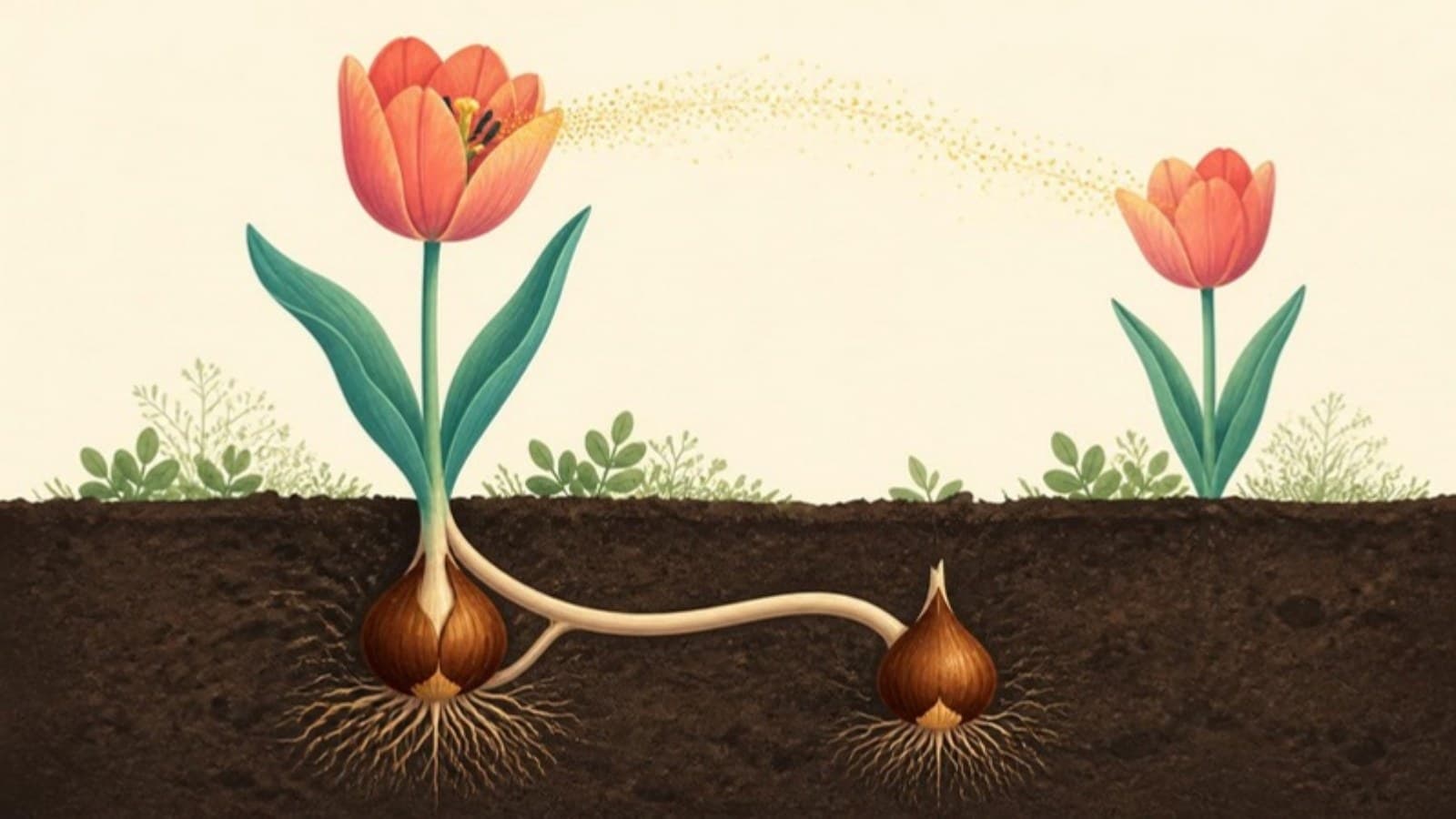
Plants reproduce asexually through vegetative parts (root, stem, leaf) without involvement of seeds or spores.
| Method | Structure | Example |
|---|---|---|
| Runner | Horizontal stem on soil surface | Grass, strawberry, Cynodon |
| Stolon | Horizontal stem (above or below ground) | Fragaria (strawberry), jasmine |
| Tuber | Swollen underground stem | Potato (eyes are buds) |
| Bulb | Short stem with fleshy leaf bases | Onion, garlic, lily |
| Offset | Short thick horizontal runner | Water hyacinth (Eichhornia), Pistia |
| Rhizome | Underground horizontal stem | Ginger, turmeric, banana |
| Sucker | Underground lateral branch | Mint, chrysanthemum |
| Leaf buds | Adventitious buds on leaf margin | Bryophyllum (produces plantlets on leaf notches) |
NEET Tip: Bryophyllum is a classic NCERT example of vegetative propagation from leaves. Adventitious buds on the leaf margins produce plantlets. Water hyacinth (Eichhornia) is called the "Terror of Bengal" because it reproduces rapidly through offsets, clogging water bodies.
Sexual reproduction involves the formation and fusion of gametes (sex cells). It involves two parents (usually) and produces offspring with genetic variation due to meiosis and recombination.
| Phase | Description | Example |
|---|---|---|
| Juvenile / Vegetative phase | Period of growth before reproductive maturity | Seedling stage in plants |
| Reproductive phase | Organism attains sexual maturity and can reproduce | Flowering in plants, puberty in humans |
| Senescent phase | Old age; decline in reproductive capacity, ending in death | Post-reproductive period |
NEET Tip: Some plants flower seasonally (mango, wheat) while others flower throughout the year (tomato, rose). Animals like birds and frogs have a specific breeding season, while humans can reproduce throughout the year.
Sexual reproduction can be divided into three stages:
Gametogenesis - Formation of male and female gametes
Gamete Transfer
Fusion of male and female gametes to form a diploid zygote (2n).
| Type | Location | Examples |
|---|---|---|
| External fertilization | Outside the body, usually in water | Frogs, fish, most aquatic organisms |
| Internal fertilization | Inside the female body | Reptiles, birds, mammals, terrestrial organisms |
NEET Tip: External fertilization produces a large number of offspring to compensate for high mortality. Internal fertilization produces fewer offspring but with better survival rates.
Zygote Formation:
Embryogenesis:
Parthenogenesis is the development of an organism from an unfertilized egg without fertilization.
| Organism | Details |
|---|---|
| Honeybee | Unfertilized eggs develop into drones (males, haploid); fertilized eggs develop into queens/workers (females, diploid) |
| Turkey | Females can occasionally produce offspring without mating |
| Some lizards (whiptail lizards) | All-female species that reproduce by parthenogenesis |
| Rotifers | Can reproduce parthenogenetically under certain conditions |
| Daphnia (water flea) | Parthenogenesis under favourable conditions; sexual reproduction under stress |
NEET Tip: In honeybees, parthenogenesis determines the sex of offspring. Males (drones) are haploid because they develop from unfertilized eggs. This system of sex determination is called haplodiploidy.
Practice break
Reading is prep. Practising is progress.
Free to try · replies within a few hours on WhatsApp
| Feature | Asexual Reproduction | Sexual Reproduction |
|---|---|---|
| Number of parents | One | Usually two |
| Gamete formation | Not involved | Required |
| Fertilization | Absent | Present (syngamy) |
| Meiosis | Not involved | Essential (during gametogenesis) |
| Genetic variation | Absent (clones) | Present (due to recombination) |
| Speed | Rapid | Slower |
| Offspring number | Usually more | Usually fewer |
| Evolutionary advantage | Maintains successful genotypes | Generates diversity for adaptation |
| Examples | Binary fission, budding, fragmentation | Most animals and flowering plants |
Types of Asexual Reproduction: "Biology Makes Beautiful Flowers Really Special Very" = Binary fission, Multiple fission, Budding, Fragmentation, Regeneration, Sporulation, Vegetative propagation
Vegetative Propagation Structures: "Running Slowly, Tom Bought Oranges, Rice, Sugar, Lemons" = Runner, Stolon, Tuber, Bulb, Offset, Rhizome, Sucker, Leaf buds
External vs Internal Fertilization: "Fish Frogs Fertilize Externally" (aquatic = external); "Reptiles Birds Mammals do it Internally" (terrestrial = internal)
| Year | Question Topic | Correct Answer |
|---|---|---|
| 2025 | Type of fission in Paramecium | Transverse binary fission |
| 2024 | Example of vegetative propagation by leaf | Bryophyllum |
| 2023 | Parthenogenesis in honeybees produces | Haploid drones (males) |
| 2022 | Zoospores are characteristic of | Aquatic fungi (motile, flagellated spores) |
| 2021 | Juvenile phase in plants is called | Vegetative phase |
| 2020 | Organisms that lay eggs are called | Oviparous |
| 2019 | Difference between isogametes and heterogametes | Isogametes are morphologically similar; heterogametes are dissimilar |
Q1. Which of the following is a correct pair of an organism and its mode of asexual reproduction?
Yeast reproduces asexually by budding. Plasmodium undergoes multiple fission, not binary fission. Hydra reproduces by budding, but option (d) is the most standard NCERT pair.
Q2. The "Terror of Bengal" refers to:
Water hyacinth (Eichhornia crassipes) reproduces rapidly through offsets and clogs water bodies across Bengal and other regions, hence the name.
Q3. Parthenogenesis is observed in:
In honeybees, unfertilized eggs develop parthenogenetically into haploid drones (males).
Q4. Which type of reproduction introduces maximum genetic variation?
Sexual reproduction involves meiosis and recombination during gamete formation and fusion, resulting in genetically unique offspring.
Q5. External fertilization is commonly seen in:
Most aquatic organisms like frogs (amphibians) and bony fish release gametes into water where external fertilization takes place.
Q6. In Bryophyllum, vegetative propagation occurs through:
Bryophyllum produces adventitious buds on the notches of its leaf margins. These buds develop into small plantlets that detach and grow into new plants.
Q7. The zygote in sexually reproducing organisms is:
The zygote is formed by fusion of two haploid gametes (n + n = 2n), so it is always diploid.
Q8. Which of the following is an example of an organism that can reproduce both asexually and sexually?
Hydra can reproduce asexually by budding under favourable conditions and sexually when conditions become unfavourable. Most higher animals reproduce only sexually.
Q: Why is sexual reproduction considered superior to asexual reproduction? A: Sexual reproduction generates genetic variation through meiosis and recombination. This diversity allows populations to adapt to changing environments and evolve resistance to diseases and parasites. While asexual reproduction is faster, it produces identical clones that are all equally vulnerable to the same threats.
Q: What is the significance of meiosis in sexual reproduction? A: Meiosis reduces the chromosome number from diploid (2n) to haploid (n) during gamete formation. This ensures that when two gametes fuse during fertilization, the diploid chromosome number is restored. Without meiosis, chromosome number would double with each generation.
Q: Why do organisms that reproduce by external fertilization produce a large number of gametes? A: In external fertilization, gametes are released into the aquatic environment where they face many hazards. Many gametes are lost to predation, desiccation, or simply fail to encounter a gamete of the opposite sex. Producing large numbers of gametes increases the probability that at least some will successfully fuse and develop into offspring.
Q: How do honeybees determine the sex of their offspring? A: Honeybees use a haplodiploidy system. The queen can control whether eggs are fertilized. Fertilized eggs (diploid, 2n) develop into females (workers or queens), while unfertilized eggs (haploid, n) develop parthenogenetically into males (drones). The diet of female larvae determines whether they become queens or workers.
Q: What is the difference between fragmentation and regeneration? A: Fragmentation is a mode of asexual reproduction where the organism naturally breaks into fragments, each growing into a complete organism (e.g., Spirogyra). Regeneration is the ability to regrow lost body parts. In simple organisms like Planaria, regeneration can also serve as reproduction because even small fragments can regenerate into a whole organism. However, in complex animals, regeneration only repairs damaged parts.
Budding, fragmentation and regeneration get grouped together in revision, but NEET options are written around the fine distinctions between them. Message us on WhatsApp at +91 88264 44334 with the terms you keep mixing up, and we'll send matching examples for each, the way NEET options are usually framed.
Related reading: Reproductive Health Notes · NEET Reproduction Weightage Analysis · Class 12 Biology Coaching
Related resources

About the author
Dr. Shekhar C. Singh
AIIMS New Delhi alumnus who has taught biology since 2014, from NCERT foundations to the International Biology Olympiad.
Read his full profile →Get personalized guidance from AIIMS experts and achieve your medical college dreams
More from the blog
Master Ecology for NEET 2026 with this comprehensive guide covering organisms and environment, population ecology, ecosystem structure, biodiversity conservation, and environmental issues. NCERT-aligned with PYQs and 12 practice MCQs.
2 Mar 2026
Master Microbes in Human Welfare for NEET 2026 with comprehensive notes covering household products, industrial microbiology, sewage treatment, biogas production, biocontrol agents, and biofertilizers. NCERT-aligned with PYQs and MCQs.
2 Mar 2026
Master Genetics for NEET 2026 with comprehensive notes on Mendel's laws, inheritance patterns, chromosomal basis, linkage, and genetic disorders. NCERT-aligned content with diagrams and PYQs.
12 Jun 2026
Share your thoughts, ask a question, or help another student
Type it below and send it to us on WhatsApp — no sign-up needed.
For NEET Biology, aim for 3-4 hours of focused study daily. Quality matters more than quantity!
Yes! NCERT covers 95% of NEET Biology questions. Master it completely before any reference book.
Human Physiology (20%), Genetics (18%), and Ecology (12%) are the highest-scoring areas.
Need personalized guidance?