Loading...
Loading...
Master Genetics for NEET 2026 with comprehensive notes on Mendel's laws, inheritance patterns, chromosomal basis, linkage, and genetic disorders. NCERT-aligned content with diagrams and PYQs.

5 points to remember for NEET
Genetics is the highest weightage chapter in NEET Biology, contributing 8-12 questions annually. This comprehensive guide covers all NCERT concepts essential for NEET 2026.
| Advantage | Description |
|---|---|
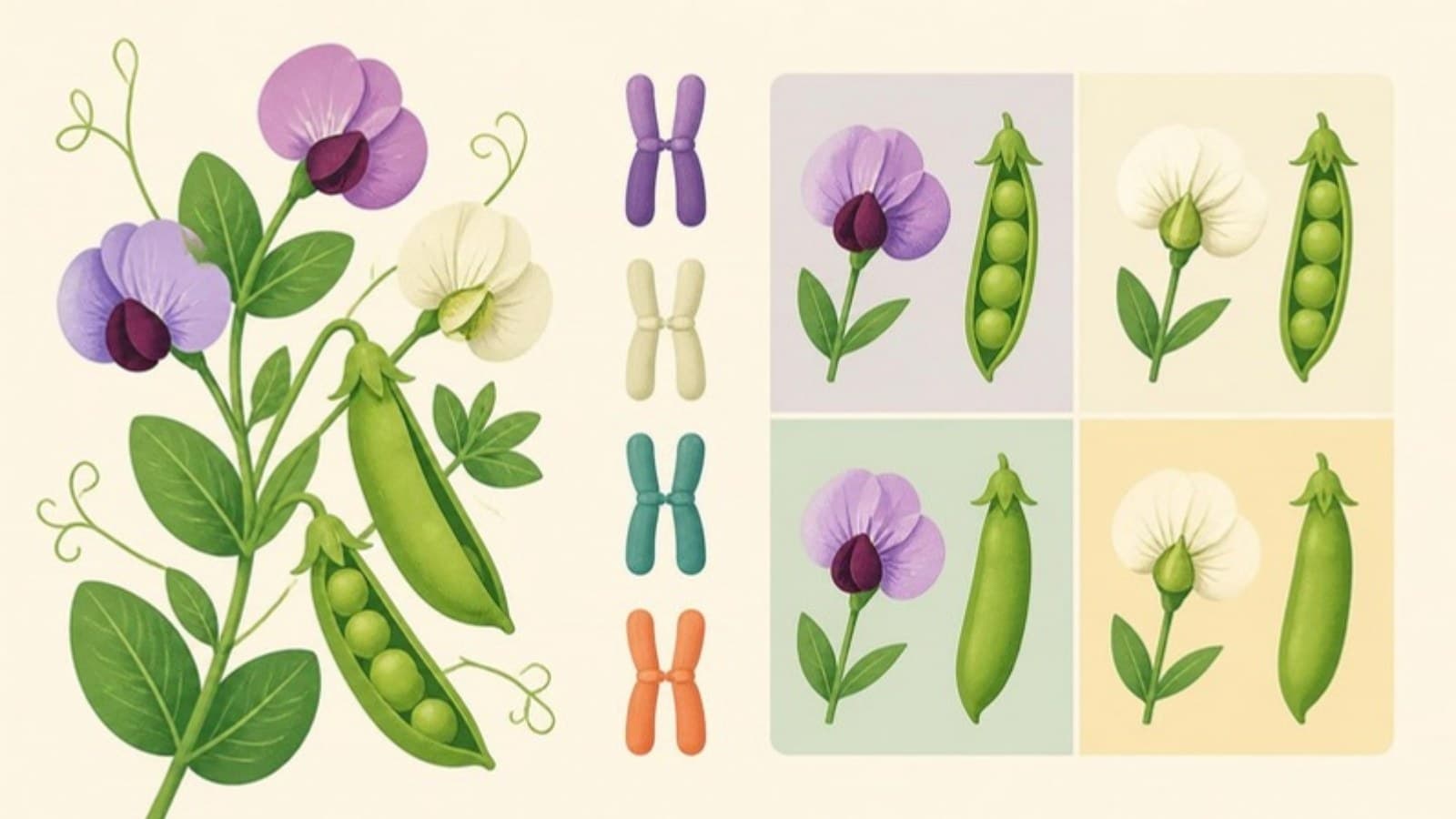
| Contrasting traits | 7 pairs of clearly visible differences |
| Annual plant | Short generation time |
| Self-pollination | Easy to maintain pure lines |
| Cross-pollination | Can be artificially done |
| Large number of seeds | Statistical analysis possible |
| Trait | Dominant | Recessive |
|---|---|---|
| Seed shape | Round (R) | Wrinkled (r) |
| Seed color | Yellow (Y) | Green (y) |
| Pod shape | Inflated (I) | Constricted (i) |
| Pod color | Green (G) | Yellow (g) |
| Flower color | Purple (P) | White (p) |
| Flower position | Axial (A) | Terminal (a) |
| Stem height | Tall (T) | Dwarf (t) |
Statement: When two organisms with contrasting characters are crossed, only one character appears in F1 (dominant), while the other remains hidden (recessive).
Key Points:
Statement: During gamete formation, the two alleles of a gene separate so that each gamete receives only one allele.
Monohybrid Cross Example:
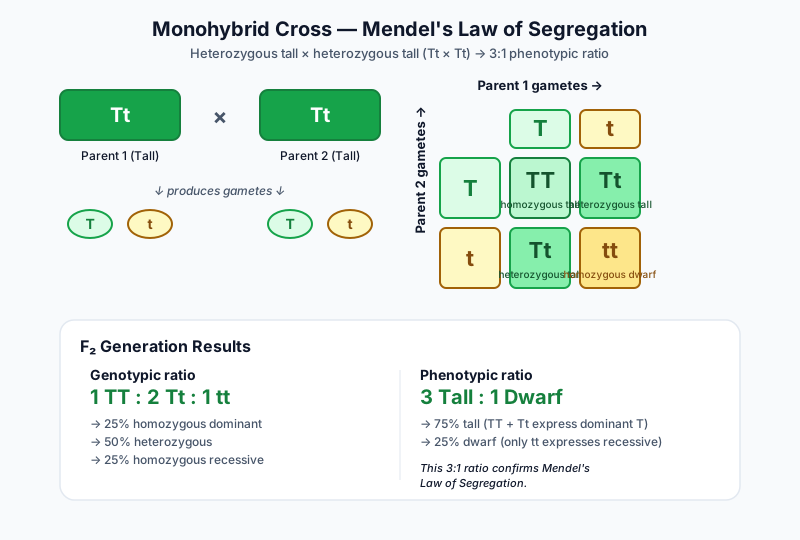
Test Cross: Cross with homozygous recessive to determine genotype.
Statement: Alleles of different genes assort independently of each other during gamete formation, provided genes are on different chromosomes.
Dihybrid Cross Example:
| Phenotype | Ratio | Genotypes |
|---|---|---|
| Round Yellow | 9 | RY |
| Round Green | 3 | R_yy |
| Wrinkled Yellow | 3 | rrY_ |
| Wrinkled Green | 1 | rryy |
Neither allele is completely dominant; heterozygote shows intermediate phenotype.
Example: Snapdragon flower color
Both alleles express equally in heterozygote.
Example: ABO blood groups
More than two alleles exist for a gene in a population.
Example: ABO blood groups (3 alleles: I^A, I^B, i)
Single gene affects multiple traits.
Example: Sickle cell anemia - single mutation causes multiple effects:
One gene masks the expression of another gene.
Example: Coat color in dogs
Multiple genes control one trait; shows continuous variation.
Example: Skin color in humans (3+ genes)
Proposed by: Sutton and Boveri (1902)
Genes on the same chromosome tend to inherit together.
Types:
Coupling (Cis): Dominant alleles on same chromosome (AB/ab) Repulsion (Trans): Dominant alleles on different homologs (Ab/aB)
| Sex | Chromosomes | Gametes |
|---|---|---|
| Female | 44 + XX | All carry X |
| Male | 44 + XY | Half X, half Y |
Sex of offspring determined by father's sperm.
Characteristics:
Examples:
| Cross | Offspring |
|---|---|
| X^C X^C × X^C Y | All normal |
| X^C X^c × X^C Y | 1 normal female : 1 carrier female : 1 normal male : 1 colorblind male |
| X^c X^c × X^C Y | All females carriers : All males colorblind |
Abnormal number of chromosomes.
| Type | Definition |
|---|---|
| Monosomy | 2n - 1 (one less) |
| Trisomy | 2n + 1 (one extra) |
| Nullisomy | 2n - 2 |
| Tetrasomy | 2n + 2 |
| Feature | Description |
|---|---|
| Karyotype | 47, +21 |
| Cause | Non-disjunction in meiosis |
| Risk factor | Advanced maternal age |
| Features | Intellectual disability, flat face, short stature, congenital heart defects |
| Feature | Description |
|---|---|
| Karyotype | 45, X (monosomy X) |
| Sex | Female |
| Features | Short stature, webbed neck, sterile, underdeveloped ovaries |
Practice break
Reading is prep. Practising is progress.
Free to try · replies within a few hours on WhatsApp
| Feature | Description |
|---|---|
| Karyotype | 47, XXY |
| Sex | Male |
| Features | Tall, gynecomastia, sterile, small testes |
| Feature | Description |
|---|---|
| Karyotype | 47, XXX |
| Sex | Female |
| Features | Usually normal, may have reduced fertility |
| Disorder | Affected Gene/Protein |
|---|---|
| Huntington's disease | Huntingtin protein |
| Polydactyly | Extra fingers/toes |
| Brachydactyly | Short fingers |
| Disorder | Cause | Features |
|---|---|---|
| Phenylketonuria (PKU) | Phenylalanine hydroxylase deficiency | Mental retardation if untreated |
| Sickle cell anemia | Abnormal hemoglobin (HbS) | Sickle-shaped RBCs, anemia |
| Thalassemia | Reduced/absent globin chains | Severe anemia |
| Cystic fibrosis | CFTR protein defect | Thick mucus, lung infections |
| Albinism | Tyrosinase deficiency | No melanin pigment |
| Pattern | Characteristics |
|---|---|
| Autosomal dominant | Affected in every generation, both sexes equally |
| Autosomal recessive | May skip generations, both sexes equally |
| X-linked recessive | More males affected, never father to son |
| X-linked dominant | Affected father → all daughters affected |
Q1 (NEET 2023): A cross between two tall plants produced 75 tall and 25 dwarf plants. The genotype of parents would be:
Q2 (NEET 2022): Which of the following is an example of co-dominance?
Q3 (NEET 2021): Down syndrome is caused by:
Q4 (NEET 2020): In a dihybrid cross, F2 generation ratio is:
Q5 (NEET 2019): Color blindness is more common in males because:
Q: Why is the 9:3:3:1 ratio not always observed? A: This ratio assumes: (1) genes are on different chromosomes (no linkage), (2) no gene interactions (epistasis), (3) complete dominance. Deviations occur when these conditions aren't met.
Q: Why is color blindness more common in males? A: The gene for color vision is on the X chromosome. Males (XY) have only one X, so a single mutant allele causes the condition. Females (XX) need mutations on both X chromosomes to be affected.
Q: How does non-disjunction cause chromosomal disorders? A: Non-disjunction is failure of chromosomes to separate during meiosis. This produces gametes with extra or missing chromosomes, leading to conditions like Down syndrome (trisomy 21) when fertilized.
Q: Why do carriers of sickle cell anemia have malaria resistance? A: Carriers (HbA HbS) have some sickle-shaped RBCs under low oxygen. The malaria parasite cannot survive well in these cells, providing selective advantage in malaria-endemic regions.
Q: What is the difference between linkage and crossing over? A: Linkage keeps genes on the same chromosome together during inheritance. Crossing over (during meiosis) breaks this linkage by exchanging segments between homologous chromosomes, creating recombinant offspring.
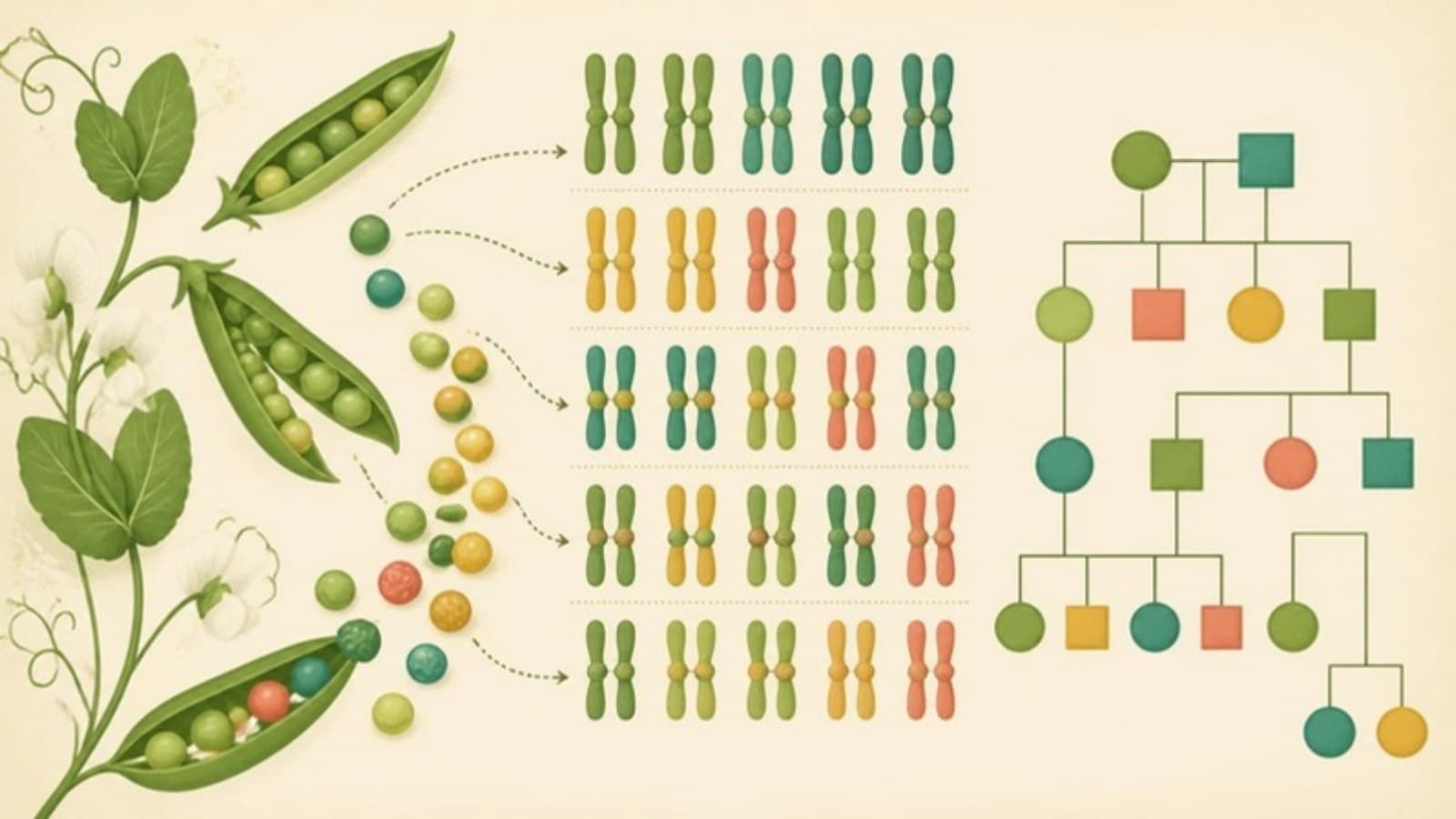
Pedigree charts are one of the few NEET question types where speed comes purely from having a fixed reading method. Message us on WhatsApp at +91 88264 44334 with a pedigree question you got wrong, and we'll show you the reading approach that avoids the usual trap.
Related reading: Genetics for NEET - Mendel to Molecular Biology · NEET Genetics Weightage Analysis · Class 12 Biology Coaching
Related resources

About the author
Dr. Shekhar C. Singh
AIIMS New Delhi alumnus who has taught biology since 2014, from NCERT foundations to the International Biology Olympiad.
Read his full profile →Get personalized guidance from AIIMS experts and achieve your medical college dreams
More from the blog
Master Genetics from Mendelian inheritance to molecular biology with this complete NEET 2026 guide. Includes previous year analysis, common mistakes, diagrams, and 10 practice MCQs with detailed explanations.
9 Feb 2026
title: NEET Genetics Weightage 2026 — MBI & PIV Combined Analysis. Complete weightage analysis, question patterns, and chapter-wise strategy for NEET 2026 Biology preparation.
7 Feb 2026
Master Ecology for NEET 2026 with this comprehensive guide covering organisms and environment, population ecology, ecosystem structure, biodiversity conservation, and environmental issues. NCERT-aligned with PYQs and 12 practice MCQs.
2 Mar 2026
Share your thoughts, ask a question, or help another student
Type it below and send it to us on WhatsApp — no sign-up needed.
For NEET Biology, aim for 3-4 hours of focused study daily. Quality matters more than quantity!
Yes! NCERT covers 95% of NEET Biology questions. Master it completely before any reference book.
Human Physiology (20%), Genetics (18%), and Ecology (12%) are the highest-scoring areas.
Need personalized guidance?