Loading...
Loading...
Master Photosynthesis for NEET 2026 with comprehensive notes on light reactions, Calvin cycle, C3, C4, and CAM pathways. NCERT-aligned content with diagrams and previous year questions.

5 points to remember for NEET
Photosynthesis is one of the highest weightage chapters in NEET Biology, contributing 4-6 questions annually. Master this chapter for a strong score in Plant Physiology.
Definition: Process by which green plants convert light energy into chemical energy, synthesizing glucose from CO₂ and H₂O.
Overall Equation: 6CO₂ + 12H₂O + Light → C₆H₁₂O₆ + 6O₂ + 6H₂O
Where Does Photosynthesis Occur?
| Pigment | Color | Absorption Peak | Function |
|---|---|---|---|
| Chlorophyll a | Blue-green | 430 nm, 662 nm | Primary pigment, reaction center |
| Chlorophyll b | Yellow-green | 453 nm, 642 nm | Accessory pigment |
| Carotenoids | Yellow-orange | 400-500 nm | Accessory, photoprotection |
| Xanthophylls | Yellow | 400-500 nm | Accessory pigment |
Key Points:
Occur in thylakoid membranes and require light.
| Photosystem | Reaction Center | Absorption Peak | Location |
|---|---|---|---|
| PS I | P700 | 700 nm | Stroma lamellae |
| PS II | P680 | 680 nm | Grana thylakoids |
NEET Tip: PS II was discovered after PS I but acts first in light reactions.
Z-Scheme (Non-cyclic electron flow):
Products of Non-cyclic:
| Type | Electron Flow | Products | O₂ Evolution |
|---|---|---|---|
| Non-cyclic | PS II → PS I | ATP + NADPH | Yes |
| Cyclic | PS I → PS I | ATP only | No |
Sources of H⁺ accumulation:
Occur in stroma, don't require light directly but need ATP and NADPH from light reactions.
Location: Stroma of chloroplast
Key Enzyme: RuBisCO (Ribulose-1,5-bisphosphate carboxylase/oxygenase)
| Input | Amount |
|---|---|
| CO₂ | 1 molecule |
| ATP | 3 molecules |
| NADPH | 2 molecules |
To make 1 glucose (6 carbons): 6 CO₂, 18 ATP, 12 NADPH
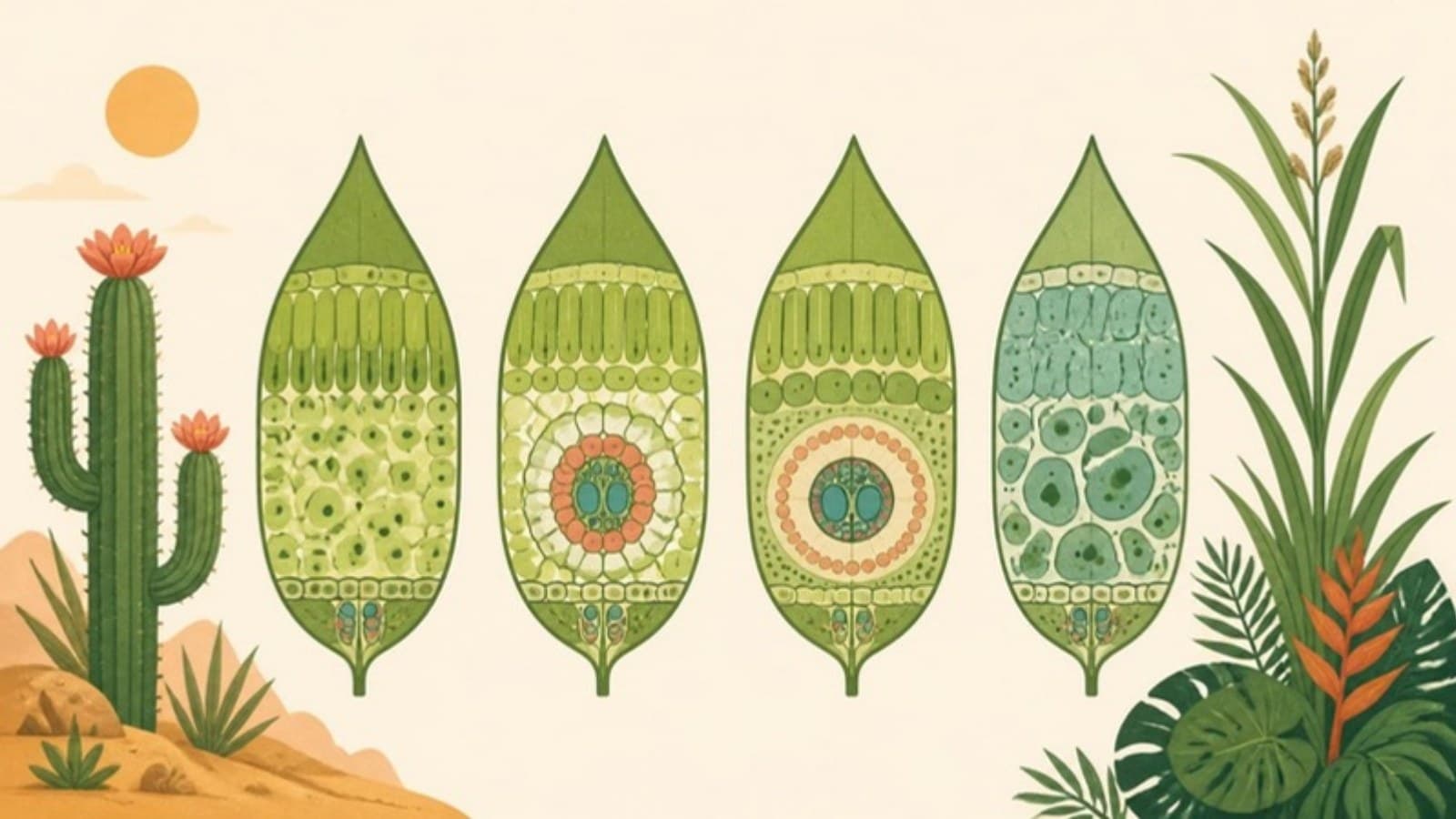
C4 plants have special leaf anatomy:
| Cell Type | Location | Chloroplasts | Function |
|---|---|---|---|
| Mesophyll | Outer | Granal | Initial CO₂ fixation |
| Bundle sheath | Around vascular bundles | Agranal | Calvin cycle |
In Mesophyll Cells:
In Bundle Sheath Cells: 5. 4C acid decarboxylated → CO₂ + Pyruvate 6. CO₂ enters Calvin cycle (fixed by RuBisCO) 7. Pyruvate returns to mesophyll
| Feature | C3 Plants | C4 Plants |
|---|---|---|
| First product | 3-PGA (3C) | OAA (4C) |
| CO₂ acceptor | RuBP | PEP |
| Primary enzyme | RuBisCO | PEP carboxylase |
| Kranz anatomy | Absent | Present |
| Photorespiration | High | Negligible |
| CO₂ compensation point | 50 ppm | 10 ppm |
| Optimum temp | 20-25°C | 30-40°C |
| Examples | Wheat, Rice, Potato | Maize, Sugarcane, Sorghum |
CAM: Crassulacean Acid Metabolism
Practice break
Reading is prep. Practising is progress.
Free to try · replies within a few hours on WhatsApp
Night (Stomata Open):
Day (Stomata Closed): 4. Malic acid decarboxylated → CO₂ + Pyruvate 5. CO₂ used in Calvin cycle 6. Pyruvate regenerates PEP
Examples: Cactus, Pineapple, Agave, Bryophyllum
| Feature | C4 | CAM |
|---|---|---|
| Separation | Spatial (cells) | Temporal (day/night) |
| Stomata | Open during day | Open at night |
| Water efficiency | High | Very high |
| Productivity | High | Low |
Rate of photosynthesis is limited by the factor present in minimum quantity.
| Factor | Effect |
|---|---|
| Light intensity | Rate increases, then plateaus |
| CO₂ concentration | Rate increases up to 0.05% |
| Temperature | Optimum varies; enzymes denature at high temp |
| Water | Affects stomatal opening, electron donor |
Chloroplast → Peroxisome → Mitochondria → Chloroplast
Q1 (NEET 2023): The first stable product of C3 cycle is:
Q2 (NEET 2022): Kranz anatomy is found in:
Q3 (NEET 2021): During cyclic photophosphorylation:
Q4 (NEET 2020): The enzyme responsible for CO₂ fixation in C4 plants is:
Q5 (NEET 2019): In CAM plants, stomata are:
Q: Why is PS II named so even though it acts first? A: Photosystems were named based on their order of discovery, not their order of function. PS I was discovered first, hence the name. Functionally, PS II acts before PS I in the Z-scheme.
Q: Why don't C4 plants photorespire? A: C4 plants use PEP carboxylase for initial CO₂ fixation, which has no oxygenase activity. Additionally, they concentrate CO₂ in bundle sheath cells, ensuring RuBisCO preferentially fixes CO₂.
Q: What is the advantage of CAM over C4? A: CAM plants have the highest water use efficiency because they keep stomata closed during hot daytime. This is critical for desert plants. However, C4 plants have higher productivity.
Q: Why is RuBisCO considered inefficient? A: RuBisCO has low catalytic rate (only 3 CO₂ fixed per second) and cannot distinguish well between CO₂ and O₂, leading to photorespiration in C3 plants.
Q: What happens to photosynthesis at very high temperatures? A: High temperatures denature enzymes, increase photorespiration (O₂ solubility decreases less than CO₂), and cause stomatal closure leading to CO₂ limitation.
Light reactions and the Calvin cycle have a fairly predictable set of question types that NEET returns to across papers. Message us on WhatsApp at +91 88264 44334 and we'll send the light-reaction and Calvin-cycle question types that have actually shown up in recent NEET papers.
Related reading: Photosynthesis Complete NEET Guide · NEET Plant Physiology Weightage Analysis · Class 11 Biology Coaching
Related resources

About the author
Dr. Shekhar C. Singh
AIIMS New Delhi alumnus who has taught biology since 2014, from NCERT foundations to the International Biology Olympiad.
Read his full profile →Get personalized guidance from AIIMS experts and achieve your medical college dreams
More from the blog
Complete photosynthesis guide for NEET 2026. Learn light reactions, Calvin cycle, C3/C4/CAM plants, photorespiration, and practice with 10 original MCQs. Analysis of 15 previous year questions included.
9 Feb 2026
Master Nervous System for NEET 2026 with comprehensive notes on neuron structure, nerve impulse, brain anatomy, and reflex action. NCERT-aligned content with diagrams and PYQs.
12 Jun 2026
Master Animal Kingdom classification for NEET 2026 with this complete guide covering all non-chordate and chordate phyla, basis of classification, vertebrate classes, mnemonics, PYQs, and 12 practice MCQs aligned with NCERT.
2 Mar 2026
Share your thoughts, ask a question, or help another student
Type it below and send it to us on WhatsApp — no sign-up needed.
For NEET Biology, aim for 3-4 hours of focused study daily. Quality matters more than quantity!
Yes! NCERT covers 95% of NEET Biology questions. Master it completely before any reference book.
Human Physiology (20%), Genetics (18%), and Ecology (12%) are the highest-scoring areas.
Need personalized guidance?