Loading...
Loading...
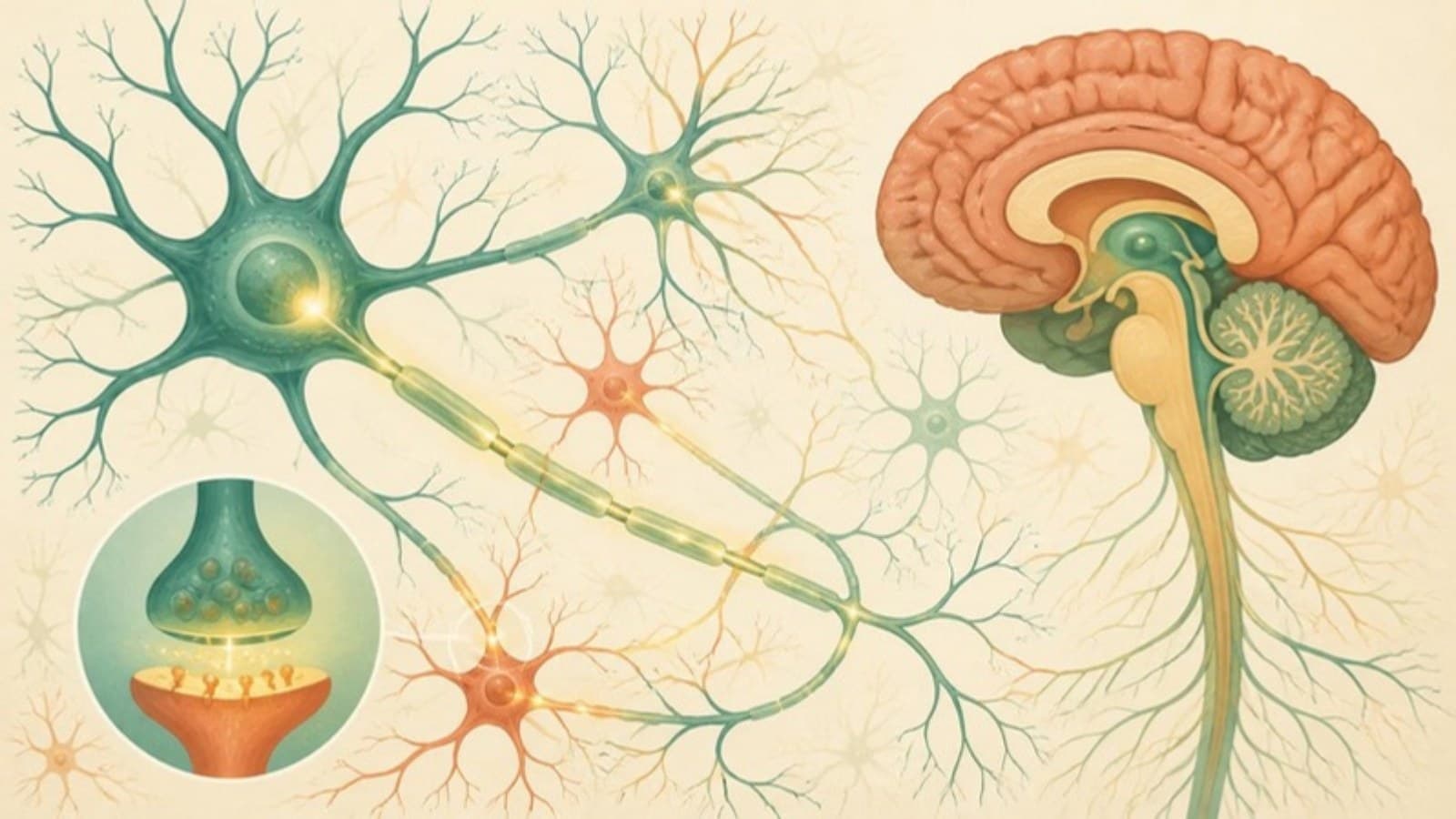
Master Nervous System for NEET 2026 with comprehensive notes on neuron structure, nerve impulse, brain anatomy, and reflex action. NCERT-aligned content with diagrams and PYQs.

5 points to remember for NEET
Neural Control and Coordination is one of the most important and high-weightage chapters, contributing 5-7 questions in NEET annually. This comprehensive guide covers all NCERT concepts.
Definition: The system that controls and coordinates body activities through rapid electrical signals.
Central Nervous System (CNS):
Peripheral Nervous System (PNS):
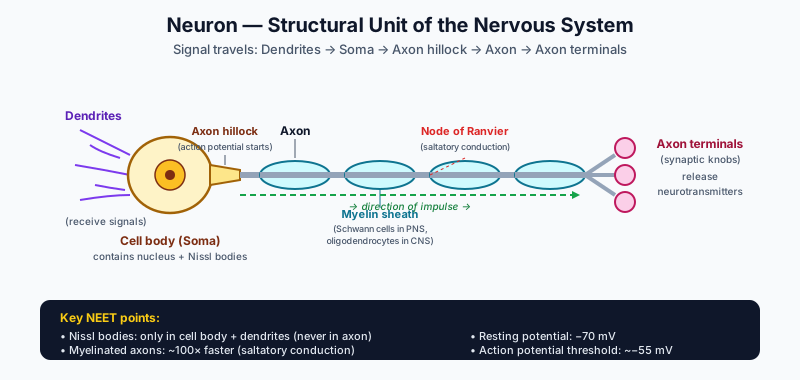
Three Main Parts:
| Feature | Myelinated | Unmyelinated |
|---|---|---|
| Myelin | Present | Absent |
| Nodes of Ranvier | Present | Absent |
| Conduction | Saltatory (faster) | Continuous (slower) |
| Speed | 100-120 m/s | 0.5-2 m/s |
| Location | White matter, PNS | Gray matter |
Myelin in CNS: Oligodendrocytes Myelin in PNS: Schwann cells
| Type | Structure | Function |
|---|---|---|
| Sensory (Afferent) | Long dendrite, short axon | Carry impulse to CNS |
| Motor (Efferent) | Short dendrite, long axon | Carry impulse from CNS |
| Interneurons | Short processes | Connect neurons within CNS |
| Based on Processes | Number of Processes |
|---|---|
| Unipolar | 1 (axon only) |
| Bipolar | 2 (1 dendrite, 1 axon) |
| Multipolar | 3+ (many dendrites, 1 axon) |
Value: -70 mV (inside negative relative to outside)
Maintenance:
Stimulus → Threshold (-55 mV) → Action Potential
| Phase | Events | Potential |
|---|---|---|
| Resting | Na⁺/K⁺ pump maintains gradient | -70 mV |
| Depolarization | Na⁺ channels open, Na⁺ rushes in | -70 → +30 mV |
| Repolarization | Na⁺ channels close, K⁺ channels open | +30 → -70 mV |
| Hyperpolarization | K⁺ channels slow to close | Below -70 mV |
| Return to resting | Na⁺/K⁺ pump restores gradient | -70 mV |
All-or-None Law: Action potential either occurs fully or not at all; no partial response.
Refractory Period:
| Type | Mechanism | Speed |
|---|---|---|
| Continuous | Sequential depolarization | Slower |
| Saltatory | Jumps between Nodes of Ranvier | Faster |
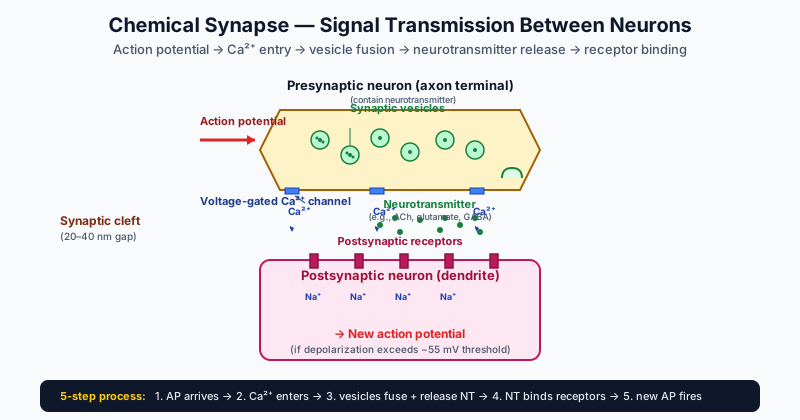
Definition: Junction between two neurons where signal transmission occurs.
| Type | Mechanism | Speed |
|---|---|---|
| Electrical | Gap junctions, direct ion flow | Very fast |
| Chemical | Neurotransmitter release | Slower |
| Neurotransmitter | Location | Effect |
|---|---|---|
| Acetylcholine | NMJ, brain | Excitatory/Inhibitory |
| Norepinephrine | Sympathetic NS | Excitatory |
| Dopamine | Brain | Pleasure, movement |
| Serotonin | Brain | Mood, sleep |
| GABA | Brain | Inhibitory |
| Glutamate | Brain | Excitatory |
Weight: ~1400 g Protection: Skull, meninges, CSF
| Layer | Location | Characteristics |
|---|---|---|
| Dura mater | Outermost | Tough, fibrous |
| Arachnoid | Middle | Web-like, CSF beneath |
| Pia mater | Innermost | Delicate, on brain surface |
CSF (Cerebrospinal Fluid):
A. Cerebrum (Largest Part - 80%)
| Lobe | Location | Function |
|---|---|---|
| Frontal | Front | Motor control, thinking, speech (Broca's area) |
| Parietal | Top | Sensory processing, spatial awareness |
| Temporal | Side | Hearing, memory, speech comprehension (Wernicke's area) |
| Occipital | Back | Vision |
Cerebral Cortex:
Association Areas:
B. Thalamus
C. Hypothalamus
D. Limbic System
A. Cerebellum (Little Brain)
B. Pons
C. Medulla Oblongata
Brain Stem: Midbrain + Pons + Medulla
Location: Within vertebral column Length: ~45 cm Structure:
Functions:
| Number | Name | Type | Function |
|---|---|---|---|
| I | Olfactory | Sensory | Smell |
| II | Optic | Sensory | Vision |
| III | Oculomotor | Motor | Eye movement |
| IV | Trochlear | Motor | Eye movement |
| V | Trigeminal | Mixed | Face sensation, chewing |
| VI | Abducens | Motor | Eye movement |
| VII | Facial | Mixed | Facial expression, taste |
| VIII | Vestibulocochlear | Sensory | Hearing, balance |
| IX | Glossopharyngeal | Mixed | Taste, swallowing |
| X | Vagus | Mixed | Visceral organs |
| XI | Accessory | Motor | Neck muscles |
| XII | Hypoglossal | Motor | Tongue movement |
Mnemonic: On Old Olympus Towering Tops, A Finn And German Viewed Some Hops
Practice break
Reading is prep. Practising is progress.
Free to try · replies within a few hours on WhatsApp
| Region | Number |
|---|---|
| Cervical | 8 |
| Thoracic | 12 |
| Lumbar | 5 |
| Sacral | 5 |
| Coccygeal | 1 |
| Feature | Sympathetic | Parasympathetic |
|---|---|---|
| Origin | Thoracolumbar | Craniosacral |
| Ganglion location | Close to spinal cord | Near/in target organ |
| Neurotransmitter | Norepinephrine | Acetylcholine |
| General effect | Fight or flight | Rest and digest |
| Pupil | Dilates | Constricts |
| Heart rate | Increases | Decreases |
| Digestion | Inhibits | Stimulates |
| Bronchi | Dilates | Constricts |
Definition: Automatic, involuntary response to a stimulus.
Components (in order):
| Type | Example | Integration Center |
|---|---|---|
| Spinal | Knee jerk, withdrawal | Spinal cord |
| Cranial | Pupillary reflex | Brain |
| Conditional | Salivation to bell (Pavlov) | Brain |
| Unconditional | Salivation to food | Brain |
Structure:
Photoreceptors:
| Type | Shape | Pigment | Function | Sensitivity |
|---|---|---|---|---|
| Rods | Rod-shaped | Rhodopsin | Dim light, peripheral vision | High |
| Cones | Cone-shaped | Photopsins | Color, bright light, acuity | Low |
Fovea: Maximum cone density, sharpest vision Blind spot: Where optic nerve exits, no receptors
Three Parts:
| Part | Structures | Function |
|---|---|---|
| Outer ear | Pinna, ear canal, tympanic membrane | Sound collection |
| Middle ear | Malleus, Incus, Stapes | Sound amplification |
| Inner ear | Cochlea, vestibular apparatus | Hearing, balance |
Organ of Corti: Contains hair cells (auditory receptors) in cochlea
Q1 (NEET 2023): Resting membrane potential of neuron is:
Q2 (NEET 2022): The part of brain responsible for balance is:
Q3 (NEET 2021): Saltatory conduction occurs in:
Q4 (NEET 2020): Hypothalamus controls:
Q5 (NEET 2019): Which neurotransmitter is released at neuromuscular junction?
Q: Why is the resting potential negative? A: The Na⁺/K⁺ pump creates an ionic gradient (3 Na⁺ out, 2 K⁺ in). Additionally, K⁺ leak channels allow K⁺ to diffuse out, leaving the inside more negative relative to outside.
Q: What is the advantage of saltatory conduction? A: In myelinated neurons, action potential jumps between Nodes of Ranvier instead of traveling continuously. This is faster (100 m/s vs 1 m/s) and more energy-efficient.
Q: Why is the cerebellum called the "little brain"? A: It has a similar folded structure to the cerebrum but is smaller. Despite being only 10% of brain volume, it contains more neurons than the rest of the brain combined.
Q: What happens if the corpus callosum is cut? A: This procedure (commissurotomy) prevents communication between hemispheres. Patients can function normally in daily life but show "split-brain" effects in specific tests.
Q: Why does Parkinson's disease cause tremors? A: Parkinson's involves death of dopamine-producing neurons in the substantia nigra. Dopamine is essential for smooth, coordinated movements, so its deficiency causes tremors and rigidity.
Cerebrum, cerebellum, hypothalamus, medulla — each has a distinct function NEET expects you to attach correctly, not just recognise by name. Message us on WhatsApp at +91 88264 44334 with the brain region you keep confusing, and we'll send a function-only reference built the way NEET phrases these questions.
Related reading: Chemical Coordination & Endocrine System Notes · Human Physiology Complete Notes · Class 11 Biology Coaching
Related resources

About the author
Dr. Shekhar C. Singh
AIIMS New Delhi alumnus who has taught biology since 2014, from NCERT foundations to the International Biology Olympiad.
Read his full profile →Get personalized guidance from AIIMS experts and achieve your medical college dreams
More from the blog
Master Excretion for NEET 2026 with comprehensive notes on kidney structure, nephron function, urine formation, and regulation. NCERT-aligned content with diagrams and PYQs.
12 Jun 2026
Master Digestion and Absorption for NEET 2026 with comprehensive notes on digestive system, enzymes, absorption mechanisms, and digestive disorders. NCERT-aligned content with diagrams and PYQs.
12 Jun 2026
Master Body Fluids and Circulation for NEET 2026 with comprehensive notes on blood, heart, cardiac cycle, ECG, and circulatory system. NCERT-aligned content with diagrams and PYQs.
12 Jan 2026
Share your thoughts, ask a question, or help another student
Type it below and send it to us on WhatsApp — no sign-up needed.
For NEET Biology, aim for 3-4 hours of focused study daily. Quality matters more than quantity!
Yes! NCERT covers 95% of NEET Biology questions. Master it completely before any reference book.
Human Physiology (20%), Genetics (18%), and Ecology (12%) are the highest-scoring areas.
Need personalized guidance?