Loading...
Loading...
Master Excretion for NEET 2026 with comprehensive notes on kidney structure, nephron function, urine formation, and regulation. NCERT-aligned content with diagrams and PYQs.

5 points to remember for NEET
Excretion is an important chapter in Human Physiology, contributing 3-5 questions in NEET annually. This comprehensive guide covers all NCERT concepts for NEET 2026.
Definition: Removal of metabolic waste products from the body.
| Waste Product | Source | Animals | Toxicity | Water Requirement |
|---|---|---|---|---|
| Ammonia | Protein metabolism | Aquatic animals | Very high | Very high |
| Urea | Ammonia conversion in liver | Mammals, amphibians | Moderate | Moderate |
| Uric acid | Purine metabolism | Birds, reptiles, insects | Low | Very low |
| Type | Waste Product | Examples |
|---|---|---|
| Ammonotelic | Ammonia | Fish, aquatic invertebrates |
| Ureotelic | Urea | Mammals, amphibians |
| Uricotelic | Uric acid | Birds, reptiles, insects |
NEET Important: Humans are primarily ureotelic but also excrete some ammonia and uric acid.
| Animal | Excretory Organ |
|---|---|
| Protozoa | Contractile vacuole |
| Flatworms | Flame cells (protonephridia) |
| Earthworm | Nephridia |
| Insects | Malpighian tubules |
| Crustaceans | Green (antennal) glands |
| Vertebrates | Kidneys |
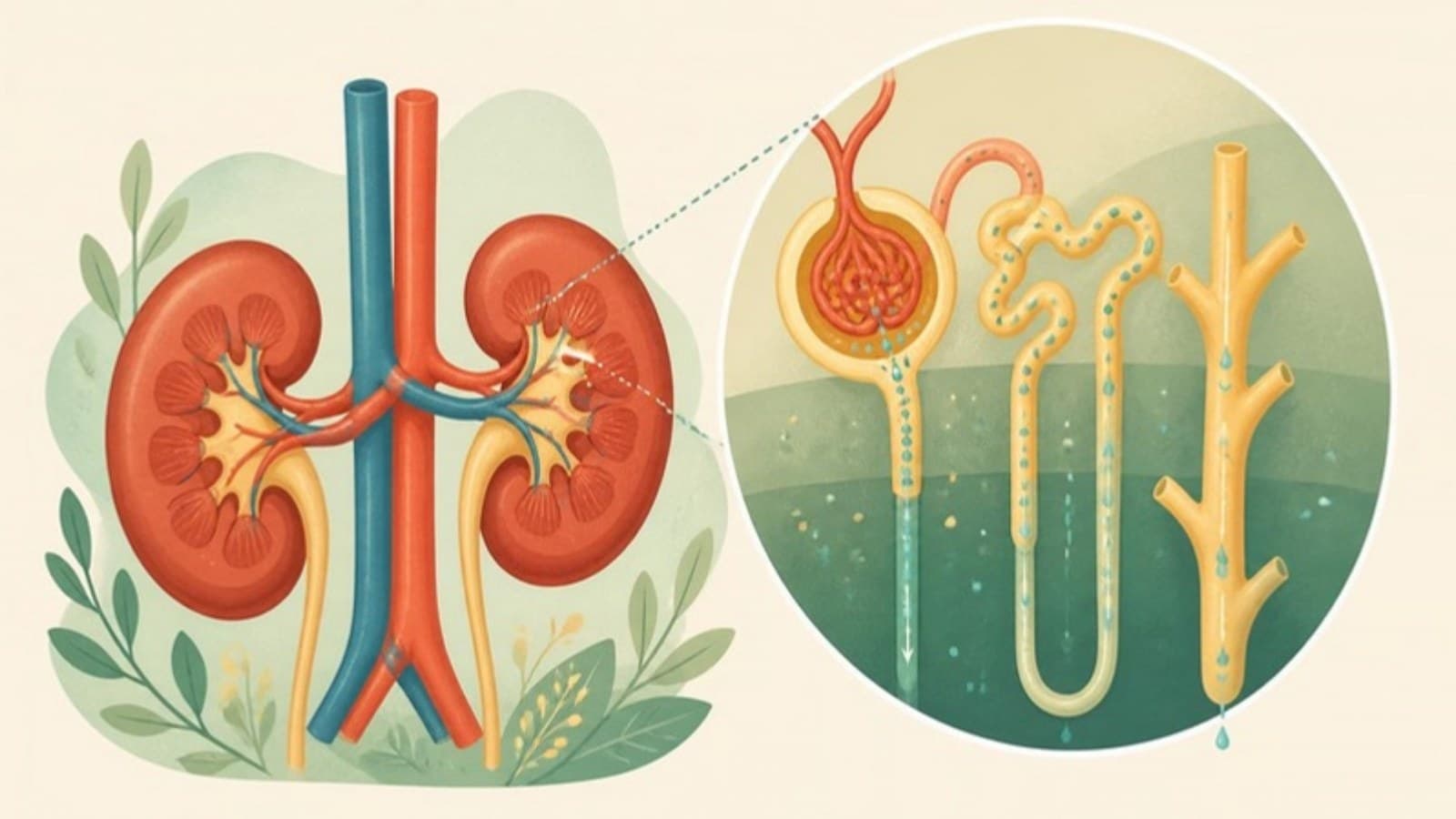
Location: Retroperitoneal, between T12-L3 vertebrae
Size: ~11 cm × 6 cm × 3 cm, ~150 g each
External Structure:
Internal Structure:
| Region | Location | Features |
|---|---|---|
| Cortex | Outer | Contains glomeruli, PCT, DCT |
| Medulla | Inner | Contains loops of Henle, collecting ducts |
| Pyramids | Medulla | Triangular structures with apices pointing inward |
| Pelvis | Central | Funnel-shaped, continuous with ureter |
| Calyces | Around pyramids | Minor (collect urine) and major calyces |
Number: ~1 million nephrons per kidney
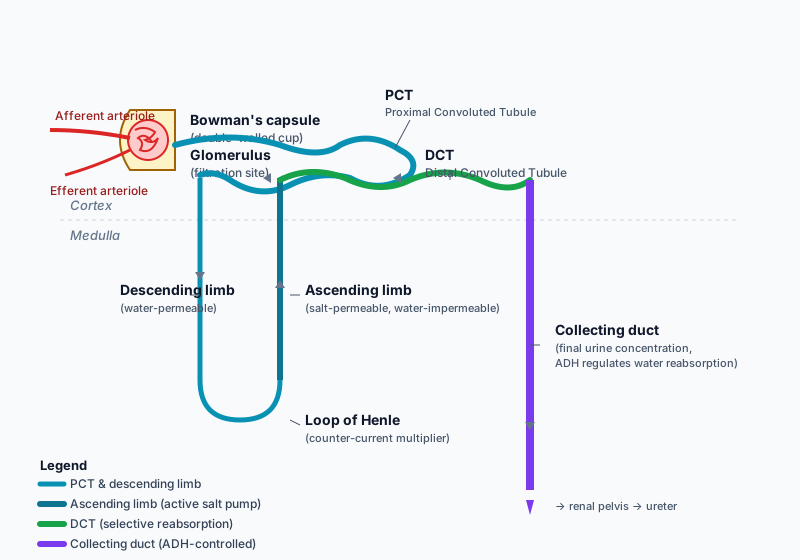
Parts of Nephron:
Renal Corpuscle (Malpighian Body)
Renal Tubule
| Feature | Cortical Nephrons | Juxtamedullary Nephrons |
|---|---|---|
| Location | Mostly in cortex | Close to medulla |
| Percentage | 80-85% | 15-20% |
| Loop of Henle | Short | Long (deep into medulla) |
| Vasa recta | Absent/rudimentary | Well-developed |
| Function | General filtration | Urine concentration |
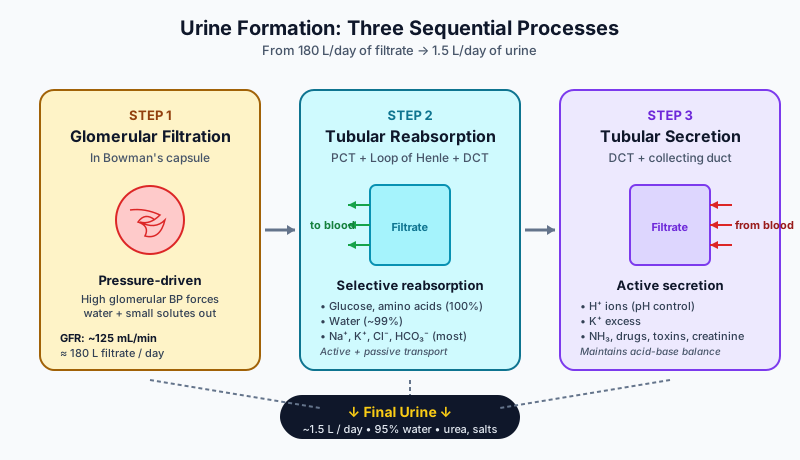
Process: Blood filtered through glomerular capillaries into Bowman's capsule
Filtration Membrane (3 layers):
What Gets Filtered:
What is NOT Filtered:
Glomerular Filtration Rate (GFR):
Net Filtration Pressure (NFP): NFP = Glomerular Hydrostatic Pressure - (Capsular Pressure + Colloidal Osmotic Pressure) NFP = 55 - (15 + 30) = 10 mm Hg
Location and Substances Reabsorbed:
| Segment | Substances Reabsorbed | Mechanism |
|---|---|---|
| PCT | 70-80% water, all glucose, all amino acids, Na⁺, Cl⁻, K⁺, HCO₃⁻ | Active and passive |
| Descending LoH | Water | Osmosis |
| Ascending LoH | Na⁺, Cl⁻, K⁺ | Active (thick), Passive (thin) |
| DCT | Na⁺, Ca²⁺, water (regulated) | Active, hormone-dependent |
| Collecting Duct | Water, urea | ADH-dependent |
NEET Important:
Process: Active transport of substances from blood into tubular fluid
| Substance | Location | Significance |
|---|---|---|
| H⁺ ions | PCT, DCT | Acid-base balance |
| K⁺ ions | DCT, Collecting duct | K⁺ regulation |
| Creatinine | PCT | Waste removal |
| Drugs, toxins | PCT | Detoxification |
Creates osmotic gradient in medulla for urine concentration.
Loop of Henle:
Vasa Recta:
Result: Urine can be concentrated up to 4× plasma concentration
| Factor | ADH Level | Effect on DCT/CD | Urine Volume | Urine Concentration |
|---|---|---|---|---|
| Dehydration | ↑ | ↑ Water reabsorption | ↓ | ↑ (concentrated) |
| Over-hydration | ↓ | ↓ Water reabsorption | ↑ | ↓ (dilute) |
Source: Hypothalamus (made), Posterior pituitary (released)
| Factor | Aldosterone | Effect | Result |
|---|---|---|---|
| Low Na⁺/High K⁺ | ↑ | ↑ Na⁺ reabsorption, ↑ K⁺ secretion | ↑ Blood volume, ↓ K⁺ |
| High Na⁺/Low K⁺ | ↓ | Opposite | ↓ Blood volume |
Source: Adrenal cortex
Practice break
Reading is prep. Practising is progress.
Free to try · replies within a few hours on WhatsApp
Trigger: Low blood pressure/volume detected by JGA
Pathway:
Location: Where DCT contacts afferent arteriole
Components:
| Component | Concentration |
|---|---|
| Water | 95% |
| Urea | 2% |
| Creatinine | 0.1% |
| Uric acid | 0.03% |
| Na⁺, K⁺, Cl⁻ | Variable |
| pH | 4.5-8.0 (average 6.0) |
| Condition | Cause | Component Found |
|---|---|---|
| Glycosuria | Diabetes mellitus | Glucose |
| Proteinuria | Kidney damage | Protein |
| Ketonuria | Diabetes, starvation | Ketone bodies |
| Hematuria | Infection, injury | Blood |
Volume for urge: ~300 mL Maximum capacity: ~700-800 mL
| Disorder | Cause | Characteristics |
|---|---|---|
| Uremia | Kidney failure | Urea accumulation in blood |
| Renal calculi | Calcium/uric acid stones | Kidney stones |
| Glomerulonephritis | Inflammation of glomeruli | Protein in urine |
| Renal failure | Multiple causes | Inability to filter blood |
| Diabetes insipidus | ADH deficiency | Large volume of dilute urine |
Q1 (NEET 2023): GFR (Glomerular Filtration Rate) is approximately:
Q2 (NEET 2022): Which hormone increases water reabsorption in collecting ducts?
Q3 (NEET 2021): The ascending limb of loop of Henle is:
Q4 (NEET 2020): Which part of nephron is responsible for concentration of urine?
Q5 (NEET 2019): Uricotelic animals are:
Q: Why do we produce more urine in winter than summer? A: In winter, we sweat less due to lower temperatures. To maintain water balance, excess water is excreted through kidneys. Also, cold causes peripheral vasoconstriction, increasing blood flow to kidneys.
Q: How does diabetes mellitus cause glycosuria? A: In diabetes, blood glucose levels exceed the renal threshold (~180 mg/dL). The PCT cannot reabsorb all glucose, so excess glucose appears in urine.
Q: Why is the ascending limb of loop of Henle impermeable to water? A: This is crucial for the countercurrent mechanism. The thick ascending limb actively pumps out NaCl without water following, creating the osmotic gradient in the medulla needed for urine concentration.
Q: What happens if both kidneys fail? A: Complete kidney failure leads to uremia (toxic waste accumulation), electrolyte imbalance, and death without treatment. Hemodialysis or kidney transplant is required for survival.
Q: Why is the loop of Henle longer in juxtamedullary nephrons? A: Longer loops extend deeper into the medulla, creating a steeper osmotic gradient. This allows for greater urine concentration, important for water conservation.
This chapter rewards a diagram-first approach more than most — the steps of urine formation are easiest to hold in memory once you can see them in order. Message us on WhatsApp at +91 88264 44334 with where the confusion is (structure, urine formation, or regulation), and we'll send a diagram-first breakdown built for how NEET tests it.
Related reading: Body Fluids and Circulation Notes · Human Physiology Complete Notes · Class 11 Biology Coaching
Related resources

About the author
Dr. Shekhar C. Singh
AIIMS New Delhi alumnus who has taught biology since 2014, from NCERT foundations to the International Biology Olympiad.
Read his full profile →Get personalized guidance from AIIMS experts and achieve your medical college dreams
More from the blog
Master Digestion and Absorption for NEET 2026 with comprehensive notes on digestive system, enzymes, absorption mechanisms, and digestive disorders. NCERT-aligned content with diagrams and PYQs.
12 Jun 2026
Master Body Fluids and Circulation for NEET 2026 with comprehensive notes on blood, heart, cardiac cycle, ECG, and circulatory system. NCERT-aligned content with diagrams and PYQs.
12 Jan 2026
Master Respiration for NEET 2026 with comprehensive notes on respiratory system, mechanism of breathing, gas exchange, and transport of gases. NCERT-aligned content with diagrams and PYQs.
12 Jan 2026
Share your thoughts, ask a question, or help another student
Type it below and send it to us on WhatsApp — no sign-up needed.
For NEET Biology, aim for 3-4 hours of focused study daily. Quality matters more than quantity!
Yes! NCERT covers 95% of NEET Biology questions. Master it completely before any reference book.
Human Physiology (20%), Genetics (18%), and Ecology (12%) are the highest-scoring areas.
Need personalized guidance?