Loading...
Loading...
Master Respiration for NEET 2026 with comprehensive notes on respiratory system, mechanism of breathing, gas exchange, and transport of gases. NCERT-aligned content with diagrams and PYQs.

5 points to remember for NEET
Breathing and Exchange of Gases is a high-weightage chapter contributing 3-5 questions in NEET annually. This guide covers the complete respiratory physiology for NEET 2026.
Types of Respiration:
| Type | Definition |
|---|---|
| External respiration | Gas exchange between lungs and blood |
| Internal respiration | Gas exchange between blood and tissues |
| Cellular respiration | ATP production in cells |
Steps in Respiration:
| Animal Group | Respiratory Organ |
|---|---|
| Earthworm | Moist skin |
| Insects | Tracheal system |
| Fish | Gills |
| Amphibians | Skin, gills, lungs |
| Reptiles, Birds, Mammals | Lungs |
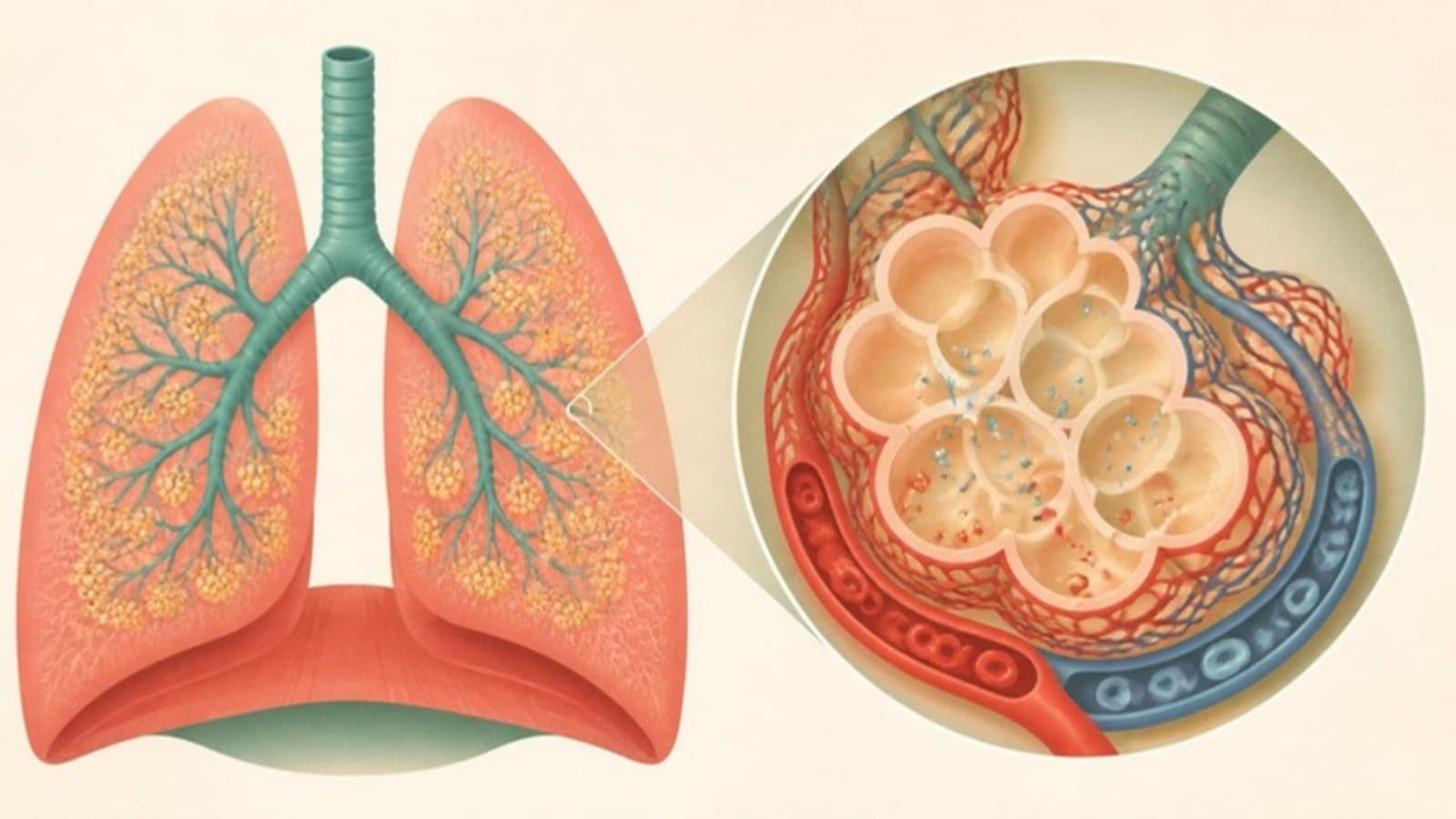
Components:
Nose:
Pharynx:
Larynx (Voice Box):
Trachea (Windpipe):
Bronchi:
Bronchioles:
Alveoli:
| Feature | Right Lung | Left Lung |
|---|---|---|
| Lobes | 3 | 2 |
| Fissures | 2 | 1 |
| Weight | ~600 g | ~550 g |
Pleura:
| Muscle | Inspiration | Expiration |
|---|---|---|
| Diaphragm | Contracts (flattens) | Relaxes (dome shape) |
| External intercostals | Contract | Relax |
| Internal intercostals | Relax | Contract (forced) |
| Abdominal muscles | Relax | Contract (forced) |
Forced Expiration: Internal intercostals and abdominal muscles contract
| Location | Inspiration | Expiration |
|---|---|---|
| Intrapleural | -6 mm Hg | -3 mm Hg |
| Intrapulmonary | -1 mm Hg | +1 mm Hg |
| Volume | Definition | Average (mL) |
|---|---|---|
| Tidal Volume (TV) | Air in normal breathing | 500 |
| Inspiratory Reserve (IRV) | Extra air on forced inspiration | 3000 |
| Expiratory Reserve (ERV) | Extra air on forced expiration | 1100 |
| Residual Volume (RV) | Air remaining after forced expiration | 1200 |
| Capacity | Formula | Average (mL) |
|---|---|---|
| Inspiratory Capacity (IC) | TV + IRV | 3500 |
| Expiratory Capacity (EC) | TV + ERV | 1600 |
| Functional Residual Capacity (FRC) | ERV + RV | 2300 |
| Vital Capacity (VC) | TV + IRV + ERV | 4600 |
| Total Lung Capacity (TLC) | VC + RV | 5800 |
NEET Important:
| Gas | Percentage |
|---|---|
| Nitrogen | 78% |
| Oxygen | 21% |
| Carbon dioxide | 0.04% |
| Others | ~1% |
| Gas | Atmospheric (mm Hg) | Alveolar (mm Hg) |
|---|---|---|
| pO₂ | 159 | 104 |
| pCO₂ | 0.3 | 40 |
| pH₂O | variable | 47 |
| pN₂ | 597 | 569 |
Factors affecting diffusion:
Respiratory membrane (0.2 μm thick):
| Gas | Direction | Pressure Gradient |
|---|---|---|
| O₂ | Alveoli → Blood | 104 - 40 = 64 mm Hg |
| CO₂ | Blood → Alveoli | 45 - 40 = 5 mm Hg |
Note: CO₂ diffuses 20× faster than O₂ despite lower gradient (higher solubility)
1. Dissolved in Plasma (3%)
2. Bound to Hemoglobin (97%)
Oxygen Carrying Capacity:
Shape: Sigmoidal (S-shaped)
Explanation: Cooperative binding - binding of first O₂ increases affinity for subsequent O₂
Important Values:
| pO₂ (mm Hg) | % Saturation | Location |
|---|---|---|
| 104 | 97-98% | Lungs |
| 40 | 75% | Tissues (resting) |
| 20 | 35% | Active tissues |
Practice break
Reading is prep. Practising is progress.
Free to try · replies within a few hours on WhatsApp
| Factor | Effect | Shift | Result |
|---|---|---|---|
| ↑ pCO₂ | Bohr effect | Right | ↓ O₂ affinity |
| ↑ H⁺ (↓ pH) | Bohr effect | Right | ↓ O₂ affinity |
| ↑ Temperature | - | Right | ↓ O₂ affinity |
| ↑ 2,3-DPG | - | Right | ↓ O₂ affinity |
NEET Tip: Right shift = releases O₂ more easily (beneficial in active tissues)
| Method | Percentage | Form |
|---|---|---|
| Dissolved in plasma | 7% | CO₂ |
| As carbaminohemoglobin | 23% | HbCO₂ |
| As bicarbonate | 70% | HCO₃⁻ |
In Tissues:
In Lungs: Reverse process occurs
Location: Medulla oblongata and pons
| Center | Location | Function |
|---|---|---|
| Respiratory rhythm center | Medulla | Basic breathing rhythm |
| Pneumotaxic center | Pons | Limits inspiration duration |
| Apneustic center | Lower pons | Prolongs inspiration |
| Factor | Receptors | Effect |
|---|---|---|
| ↑ pCO₂ | Central (medulla) | ↑ Ventilation |
| ↓ pO₂ | Peripheral (carotid, aortic bodies) | ↑ Ventilation |
| ↓ pH | Central and peripheral | ↑ Ventilation |
NEET Important: CO₂ is the primary chemical regulator of breathing, not O₂.
| Disorder | Cause | Characteristics |
|---|---|---|
| Asthma | Allergic airway inflammation | Bronchospasm, wheezing |
| Emphysema | Alveolar wall destruction | Reduced surface area |
| Bronchitis | Bronchial inflammation | Excess mucus production |
| Pneumonia | Lung infection | Fluid in alveoli |
| Tuberculosis | Mycobacterium tuberculosis | Lung damage |
| Hypoxia | Insufficient O₂ to tissues | Multiple causes |
COPD (Chronic Obstructive Pulmonary Disease): Includes emphysema and chronic bronchitis
Q1 (NEET 2023): The oxygen-hemoglobin dissociation curve is:
Q2 (NEET 2022): Bohr effect refers to:
Q3 (NEET 2021): Residual volume is:
Q4 (NEET 2020): Major transport form of CO₂ in blood is:
Q5 (NEET 2019): Pneumotaxic center is located in:
Q: Why is the oxygen-hemoglobin curve sigmoidal? A: Due to cooperative binding. When one O₂ binds, hemoglobin changes shape making it easier for subsequent O₂ molecules to bind. This creates the characteristic S-shape.
Q: Why is CO₂ the primary regulator of breathing, not O₂? A: Central chemoreceptors in the medulla are highly sensitive to CO₂/H⁺ changes. O₂ levels must drop significantly before peripheral chemoreceptors respond. Normal breathing maintains CO₂ levels, which indirectly maintains O₂.
Q: What is the significance of residual volume? A: Residual volume prevents lung collapse (atelectasis) and ensures continuous gas exchange even between breaths. Without it, alveoli would collapse during expiration.
Q: Why do we breathe faster during exercise? A: Exercise increases CO₂ production and H⁺ levels. These stimulate chemoreceptors, which signal the respiratory center to increase breathing rate and depth.
Q: How does smoking affect the respiratory system? A: Smoking destroys cilia (impairs mucus clearance), causes chronic inflammation, destroys alveolar walls (emphysema), and increases risk of lung cancer. It also produces carboxyhemoglobin, reducing oxygen-carrying capacity.
Respiration is a scoring chapter, but only if the time you give it matches what it's actually worth. Message us on WhatsApp at +91 88264 44334 with your current biology score, and we'll tell you whether your time on this chapter is proportionate to its real NEET weightage.
Related reading: Body Fluids and Circulation Notes · NEET Human Physiology Weightage Analysis · Class 11 Biology Coaching
Related resources

About the author
Dr. Shekhar C. Singh
AIIMS New Delhi alumnus who has taught biology since 2014, from NCERT foundations to the International Biology Olympiad.
Read his full profile →Get personalized guidance from AIIMS experts and achieve your medical college dreams
More from the blog
Master Excretion for NEET 2026 with comprehensive notes on kidney structure, nephron function, urine formation, and regulation. NCERT-aligned content with diagrams and PYQs.
12 Jun 2026
Master Digestion and Absorption for NEET 2026 with comprehensive notes on digestive system, enzymes, absorption mechanisms, and digestive disorders. NCERT-aligned content with diagrams and PYQs.
12 Jun 2026
Master Body Fluids and Circulation for NEET 2026 with comprehensive notes on blood, heart, cardiac cycle, ECG, and circulatory system. NCERT-aligned content with diagrams and PYQs.
12 Jan 2026
Share your thoughts, ask a question, or help another student
Type it below and send it to us on WhatsApp — no sign-up needed.
For NEET Biology, aim for 3-4 hours of focused study daily. Quality matters more than quantity!
Yes! NCERT covers 95% of NEET Biology questions. Master it completely before any reference book.
Human Physiology (20%), Genetics (18%), and Ecology (12%) are the highest-scoring areas.
Need personalized guidance?