Loading...
Loading...
Master Digestion and Absorption for NEET 2026 with comprehensive notes on digestive system, enzymes, absorption mechanisms, and digestive disorders. NCERT-aligned content with diagrams and PYQs.

5 points to remember for NEET
Human Physiology is the highest weightage unit in NEET Biology, and Digestion contributes 4-6 questions annually. This comprehensive guide covers all NCERT concepts.
Definition: Process of converting complex food into simple absorbable forms through mechanical and chemical breakdown.
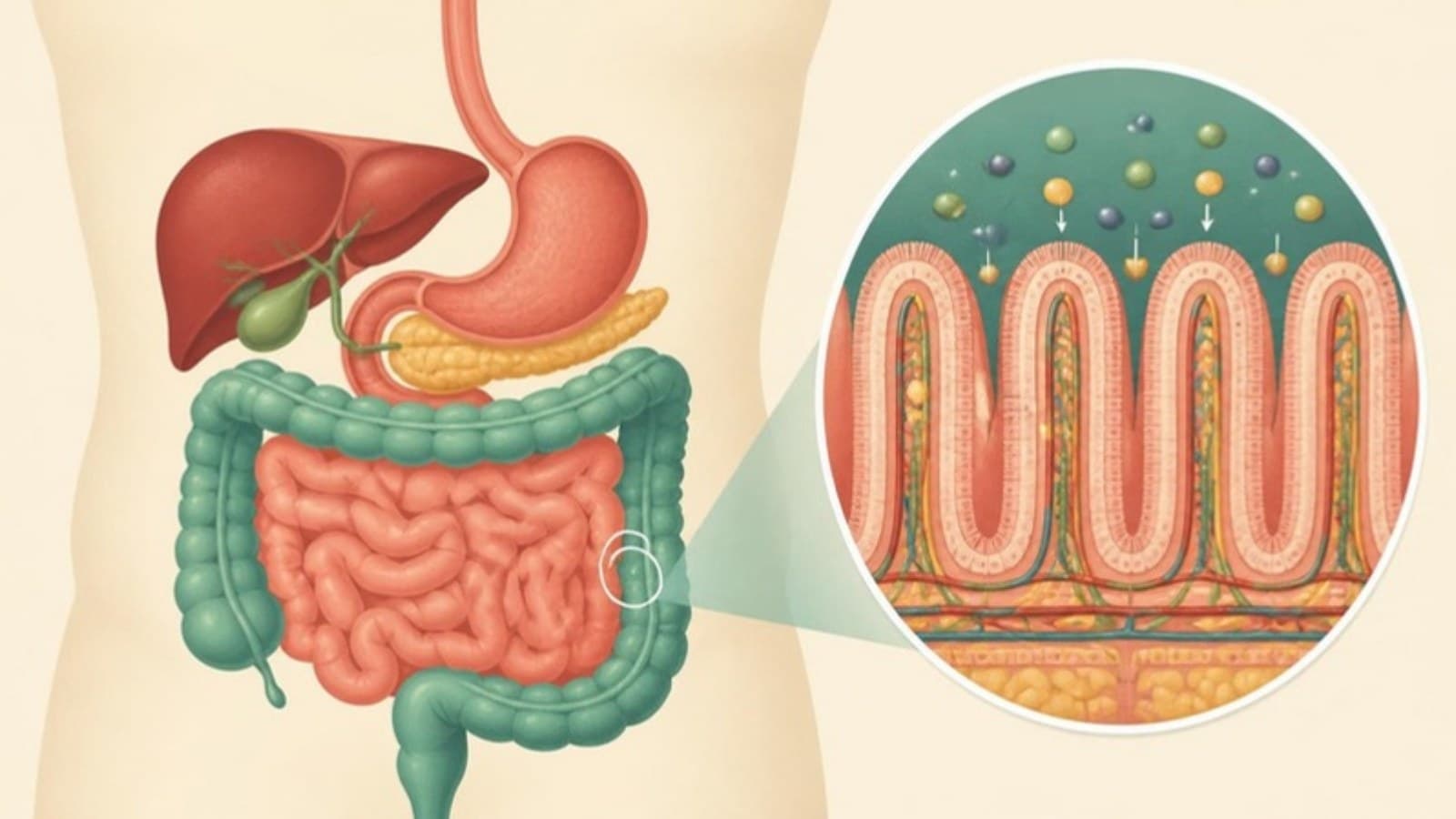
Alimentary Canal: Mouth → Pharynx → Esophagus → Stomach → Small intestine → Large intestine → Rectum → Anus
Associated Glands: Salivary glands, Liver, Pancreas
Structures:
Dental Formula:
Types of Teeth:
| Type | Function | Shape |
|---|---|---|
| Incisors (8) | Cutting | Chisel-shaped |
| Canines (4) | Tearing | Pointed |
| Premolars (8) | Crushing | Flat crown |
| Molars (12) | Grinding | Broad crown |
Shape: J-shaped muscular organ
Regions:
| Region | Location | Function |
|---|---|---|
| Cardiac | Near esophagus | Entry of food |
| Fundus | Upper dome | Temporary storage |
| Body | Main part | Mixing, churning |
| Pyloric | Near small intestine | Controlled release |
Gastric Glands (Types of Cells):
| Cell Type | Secretion | Function |
|---|---|---|
| Mucous cells | Mucus | Protects stomach lining |
| Parietal (Oxyntic) | HCl, Intrinsic factor | Activates pepsinogen, kills bacteria |
| Chief (Peptic/Zymogenic) | Pepsinogen | Protein digestion (as pepsin) |
| G cells | Gastrin | Stimulates gastric secretion |
Gastric Juice Composition:
Length: ~6 meters (longest part of alimentary canal)
Three Parts:
| Part | Length | Function |
|---|---|---|
| Duodenum | ~25 cm | Receives bile and pancreatic juice |
| Jejunum | ~2.5 m | Major digestion and absorption |
| Ileum | ~3.5 m | Absorption, especially B12 |
Intestinal Glands:
Length: ~1.5 meters
Parts: Caecum → Colon (ascending, transverse, descending, sigmoid) → Rectum → Anus
Functions:
Vermiform Appendix:
| Gland | Location | Secretion |
|---|---|---|
| Parotid | Below ear | Serous (watery, amylase-rich) |
| Submandibular | Below jaw | Mixed |
| Sublingual | Below tongue | Mucous |
Saliva Composition:
Weight: ~1.5 kg
Functions:
Bile:
Bile Composition:
| Component | Function |
|---|---|
| Bile salts | Emulsification of fats |
| Bile pigments | Bilirubin, biliverdin (waste) |
| Cholesterol | Excretion |
| Phospholipids | Emulsification |
NEET Important: Bile emulsifies fats (breaks into smaller droplets) but does NOT digest them. Lipase digests fats.
Type: Both exocrine and endocrine
Exocrine Function (Digestive):
Pancreatic Enzymes:
| Enzyme | Substrate | Product |
|---|---|---|
| Trypsinogen (→ Trypsin) | Proteins | Peptides |
| Chymotrypsinogen (→ Chymotrypsin) | Proteins | Peptides |
| Procarboxypeptidase (→ Carboxypeptidase) | Peptides | Amino acids |
| Pancreatic amylase | Starch | Maltose |
| Pancreatic lipase | Fats | Fatty acids + Glycerol |
| Nucleases | Nucleic acids | Nucleotides |
Activation: Trypsinogen → Trypsin (by enterokinase from intestine) Then trypsin activates other zymogens.
| Nutrient | Enzyme | Product |
|---|---|---|
| Starch | Salivary amylase | Maltose + Dextrins |
| (30% digested in mouth) |
| Nutrient | Enzyme | Product |
|---|---|---|
| Proteins | Pepsin | Proteoses, Peptones |
| Milk casein | Rennin | Calcium paracaseinate |
| Fats | Gastric lipase | Fatty acids (minor) |
Complete digestion occurs here.
| Nutrient | Source | Enzyme | Final Product |
|---|---|---|---|
| Starch | Pancreatic amylase | Amylase | Maltose |
| Maltose | Intestinal juice | Maltase | Glucose |
| Sucrose | Intestinal juice | Sucrase | Glucose + Fructose |
| Lactose | Intestinal juice | Lactase | Glucose + Galactose |
| Proteins | Pancreas | Trypsin, Chymotrypsin | Peptides |
| Peptides | Intestine | Peptidases | Amino acids |
| Fats | Pancreas | Lipase | Fatty acids + Glycerol |
| Nucleic acids | Pancreas | Nucleases | Nucleotides |
| Nucleotides | Intestine | Nucleotidases | Sugars + Bases + PO₄ |
| Substance | Primary Site |
|---|---|
| Glucose, amino acids | Small intestine (jejunum, ileum) |
| Fatty acids | Small intestine (via lacteals) |
| Vitamin B12 | Terminal ileum |
| Water | Large intestine |
| Alcohol | Stomach |
| Drugs | Stomach |
Practice break
Reading is prep. Practising is progress.
Free to try · replies within a few hours on WhatsApp
| Mechanism | Substances | Energy Required |
|---|---|---|
| Passive diffusion | Water, small molecules | No |
| Facilitated diffusion | Fructose | No |
| Active transport | Glucose, amino acids, Na⁺ | Yes (ATP) |
Carbohydrates:
Proteins:
Fats:
Water and Electrolytes:
| Feature | Increase in Surface Area |
|---|---|
| Length (~6 m) | Base surface area |
| Circular folds (plicae) | 3× |
| Villi | 10× |
| Microvilli | 20× |
| Total | ~600× (~250 m²) |
Villi Structure:
| Hormone | Source | Stimulus | Action |
|---|---|---|---|
| Gastrin | Stomach (G cells) | Food in stomach | ↑ HCl secretion |
| Secretin | Duodenum | Acid chyme | ↑ Pancreatic bicarbonate |
| CCK (Cholecystokinin) | Duodenum | Fat, protein | ↑ Bile release, ↑ Pancreatic enzymes |
| GIP | Duodenum | Glucose, fat | ↓ Gastric secretion, ↑ Insulin |
| Disorder | Cause | Symptoms |
|---|---|---|
| GERD (Acid reflux) | Weak LES | Heartburn |
| Peptic ulcer | H. pylori, NSAIDs | Stomach pain, bleeding |
| Jaundice | Liver dysfunction, bile duct obstruction | Yellow skin, dark urine |
| Constipation | Low fiber, dehydration | Infrequent bowel movements |
| Diarrhea | Infection, food poisoning | Frequent loose stools |
| Lactose intolerance | Lactase deficiency | Bloating, gas after milk |
Q1 (NEET 2023): Which of the following enzymes is secreted by stomach?
Q2 (NEET 2022): Emulsification of fat is done by:
Q3 (NEET 2021): Intrinsic factor for B12 absorption is secreted by:
Q4 (NEET 2020): Enterokinase converts:
Q5 (NEET 2019): The absorbed fatty acids are transported as:
Q: Why doesn't the stomach digest itself? A: The stomach is protected by: (1) thick mucus layer secreted by mucous cells, (2) bicarbonate ions in mucus neutralizing acid, and (3) rapid cell turnover replacing damaged cells.
Q: Why is bile important even without enzymes? A: Bile salts emulsify fats into smaller droplets, increasing surface area for lipase action. Without bile, fat digestion is severely impaired.
Q: What is the role of HCl in digestion? A: HCl (1) activates pepsinogen to pepsin, (2) provides optimal pH for pepsin (1.5-2.5), (3) kills most bacteria, and (4) denatures proteins making them easier to digest.
Q: Why are fats absorbed differently from carbohydrates and proteins? A: Fatty acids and glycerol are hydrophobic. They form chylomicrons (lipoprotein particles) that are too large to enter blood capillaries directly, so they enter lacteals (lymphatic vessels) first.
Q: What causes lactose intolerance? A: Lactose intolerance occurs due to deficiency of lactase enzyme. Undigested lactose passes to the large intestine where bacteria ferment it, producing gas and causing bloating, cramps, and diarrhea.
This chapter has more enzyme-secretion pairs than almost any other, and NEET likes testing them as straight recall. Message us on WhatsApp at +91 88264 44334 with the pairing you keep mixing up, and we'll send you the exact table NEET has drawn questions from.
Related reading: Human Physiology Complete Notes · Breathing and Exchange of Gases Notes · Class 11 Biology Coaching
Related resources

About the author
Dr. Shekhar C. Singh
AIIMS New Delhi alumnus who has taught biology since 2014, from NCERT foundations to the International Biology Olympiad.
Read his full profile →Get personalized guidance from AIIMS experts and achieve your medical college dreams
More from the blog
Master Excretion for NEET 2026 with comprehensive notes on kidney structure, nephron function, urine formation, and regulation. NCERT-aligned content with diagrams and PYQs.
12 Jun 2026
Master Biomolecules for NEET 2026 with detailed notes on carbohydrates, proteins, lipids, nucleic acids, and enzymes. NCERT-aligned content with diagrams and previous year questions.
12 Jan 2026
Master Body Fluids and Circulation for NEET 2026 with comprehensive notes on blood, heart, cardiac cycle, ECG, and circulatory system. NCERT-aligned content with diagrams and PYQs.
12 Jan 2026
Share your thoughts, ask a question, or help another student
Type it below and send it to us on WhatsApp — no sign-up needed.
For NEET Biology, aim for 3-4 hours of focused study daily. Quality matters more than quantity!
Yes! NCERT covers 95% of NEET Biology questions. Master it completely before any reference book.
Human Physiology (20%), Genetics (18%), and Ecology (12%) are the highest-scoring areas.
Need personalized guidance?