Loading...
Loading...
Master Body Fluids and Circulation for NEET 2026 with comprehensive notes on blood, heart, cardiac cycle, ECG, and circulatory system. NCERT-aligned content with diagrams and PYQs.

5 points to remember for NEET
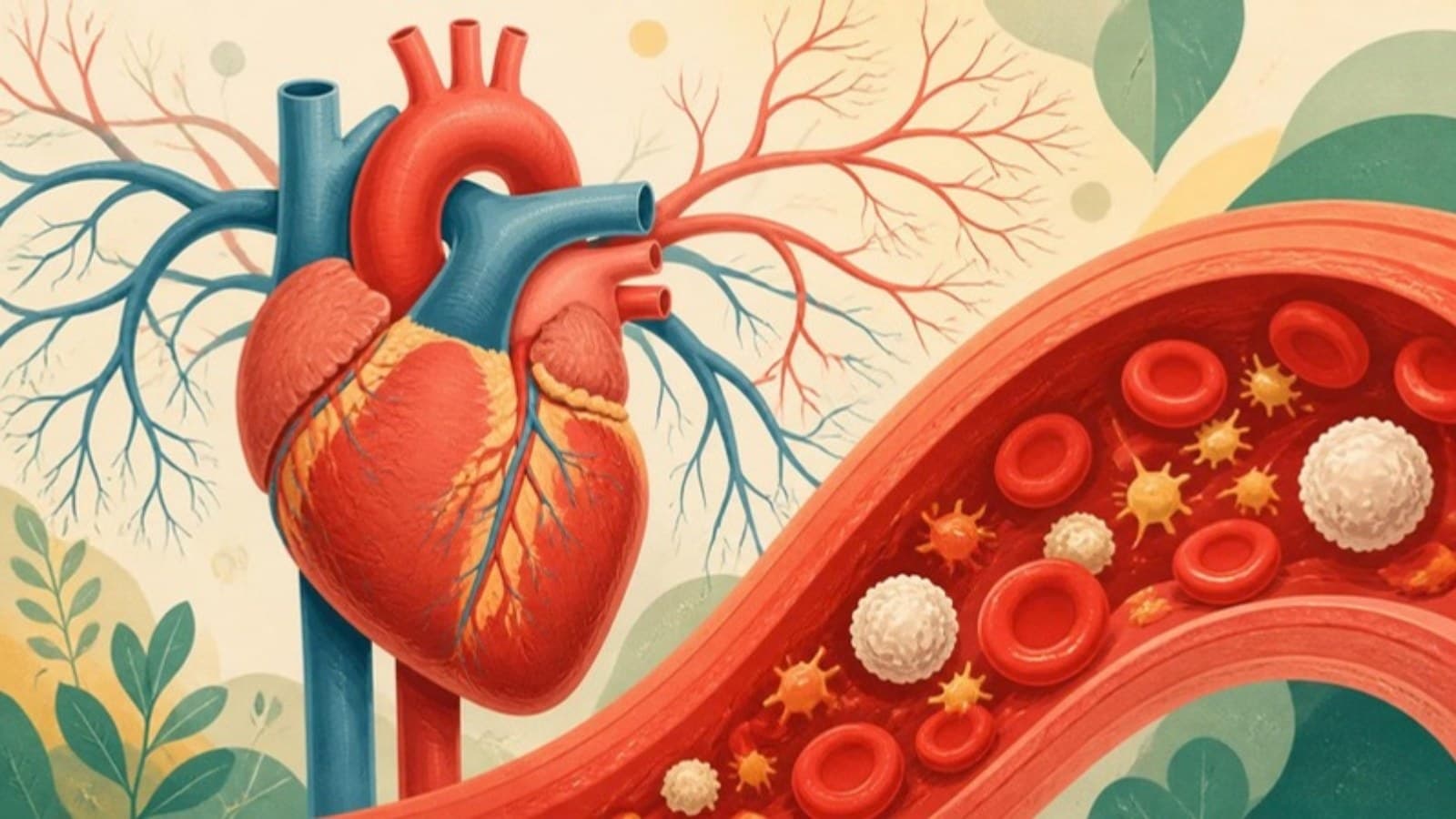
Body Fluids and Circulation is one of the most important chapters in Human Physiology, contributing 5-7 questions in NEET annually. This comprehensive guide covers all NCERT concepts.
| Fluid | Location | Function |
|---|---|---|
| Blood | Cardiovascular system | Transport, defense, regulation |
| Lymph | Lymphatic system | Immunity, fat absorption |
| Tissue fluid | Between cells | Nutrient/waste exchange |
Blood = Plasma (55%) + Formed Elements (45%)
Composition:
Plasma Proteins:
| Protein | Percentage | Function |
|---|---|---|
| Albumin | 60% | Osmotic pressure, transport |
| Globulins | 35% | Immunity (γ), transport (α, β) |
| Fibrinogen | 4% | Blood clotting |
| Prothrombin | <1% | Blood clotting |
Serum = Plasma - Clotting factors (Fibrinogen)
| Feature | Description |
|---|---|
| Shape | Biconcave disc |
| Nucleus | Absent (in mammals) |
| Count | 5-5.5 million/μL (males), 4.5-5 million/μL (females) |
| Lifespan | 120 days |
| Formation | Red bone marrow (Erythropoiesis) |
| Destruction | Spleen (graveyard of RBCs) |
| Contains | Hemoglobin (~270 million/RBC) |
Hemoglobin:
Erythropoiesis regulation: Hypoxia → Kidney releases Erythropoietin → ↑ RBC production
Count: 6,000-8,000/μL
Types:
| Type | Percentage | Nucleus | Granules | Function |
|---|---|---|---|---|
| Granulocytes | ||||
| Neutrophils | 60-65% | Multi-lobed | Fine, light | Phagocytosis (bacteria) |
| Eosinophils | 2-3% | Bi-lobed | Coarse, red | Parasites, allergies |
| Basophils | 0.5-1% | S-shaped | Large, blue | Histamine, heparin |
| Agranulocytes | ||||
| Lymphocytes | 20-25% | Round, large | None | Immunity (B and T cells) |
| Monocytes | 6-8% | Kidney-shaped | None | Phagocytosis (→ macrophages) |
Mnemonic: Never Let Monkeys Eat Bananas (Neutrophils, Lymphocytes, Monocytes, Eosinophils, Basophils - decreasing order)
| Feature | Description |
|---|---|
| Shape | Irregular fragments |
| Nucleus | Absent |
| Count | 1.5-3.5 lakh/μL |
| Lifespan | 8-10 days |
| Origin | Megakaryocytes in bone marrow |
| Function | Blood clotting |
| Blood Group | Antigen on RBC | Antibody in Plasma | Can Donate To | Can Receive From |
|---|---|---|---|---|
| A | A | Anti-B | A, AB | A, O |
| B | B | Anti-A | B, AB | B, O |
| AB | A and B | None | AB only | All (Universal recipient) |
| O | None | Anti-A, Anti-B | All (Universal donor) | O only |
Erythroblastosis fetalis: Rh- mother + Rh+ fetus → Mother develops anti-Rh antibodies → Destroys fetal RBCs in subsequent Rh+ pregnancies
Three Stages:
Formation of Thromboplastin:
Formation of Thrombin: Prothrombin → Thrombin (by Thromboplastin + Ca²⁺)
Formation of Fibrin: Fibrinogen → Fibrin (by Thrombin) Fibrin mesh traps blood cells → Clot
Anticoagulants:
Composition: Similar to blood but lacks RBCs and most proteins
Functions:
| Type | Organism | Characteristics |
|---|---|---|
| Open | Arthropods, Molluscs | Blood bathes organs directly |
| Closed | Annelids, Vertebrates | Blood flows in vessels |
Blood passes through heart twice per complete circuit:
| Chamber | Receives Blood From | Sends Blood To |
|---|---|---|
| Right Atrium | Superior & Inferior Vena Cava | Right Ventricle |
| Right Ventricle | Right Atrium | Pulmonary Artery |
| Left Atrium | Pulmonary Veins (4) | Left Ventricle |
| Left Ventricle | Left Atrium | Aorta |
Wall Thickness: Left ventricle > Right ventricle > Atria
| Valve | Location | Function |
|---|---|---|
| Tricuspid | RA-RV junction | Prevents backflow to RA |
| Bicuspid (Mitral) | LA-LV junction | Prevents backflow to LA |
| Pulmonary semilunar | RV-Pulmonary artery | Prevents backflow to RV |
| Aortic semilunar | LV-Aorta | Prevents backflow to LV |
Components (in order of conduction):
SA Node (Sinoatrial Node)
AV Node (Atrioventricular Node)
Bundle of His (AV Bundle)
Purkinje Fibers
Autorhythmicity: Heart can generate its own impulses (no nerve required)
Definition: Sequence of events from one heartbeat to the next
Duration: 0.8 seconds (at 75 beats/min)
| Phase | Duration | Events |
|---|---|---|
| Atrial systole | 0.1 s | Atria contract, AV valves open, blood enters ventricles |
| Ventricular systole | 0.3 s | Ventricles contract, AV valves close, semilunar valves open |
| Joint diastole | 0.4 s | All chambers relax, semilunar valves close, blood fills atria |
Practice break
Reading is prep. Practising is progress.
Free to try · replies within a few hours on WhatsApp
End Diastolic Volume (EDV): ~120 mL (blood in ventricle after filling) End Systolic Volume (ESV): ~50 mL (blood remaining after ejection) Stroke Volume (SV): EDV - ESV = 70 mL
Cardiac Output = Heart Rate × Stroke Volume = 75 × 70 = 5250 mL/min ≈ 5 L/min
| Sound | Cause | Phase |
|---|---|---|
| First (Lub) | AV valves closing | Start of ventricular systole |
| Second (Dub) | Semilunar valves closing | Start of diastole |
Definition: Graphical record of electrical activity of heart
| Component | Represents | Duration |
|---|---|---|
| P wave | Atrial depolarization | 0.08 s |
| QRS complex | Ventricular depolarization | 0.08 s |
| T wave | Ventricular repolarization | 0.16 s |
| PR interval | AV conduction time | 0.12-0.2 s |
| QT interval | Ventricular activity | 0.4 s |
Note: Atrial repolarization is hidden within QRS complex
| Abnormality | Indication |
|---|---|
| Prolonged PR interval | AV block |
| Wide QRS | Bundle branch block |
| ST elevation | Myocardial infarction |
| Irregular rhythm | Arrhythmia |
| Nerve | Effect | Neurotransmitter |
|---|---|---|
| Vagus (Parasympathetic) | ↓ Heart rate | Acetylcholine |
| Sympathetic | ↑ Heart rate, ↑ Force | Norepinephrine |
| Hormone | Effect |
|---|---|
| Adrenaline | ↑ Heart rate, ↑ Force |
| Thyroxine | ↑ Heart rate |
| Vessel | Wall Structure | Function |
|---|---|---|
| Arteries | Thick, elastic, muscular | Carry blood away from heart |
| Veins | Thin, less muscular, have valves | Carry blood to heart |
| Capillaries | Single layer endothelium | Exchange of materials |
Normal: 120/80 mm Hg (Systolic/Diastolic)
| Condition | Systolic | Diastolic |
|---|---|---|
| Normal | <120 | <80 |
| Hypertension | >140 | >90 |
| Hypotension | <90 | <60 |
| Disorder | Description |
|---|---|
| Atherosclerosis | Plaque buildup in arteries |
| Angina pectoris | Chest pain due to reduced heart blood supply |
| Heart attack (MI) | Death of heart muscle due to blocked coronary artery |
| Heart failure | Heart unable to pump adequately |
| Hypertension | High blood pressure |
Q1 (NEET 2023): The pacemaker of heart is:
Q2 (NEET 2022): Which blood group is called universal donor?
Q3 (NEET 2021): The QRS complex in ECG represents:
Q4 (NEET 2020): Cardiac output is:
Q5 (NEET 2019): "Lub" sound is produced by:
Q: Why is SA node called the pacemaker? A: SA node generates impulses at the highest rate (70-75/min) among all conducting tissues. It sets the rhythm for the entire heart, hence called the pacemaker.
Q: Why is left ventricle wall thicker than right ventricle? A: Left ventricle pumps blood to the entire body (systemic circulation) against higher resistance, requiring more force. Right ventricle only pumps to nearby lungs (pulmonary circulation) at lower pressure.
Q: What happens if the AV node fails? A: If SA node fails, AV node can take over as pacemaker (at 40-60 beats/min). If AV node also fails, Purkinje fibers can maintain a very slow rhythm (25-40/min), but this is not sustainable.
Q: Why do arteries not have valves but veins do? A: Arteries receive high-pressure blood directly from the heart, which maintains unidirectional flow. Veins carry low-pressure blood against gravity (especially from legs), so valves prevent backflow.
Q: What is the significance of the delay at AV node? A: The 0.1-second delay allows complete atrial contraction and ventricular filling before ventricles contract. Without this delay, atria and ventricles would contract simultaneously, reducing cardiac efficiency.
The numbers in this chapter — cardiac cycle duration, the AV node delay, ECG wave intervals — are where most marks are lost or won. Message us on WhatsApp at +91 88264 44334 with a cardiac cycle or ECG question you got wrong, and we'll walk through where the confusion actually is.
Related reading: Breathing and Exchange of Gases Notes · Human Physiology Complete Notes · Class 11 Biology Coaching
Related resources

About the author
Dr. Shekhar C. Singh
AIIMS New Delhi alumnus who has taught biology since 2014, from NCERT foundations to the International Biology Olympiad.
Read his full profile →Get personalized guidance from AIIMS experts and achieve your medical college dreams
More from the blog
Master Excretion for NEET 2026 with comprehensive notes on kidney structure, nephron function, urine formation, and regulation. NCERT-aligned content with diagrams and PYQs.
12 Jun 2026
Master Digestion and Absorption for NEET 2026 with comprehensive notes on digestive system, enzymes, absorption mechanisms, and digestive disorders. NCERT-aligned content with diagrams and PYQs.
12 Jun 2026
Master Respiration for NEET 2026 with comprehensive notes on respiratory system, mechanism of breathing, gas exchange, and transport of gases. NCERT-aligned content with diagrams and PYQs.
12 Jan 2026
Share your thoughts, ask a question, or help another student
Type it below and send it to us on WhatsApp — no sign-up needed.
For NEET Biology, aim for 3-4 hours of focused study daily. Quality matters more than quantity!
Yes! NCERT covers 95% of NEET Biology questions. Master it completely before any reference book.
Human Physiology (20%), Genetics (18%), and Ecology (12%) are the highest-scoring areas.
Need personalized guidance?