Loading...
Loading...
Complete photosynthesis guide for NEET 2026. Learn light reactions, Calvin cycle, C3/C4/CAM plants, photorespiration, and practice with 10 original MCQs. Analysis of 15 previous year questions included.

5 points to remember for NEET
Guaranteed Marks: 3-5 marks every single NEET exam for last 10 years
Question Types:
Common Misconceptions: 50% of students get photosynthesis questions wrong due to:
This Guide Covers:
Master this chapter → Guaranteed 18-20/20 marks potential
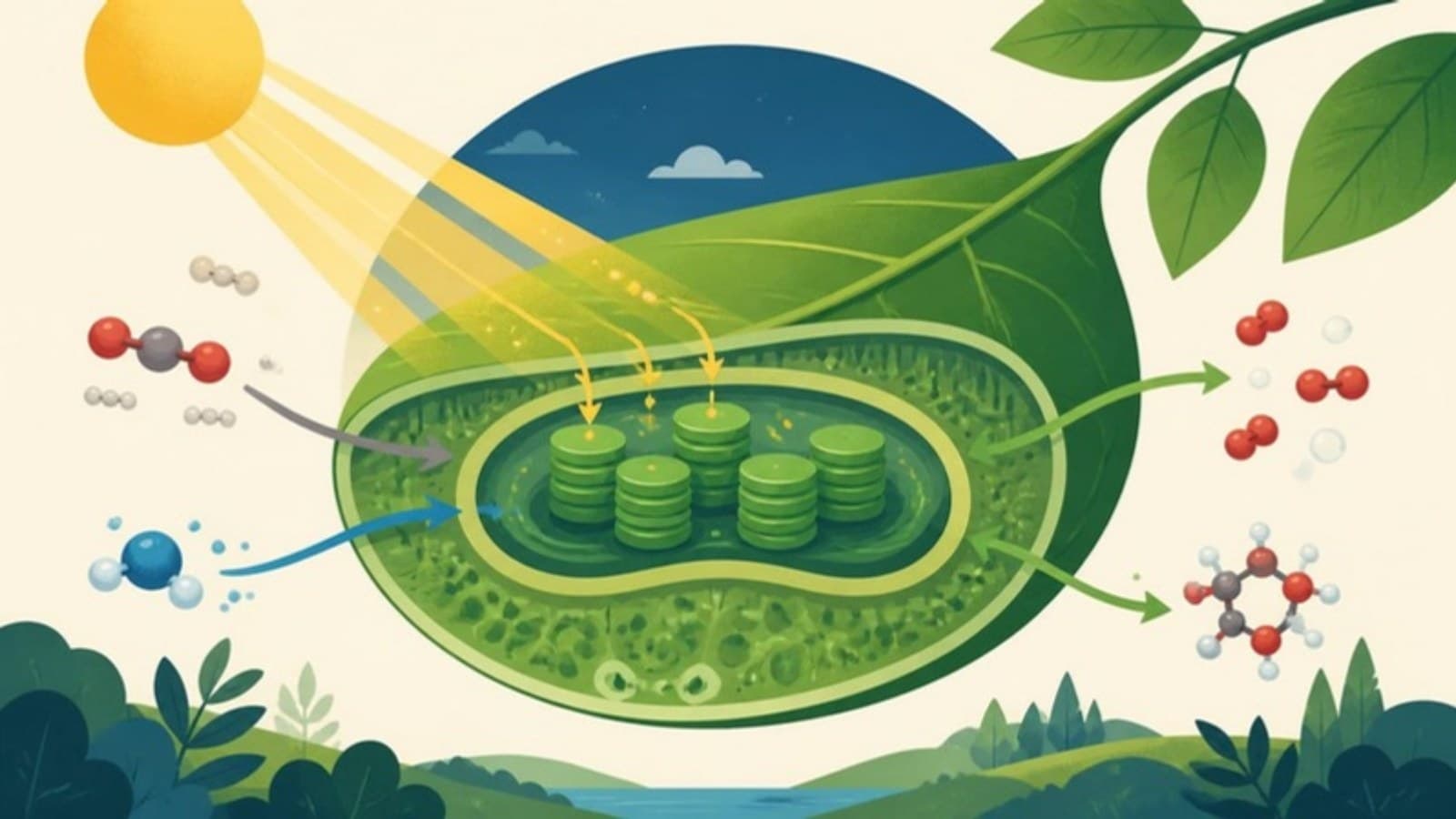
Photosynthesis is the process by which green plants, algae, and some bacteria capture light energy and convert it into chemical energy (ATP and NADPH), which is then used to synthesize organic compounds (glucose) from inorganic raw materials (CO₂ and H₂O).
6CO₂ + 6H₂O + light energy → C₆H₁₂O₆ + 6O₂
| Location | Organelle | Light/Dark Reaction |
|---|---|---|
| Leaves | Chloroplasts | Both |
| Green stems | Chloroplasts | Both |
| Algae | Chloroplasts | Both |
| Cyanobacteria | Thylakoid membranes | Both |
| Bacteria (photosynthetic) | Chromatophores | Light reactions only |
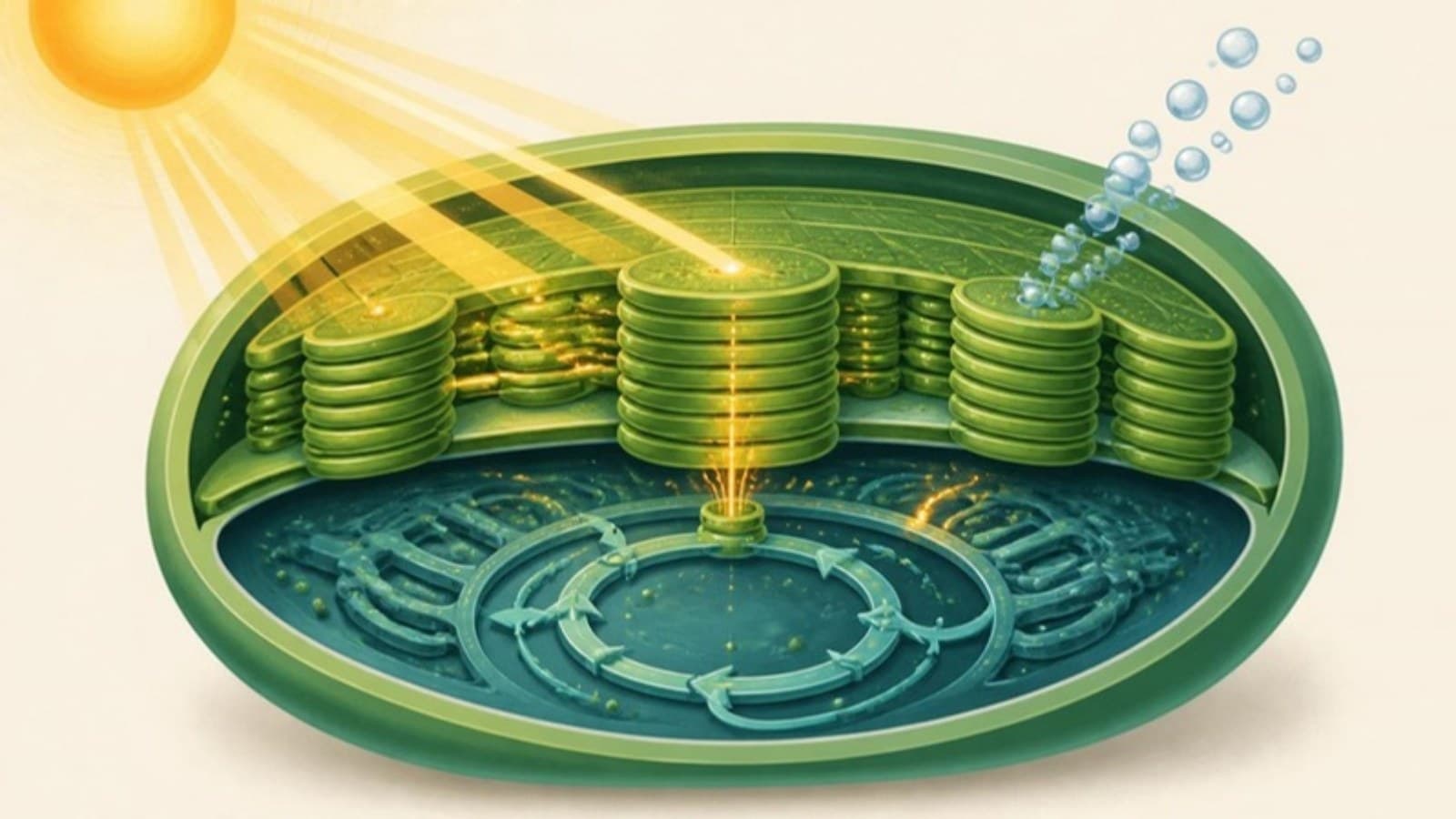
Critical Detail: Even though photosynthesis occurs in leaves, the primary location is the chloroplast, specifically:
| Phase | Light Requirement | Location | Products | Duration |
|---|---|---|---|---|
| Light Reactions | Requires light | Thylakoid membrane | ATP, NADPH, O₂ | <1 second |
| Dark Reactions | No light needed | Stroma | Glucose, other organic compounds | Several minutes |
Key Concept: "Dark" reactions don't mean they occur in darkness. They can occur in light or dark; they simply don't directly require light energy (they use ATP and NADPH from light reactions).
Light reactions are the light-dependent phase where light energy is captured and converted into chemical energy (ATP and NADPH).
Light + Water + NADP+ + ADP + Pi
→ ATP + NADPH + O₂ (released)
1. Chlorophyll Pigments
| Pigment | Color | Function |
|---|---|---|
| Chlorophyll a | Blue-green | Main light-absorbing pigment (reaction center) |
| Chlorophyll b | Yellow-green | Accessory pigment, transfers energy |
| Xanthophyll | Yellow | Accessory pigment |
| Carotenoid | Orange-yellow | Accessory pigment, photoprotection |
Absorption spectrum: Chlorophyll absorbs light at 400-450 nm (blue) and 620-680 nm (red). Green light (500-600 nm) is mostly reflected (why plants appear green).
2. Photosystem II (PSII)
| Component | Function |
|---|---|
| Reaction Center (P680) | Absorbs photon, electron excitation |
| Water-Splitting Complex | Splits water (photolysis) into H⁺, O₂, electrons |
| Antenna Complex | Collects photons, transfers energy to reaction center |
Function: Water splitting and electron release
Equation: 2H₂O + light → 4H⁺ + 4e⁻ + O₂
3. Electron Transport Chain (ETC)
| Carrier | Function |
|---|---|
| Plastoquinone (PQ) | Carries electrons from PSII to cytochrome b₆f |
| Cytochrome b₆f complex | Pumps H⁺ into thylakoid lumen, electron transfer |
| Plastocyanin (PC) | Carries electrons from cyt b₆f to PSI |
Function: Pumps H⁺ ions creating a gradient for ATP synthesis
4. Photosystem I (PSI)
| Component | Function |
|---|---|
| Reaction Center (P700) | Absorbs photon (700 nm), electron excitation |
| NADP⁺ Reductase | Reduces NADP⁺ to NADPH |
| Ferredoxin | Electron carrier from PSI to NADP⁺ reductase |
Function: Reduces NADP⁺ to NADPH
5. ATP Synthase
| Component | Function |
|---|---|
| F₀ subunit | Channel for H⁺ across thylakoid membrane |
| F₁ subunit | Catalyzes ATP synthesis from ADP + Pi |
Function: Uses H⁺ gradient to phosphorylate ADP to ATP
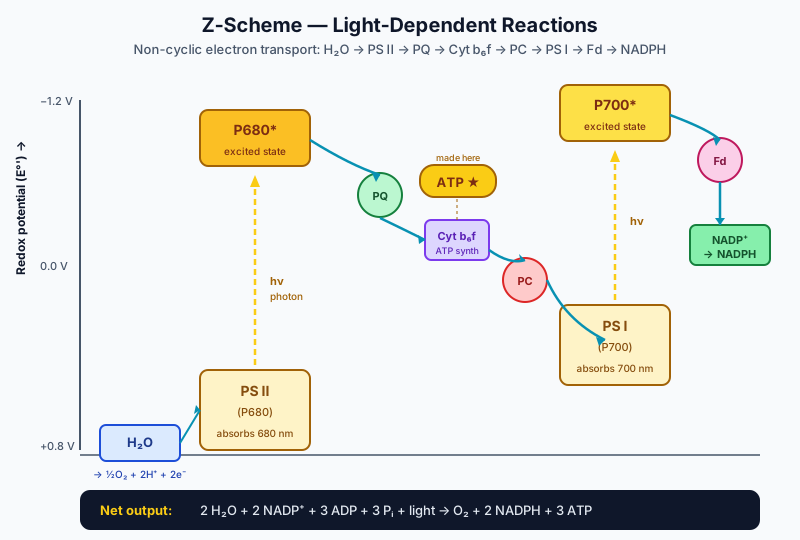
The Z-scheme (also called Jablonski diagram) shows how electrons flow from water through PSII → ETC → PSI → NADP⁺.
Why "Z" Shape:
Reading the Z-Scheme:
                    PSI Photon
                       ↓
        P700 (High energy)
             ↙           ↖
    NADP⁺ + 2e⁻ → NADPH


    Cytochrome b₆f
         ↑
    ETC (H⁺ pumping)
         ↑
    PSII Photon
         ↓
    P680 (High energy)
         ↓
    Water splitting
    2H₂O → 4H⁺ + O₂ + 4e⁻
Critical Details:
Definition: Electron flow from water through both photosystems (PSII and PSI) producing both ATP and NADPH.
Steps:
Step 1: H₂O → O₂ + 4H⁺ + 4e⁻ (at PSII)
Step 2: Electrons from water reach P680 (reaction center of PSII)
Step 3: Photon absorbed by P680 → electrons excited to higher energy
Step 4: Excited electrons move through electron transport chain (PQ → cyt b₆f → PC)
Step 5: H⁺ pumped into thylakoid lumen during ETC → H⁺ gradient
Step 6: Electrons reach P700 (reaction center of PSI)
Step 7: Photon absorbed by P700 → electrons excited to higher energy
Step 8: Excited electrons move through ferredoxin
Step 9: Electrons reduce NADP⁺ → NADPH (at NADP⁺ reductase)
Step 10: H⁺ gradient drives ATP synthase → ADP + Pi → ATP
Products: 1 NADPH and ~1 ATP per 2 photons absorbed
Equation:
2H₂O + 2NADP⁺ + 3ADP + 3Pi + light
→ O₂ + 2NADPH + 3ATP
Definition: Only PSI is active; electrons recycle without producing NADPH or releasing O₂; produces only ATP.
When It Occurs:
Steps:
Step 1: P700 absorbs photon → electrons excited
Step 2: Excited electrons move through ETC (PQ → cyt b₆f → PC)
Step 3: H⁺ pumped into thylakoid lumen (same as non-cyclic)
Step 4: Electrons return to P700 (hence "cyclic")
Step 5: H⁺ gradient drives ATP synthesis
Products: Only ATP (no NADPH, no O₂)
Ratio: Cyclic phosphorylation produces ~1 ATP per photon
Equation:
ADP + Pi + light → ATP + H₂O
| Feature | Cyclic | Non-Cyclic |
|---|---|---|
| Photosystems Involved | PSI only | PSII + PSI |
| Water Splitting | No | Yes |
| O₂ Released | No | Yes |
| NADPH Produced | No | Yes |
| ATP Produced | Yes | Yes |
| Electron Flow | Circular (recycled) | Linear (water → NADP⁺) |
| When It Occurs | When NADP⁺ is limiting | Main daytime reaction |
| Proportion in Day | ~20% of light reactions | ~80% of light reactions |
| Energy Efficiency | Less efficient | More efficient |
| Organisms | Bacteria mainly | All photosynthetic organisms |
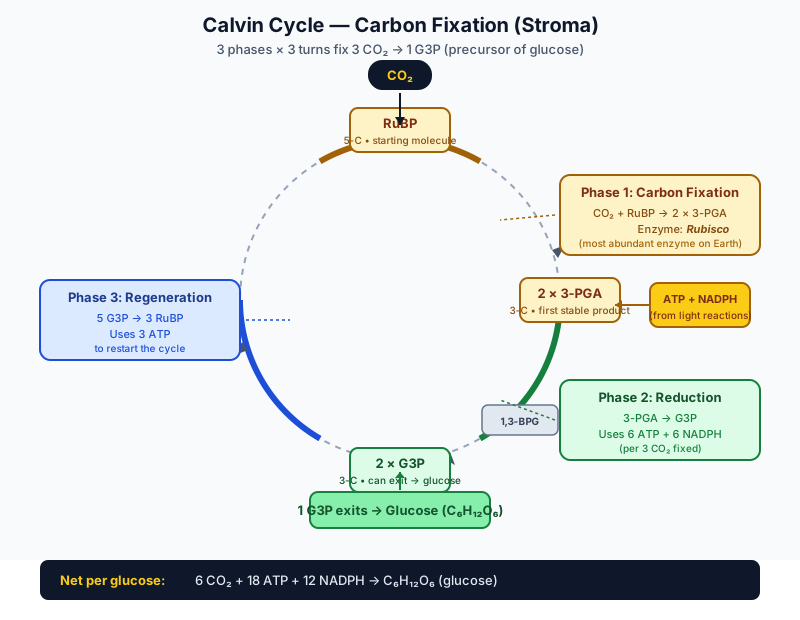
Definition: Light-independent reactions where ATP and NADPH (from light reactions) are used to fix CO₂ and synthesize glucose. Occur in chloroplast stroma.
Why "Dark"? These reactions don't require light directly. They were discovered by studying photosynthesis in dark conditions; CO₂ was still fixed using stored ATP. In actual sunlight, dark reactions run during the day using light-reaction products.
Overall Equation:
3CO₂ + 9ATP + 6NADPH + 6H⁺
→ 1 Glucose (C₆) + 9ADP + 8Pi + 6NADP⁺ + 6H₂O
Key Insight: 3 CO₂ molecules are needed to make 1 glucose (6 carbons), because each CO₂ is only 1 carbon.
The Calvin Cycle requires 3 turns to fix 3 CO₂ molecules and produce 1 glucose precursor.
Phases:
Reactants: 1 CO₂ + 3ATP + 2NADPH
Products: 1 G3P (3-carbon sugar) + 3ADP + 2NADP⁺
Step-by-Step Process:
Step 1: CO₂ combines with RuBP (5-carbon sugar)
        CO₂ + RuBP → Unstable 6-carbon intermediate

Step 2: Intermediate breaks into 2 molecules of 3-PG (3-phosphoglycerate)
        Enzyme: RuBisCO (Ribulose-1,5-bisphosphate carboxylase/oxygenase)

Reaction: 1CO₂ + 1RuBP → 2 x 3-PG
Critical Detail: RuBisCO is the most abundant protein on Earth (30% of total leaf protein). It's a huge enzyme with low catalytic rate, which is why plants need so much of it.
Step 3: 3-PG phosphorylated using ATP
        2 x 3-PG + 2ATP → 2 x 1,3-bisphosphoglycerate + 2ADP

Step 4: 1,3-bisphosphoglycerate reduced using NADPH
        2 x 1,3-bisphosphoglycerate + 2NADPH
        → 2 x G3P (glyceraldehyde-3-phosphate) + 2NADP⁺

Energy: Uses 2 ATP and 2 NADPH per 2 x 3-PG (per 1 CO₂ fixed)
Products:
Step 5: 1 G3P exits cycle

Step 6: Remaining 1 G3P (3C) regenerates RuBP (5C)
        Using the 3 carbons through series of reactions
        Requires 1 ATP

Summary: 3G3P (9C total) → 2 RuBP (10C) + (1C exits)
Enzyme: Regeneration involves multiple enzymes (aldolase, transketolase, etc.)
To make 1 glucose (6 carbons), the Calvin Cycle must turn 3 times:
| Turn | CO₂ Fixed | RuBP Regenerated | G3P Produced | ATP Used | NADPH Used |
|---|---|---|---|---|---|
| 1 | 1 | 1 | 1 (exits) | 3 | 2 |
| 2 | 1 | 1 | 1 (exits) | 3 | 2 |
| 3 | 1 | 1 | 1 (exits) | 3 | 2 |
| Total for 1 Glucose | 3 | 3 | 3 exit | 9 | 6 |
Summary Equation (for 3 cycles):
3CO₂ + 9ATP + 6NADPH
→ 1 Glucose (C₆H₁₂O₆) + 9ADP + 8Pi + 6NADP⁺ + 6H₂O
The Calvin Cycle is tightly regulated to match light-reaction ATP and NADPH production:
| Enzyme | Regulation |
|---|---|
| RuBisCO | Inhibited in dark; activated by light-produced ATP and Mg²⁺ |
| 3-PG kinase | Activated by ATP |
| G3P dehydrogenase | Activated by NADPH |
Why Important: This ensures glucose is made only when light reactions are producing ATP and NADPH, preventing futile cycling.
This is one of the most frequently asked topics in NEET (2-3 marks guaranteed).
C3 Plants: First stable compound in photosynthesis is 3-phosphoglycerate (3-PG), a 3-carbon compound
C4 Plants: First stable compound is oxaloacetate (OAA), a 4-carbon compound
Occurs in: Most plants (rice, wheat, cotton, potato, tobacco, sunflower)
Location: Single type of photosynthetic cell
First Fixation:
CO₂ + RuBP → 2 x 3-PG (via RuBisCO)
Calvin Cycle: Follows standard 3-phase cycle
CO₂ Compensation Point: 50-150 ppm (relatively high)
Light Compensation Point: High light required for saturation
Photorespiration: High rate (15-25% of gross photosynthesis lost)
Efficiency: Lower in hot, dry conditions
Stomatal Conductance: Higher (more open stomata)
WUE (Water Use Efficiency): Low to moderate
Occurs in: Corn, sugarcane, maize, sorghum, millet, cactus, many tropical grasses
Location: Two cell types:
First Fixation (in Mesophyll Cell):
CO₂ + PEP (phosphoenolpyruvate) → Oxaloacetate (4C)
Enzyme: PEP carboxylase (very efficient, high affinity for CO₂)
CO₂ Transport:
Oxaloacetate → Malate (via reduction with NADPH)
OR
Oxaloacetate → Aspartate (via transamination)

Malate/Aspartate transported to bundle sheath cell
In Bundle Sheath Cell:
Malate/Aspartate → Released CO₂
Released CO₂ → Calvin Cycle
Regeneration:
Pyruvate (from Calvin Cycle) returns to mesophyll cell
Pyruvate → PEP (requires ATP)
Key Advantage: PEP carboxylase has much higher affinity for CO₂ than RuBisCO; concentrates CO₂ in bundle sheath cells
| Feature | C3 Plants | C4 Plants |
|---|---|---|
| First Stable Product | 3-PG (3-carbon) | Oxaloacetate (4-carbon) |
| CO₂ Fixing Enzyme | RuBisCO | PEP carboxylase |
| Primary CO₂ Acceptor | RuBP (5C) | PEP (2C) |
| Photosynthetic Cell Types | One (mesophyll) | Two (mesophyll + bundle sheath) |
| Calvin Cycle Location | Mesophyll | Bundle sheath |
| Optimum Temperature | 20-25°C | 30-40°C |
| CO₂ Compensation Point | 50-150 ppm | 0-5 ppm |
| Light Compensation Point | Higher | Lower |
| Photorespiration Rate | High (15-25%) | Very Low (0-5%) |
| Water Use Efficiency | Low | High |
| Stomatal Conductance | Higher (stomata more open) | Lower (stomata partly closed) |
| Gas Exchange Rate | More CO₂ loss with water | Less CO₂ loss (efficient) |
| Examples | Rice, wheat, cotton, potato | Corn, sugarcane, maize, cactus |
| Geographic Distribution | Temperate regions | Tropical/subtropical regions |
| ATP Requirement | ~3 ATP per CO₂ | ~5 ATP per CO₂ |
| Energy Efficiency | Moderate | High (but uses more ATP) |
| Adaptation | Cool, moist climate | Hot, dry climate |
Problem for C3 plants in hot, dry areas:
C4 Solution:
Analogy: C4 plants are "CO₂ concentrators" - they pump CO₂ into bundle sheath cells like heat exchangers concentrate thermal energy.
CAM = Crassulacean Acid Metabolism (named after Crassula, a succulent family)
Definition: Plants that fix CO₂ at night and complete Calvin Cycle during day; temporal separation of CO₂ fixation and Calvin Cycle
Occurs in: Succulents (aloe, agave, pineapple), cacti, some desert grasses
In extreme deserts:
Process:
Advantage: Can fix CO₂ only at night when stomata are open; complete Calvin Cycle during day when light is available
Night (CO₂ Fixation):
CO₂ + PEP → Oxaloacetate (via PEP carboxylase)
Oxaloacetate → Malate (via NADPH from stored starch)
Malate → Stored in large vacuole
Starch consumed for NADPH and ATP
Day (Calvin Cycle):
Malate released from vacuole
Malate → CO₂ + Pyruvate
CO₂ → Calvin Cycle (produces glucose)
Starch regenerated from glucose for night use
Summary: Night = CO₂ fixation; Day = Calvin Cycle (reverse order from normal plants)
| Feature | C3 | C4 | CAM |
|---|---|---|---|
| CO₂ Fixation Time | Day | Day | Night |
| Cell Types | One | Two | One |
| CO₂ Fixing Enzyme | RuBisCO | PEP carboxylase | PEP carboxylase |
| First Compound | 3-PG | Oxaloacetate | Malate |
| Calvin Cycle Location | Mesophyll | Bundle sheath | Mesophyll |
| Photorespiration | High | Low | Very low |
| WUE (Water Use Efficiency) | Low | Moderate-High | Very High |
| Optimum Climate | Temperate, moist | Tropical, hot | Desert, very dry |
| ATP Requirement | 3 ATP/CO₂ | 5 ATP/CO₂ | 4-5 ATP/CO₂ |
| Growth Rate | Fast | Fast | Slow |
| Examples | Wheat, rice | Corn, sugarcane | Cactus, aloe |
Definition: Oxygenation of RuBP by RuBisCO (instead of carboxylation), leading to loss of fixed carbon and production of CO₂, consuming ATP and NADPH without producing glucose.
RuBisCO Dual Specificity: RuBisCO (ribulose-1,5-bisphosphate carboxylase/oxygenase) has BOTH:
Which Activity Occurs? Depends on CO₂/O₂ ratio:
When Low CO₂/O₂ Occurs:
When RuBisCO oxygenates RuBP:
RuBP + O₂ → 1 x 3-PG + 1 x 2-Phosphoglycolate (2-PG)
2-Phosphoglycolate (2-PG) Fate:
2-PG → Glycolate (in chloroplast)
Glycolate → Transferred to peroxisome

In Peroxisome:
Glycolate → Glyoxylate → Glycine

In Mitochondria:
2 Glycine → 1 Serine + CO₂ + NH₃ (LOST CARBON!)

In Peroxisome:
Serine → Glycerate

Back to Chloroplast:
Glycerate → 3-PG (ATP-dependent)
Result:
Ratio: For every 1 CO₂ fixed by carboxylation, ~0.25-0.5 CO₂ lost by photorespiration (varies by plant type and conditions)
C3 Plants in Hot, Dry Conditions:
C4 and CAM Plants:
Mostly yes, but some possible benefits:
Practical Significance: C4 and CAM plants evolved primarily to overcome photorespiration losses in hot, dry climates.
Photosynthesis rate is determined by the slowest limiting factor (like assembly line limited by slowest worker).
Relationship: At low light intensities, photosynthesis rate increases linearly with light intensity
Saturation Point:
Beyond Saturation: Further increase in light doesn't increase rate (light not the limiting factor anymore)
Light Compensation Point: Light intensity at which photosynthesis = respiration (net gas exchange = 0)
Range: Normal atmospheric ~400 ppm (as of 2025)
Relationship: Photosynthesis increases with CO₂ up to ~1000-1500 ppm, then plateaus
CO₂ Compensation Point: CO₂ concentration at which photosynthesis = respiration
Practical Application: Greenhouse farmers increase CO₂ to 800-1000 ppm to boost crop yields
Optimum Temperature:
Why Temperature Affects:
Temperature Range:
Roles of Water:
Effect of Water Stress:
Water Use Efficiency (WUE):
More chlorophyll → Higher light-capturing capacity
But: Excess chlorophyll without sufficient CO₂ or light can be wasteful
Practical: Nitrogen-rich fertilizer increases chlorophyll; chlorophyll requires nitrogen
Statement: "The rate of a physiological process is governed by the slowest step in the process."
Example Scenario:
Light: Adequate
CO₂: Low
Temperature: Optimal
Water: Adequate

Result: Photosynthesis rate limited by low CO₂
(Increasing light further won't help; need more CO₂)
Practical Application: Farmers manipulate limiting factors:
"Oxygen released during photosynthesis comes from:"
A) CO₂ B) H₂O C) Glucose D) Air
Answer: B) H₂O
Explanation: Isotope labeling experiments (using ¹⁸O) showed that O₂ released comes from water, not CO₂. This was revolutionary in proving water, not CO₂, is the source of oxygen.
Evidence:
H₂ ¹⁸O + CO₂ → Glucose + ¹⁸O₂ (oxygen is labeled)
Weight: 1 mark, direct concept
"In the Z-scheme of photosynthesis, electrons released from water are at the level of:"
A) Ferredoxin B) NADP⁺ C) Photosystem I D) Photosystem II
Answer: D) Photosystem II
Explanation: Water splitting occurs at the water-splitting complex within PSII. Electrons released from water reach the reaction center P680 of PSII.
Z-scheme location: Bottom of Z (electrons from water start here)
Weight: 1 mark, diagram understanding
"Which of the following is NOT required for the Calvin cycle?"
A) ATP B) NADPH C) Light D) RuBP
Answer: C) Light
Explanation: Calvin Cycle (dark reactions) doesn't directly require light. It requires ATP and NADPH (light-reaction products), CO₂, and RuBP (from regeneration).
Common Misconception: Students think "dark reaction" means no light at all. Actually, it means light is not directly required; the reactions can occur in dark if ATP and NADPH are supplied.
Weight: 1 mark, definitional
"In C₄ plants, CO₂ is first fixed by combining with:"
A) RuBP B) PEP C) 3-PG D) G3P
Answer: B) PEP
Explanation: C4 pathway first fixes CO₂ with phosphoenolpyruvate (PEP) via PEP carboxylase, forming oxaloacetate (4-carbon compound).
C3 plants (for comparison): Fix CO₂ with RuBP
Weight: 1 mark, pathway specificity
"Light reactions occur in the ___ and dark reactions occur in the ___."
A) Stroma; thylakoid B) Thylakoid; stroma C) Cristae; matrix D) Grana; stroma
Answer: B) Thylakoid; stroma
Explanation:
Most Common Mistake: Confusing locations (students often reverse this)
Weight: 1 mark, location-based
"In photosynthesis, the first stable compound formed when CO₂ is fixed is:"
A) Glucose B) 3-phosphoglycerate C) Oxaloacetate D) Phosphoenolpyruvate
Answer: B) 3-phosphoglycerate
Explanation: In C3 photosynthesis (majority of plants), CO₂ combines with RuBP to form unstable 6-carbon intermediate, which immediately splits into 2 molecules of 3-PG (3-phosphoglycerate).
Historical Note: Calvin won Nobel Prize for discovering this pathway
Weight: 1 mark, pathway product
"Which of the following is an advantage of C₄ plants over C₃ plants?"
A) Lower water requirement B) Faster growth rate at optimal temperature C) Better photosynthesis at lower light intensities D) Higher net photosynthesis in hot, dry conditions
Answer: D) Higher net photosynthesis in hot, dry conditions
Explanation: C4 plants concentrate CO₂ in bundle sheath cells, reducing photorespiration even when stomata are partially closed (due to heat/drought stress). This gives them huge advantage in hot, dry climates.
Weight: 1 mark, application/comparison
"NADPH produced in the light reactions is primarily used in the:"
A) Electron transport chain B) Calvin cycle (reduction phase) C) Water splitting D) ATP synthesis
Answer: B) Calvin cycle (reduction phase)
Explanation: NADPH is a strong reducing agent (electron donor). In Calvin Cycle reduction phase:
1,3-bisphosphoglycerate + NADPH → G3P + NADP⁺
NADPH reduces 1,3-bisphosphoglycerate to glyceraldehyde-3-phosphate (G3P).
Weight: 1 mark, product utilization
"Photorespiration is minimized in C₄ and CAM plants because:"
A) They have more chlorophyll B) They close their stomata less C) They concentrate CO₂ in photosynthetic cells D) They use less water
Answer: C) They concentrate CO₂ in photosynthetic cells
Explanation:
High CO₂ concentration favors RuBisCO carboxylase activity (CO₂ fixation) over oxygenase activity (photorespiration)
Weight: 1 mark, comparative advantage
"During non-cyclic photophosphorylation, electrons are released from:"
A) NADP⁺ B) Water C) Chlorophyll a D) Ferredoxin
Answer: B) Water
Explanation: Water is split (photolyzed) at PSII water-splitting complex:
2H₂O → 4H⁺ + 4e⁻ + O₂
These electrons are released from water and eventually reach NADP⁺ (in non-cyclic photophosphorylation).
Weight: 1 mark, pathway origin
"The RuBP regeneration in the Calvin cycle requires:"
A) NADPH only B) ATP only C) Both ATP and NADPH D) Neither ATP nor NADPH
Answer: B) ATP only
Explanation: RuBP regeneration (in the Calvin cycle's third phase) requires ATP but not NADPH. The regeneration involves multiple enzyme steps that use ATP for phosphorylation but don't require NADPH.
Weight: 1 mark, energy requirement
"CAM plants open their stomata:"
A) Only during the day B) Only during the night C) Both day and night D) Neither day nor night
Answer: B) Only during the night
Explanation: CAM plants open stomata at night when it's cooler to reduce water loss. CO₂ is fixed at night and stored as malate. During the day, stomata remain closed (water conservation), and stored malate releases CO₂ for Calvin Cycle.
Weight: 1 mark, adaptation knowledge
Question Type Distribution:
Most Frequently Asked Topics:
Scoring Pattern:
Strategy for Future NEET:
Practice break
Reading is prep. Practising is progress.
Free to try · replies within a few hours on WhatsApp
Wrong: "Light reactions occur in stroma" Correct: Light reactions in thylakoid membrane; dark reactions in stroma
Why It's Wrong: Students memorize "light" and "dark" but forget these refer to light-dependence, not where they occur.
How to Avoid: Remember: Light reactions = light energy absorption = need membrane (thylakoid). Dark reactions = synthesis = need space (stroma).
Wrong: "ATP is produced in dark reactions; NADPH in light reactions" Correct: Both produced in light reactions; both used in dark reactions
Why It's Wrong: Students think ATP has to be used immediately, and NADPH has to be produced later.
How to Avoid: Light reactions produce both ATP and NADPH. Dark reactions consume both. Simple as that.
Wrong: "Oxygen released comes from CO₂ breakdown" Correct: Oxygen comes from water (H₂O)
Why It's Wrong: Students think all products come from CO₂
How to Avoid: Remember isotope labeling experiment: H₂¹⁸O produces ¹⁸O₂. This proved water is the oxygen source.
Wrong: "Calvin Cycle requires light" Correct: Calvin Cycle doesn't require light directly; only uses ATP and NADPH
Why It's Wrong: "Dark reaction" confuses students into thinking either (a) it happens in dark only, or (b) it needs light like photosynthesis
How to Avoid: Dark = light-independent, not = light-avoided. Calvin Cycle can run in light or dark if ATP and NADPH are supplied.
Wrong: "RuBisCO only fixes CO₂" Correct: RuBisCO both fixes CO₂ (carboxylase) and oxygenates RuBP (oxygenase)
Why It's Wrong: Students think RuBisCO has one function
How to Avoid: RuBisCO is actually "RuBisCO/O" (the slash represents both activities). Which happens depends on CO₂/O₂ ratio.
Wrong: "C4 plants use same ATP as C3 plants" Correct: C4 plants use ~5 ATP per CO₂ (C3 uses ~3 ATP per CO₂)
Why It's Wrong: C4 has additional steps (regeneration of PEP)
How to Avoid: C4 advantage is in photorespiration prevention, not energy efficiency. It trades more ATP for higher photosynthesis in hot, dry climates.
Wrong: "CAM plants do Calvin Cycle at night" Correct: CAM plants fix CO₂ at night; Calvin Cycle during day
Why It's Wrong: Students confuse the two processes
How to Avoid: Night = CO₂ fixation (PEP + CO₂). Day = Calvin Cycle (glucose synthesis). Temporal separation is the key.
Wrong: "Photorespiration is beneficial to the plant" Correct: Photorespiration is wasteful; no net benefit
Why It's Wrong: Teachers sometimes mention photorespiration aids nitrogen metabolism, students overgeneralize
How to Avoid: Photorespiration is primarily a loss (15-25% of fixed carbon). Minor benefits don't outweigh the loss.
Wrong: "All plants have same light saturation point" Correct: Varies: C3 > C4; sun plants > shade plants
Why It's Wrong: Students generalize
How to Avoid: Remember: C4 plants more efficient, so saturate at lower light. Shade plants adapted to low light, so saturate at low light. Sun plants need high light.
Wrong: "Electrons move upward throughout Z-scheme" Correct: Electrons move downward from PSII → ETC → PSI; then elevated upward by photon at PSI
Why It's Wrong: Students misread the diagram
How to Avoid: Remember: "downhill" (losing energy) in dark; "uphill" (gaining energy from photon) at reaction centers.
Photosynthesis Equation: 6CO₂ + 6H₂O + light → C₆H₁₂O₆ + 6O₂
O₂ Source: From water (H₂O), not CO₂ (proven by isotope labeling)
Light Reactions Location: Thylakoid membrane; Dark Reactions: Stroma
Light Reaction Products: ATP, NADPH, O₂ (from water splitting)
Dark Reaction Inputs: ATP, NADPH, CO₂ (no light required directly)
RuBisCO Dual Function: Carboxylase (CO₂ fixation) + Oxygenase (photorespiration)
Calvin Cycle 3 Phases: (1) Fixation: CO₂ + RuBP → 2 x 3-PG, (2) Reduction: 3-PG → G3P using ATP/NADPH, (3) Regeneration: G3P → RuBP using ATP
Calvin Cycle Stoichiometry: 3CO₂ + 9ATP + 6NADPH → 1 Glucose + 9ADP + 6NADP⁺
C3 Plants: RuBP + CO₂ → 3-PG; Optimum 20-25°C; High photorespiration
C4 Plants: PEP + CO₂ → Oxaloacetate; Optimum 30-40°C; Low photorespiration; 2 cell types
CAM Plants: Night CO₂ fixation; Day Calvin Cycle; Temporal separation; Desert adapted
Photorespiration: RuBP + O₂ → 3-PG + 2-phosphoglycolate; Results in CO₂ loss and energy waste
Photorespiration Loss: 15-25% in C3 plants; 0-5% in C4/CAM plants
Non-Cyclic Photophosphorylation: Water → PSII → ETC → PSI → NADP⁺; Produces ATP + NADPH + O₂
Cyclic Photophosphorylation: PSI only; Electrons recycle; Produces ATP only (no NADPH, no O₂)
Z-Scheme: Electrons start high at water, dip low at P680 (PSII), rise at P700 (PSI), end low at NADP⁺
H⁺ Gradient: ETC pumps H⁺ into thylakoid lumen; Gradient drives ATP synthase
Light Compensation Point: Light intensity where photosynthesis = respiration; Lower for shade/C4 plants
CO₂ Compensation Point: CO₂ concentration where photosynthesis = respiration; Lower for C4 plants (0-5 ppm vs 50-150 ppm)
Limiting Factors: Blackman's Law - slowest factor determines rate; Can be light, CO₂, temperature, or water
What: Visual representation of electron flow and energy changes during light reactions
Why Important: Directly asked in 1-2 questions yearly; Shows photosystem arrangement and electron path
Must Include:
Drawing Tips:
What: The 3 phases and compounds cycling through photosynthesis
Why Important: Foundation of understanding CO₂ fixation; 1-2 questions yearly on cycle steps
Must Include:
Drawing Tips:
What: Cross-section of chloroplast showing thylakoids and stroma
Why Important: Needed to answer "where do light/dark reactions occur" questions
Must Include:
Drawing Tips:
What: Two-stage CO₂ fixation showing mesophyll and bundle sheath cells
Why Important: Common question on C4 plants; Shows why C4 is more efficient
Must Include:
Drawing Tips:
What: Visual comparison of three photosynthetic pathways
Why Important: 2-3 marks yearly from comparisons; Students need to distinguish
Must Include (in table format):
Or diagram format:
Drawing Tips:
Question: During photosynthesis, light-dependent reactions occur in which compartment of the chloroplast?
A) Matrix B) Stroma C) Thylakoid membrane D) Intermembrane space
Answer: C) Thylakoid membrane
Explanation: Light reactions require thylakoid membrane because:
Difficulty: Easy | Type: Location-based | Marks: 1
Question: Scientists used ¹⁸O isotope labeling to determine the source of oxygen released during photosynthesis. Which of the following was the key finding?
A) Oxygen comes from CO₂ breakdown B) Oxygen comes from water and is equivalent to O₂ from H₂O C) Oxygen comes from air D) Oxygen comes from glucose breakdown
Answer: B) Oxygen comes from water and is equivalent to O₂ from H₂O
Explanation: Classic experiment: When plants were exposed to H₂ ¹⁸O (water labeled with ¹⁸O) and normal CO₂, the oxygen released was ¹⁸O₂ (labeled).
When plants were exposed to normal water and C¹⁸O₂ (labeled CO₂), the oxygen released was normal O₂ (not labeled).
This proved: Water is the source of O₂; CO₂ is the source of carbon (not oxygen).
This was revolutionary because previously scientists thought oxygen might come from CO₂.
Difficulty: Intermediate | Type: Conceptual understanding | Marks: 1
Question: In the Calvin cycle, after 3-phosphoglycerate (3-PG) is formed, the immediate next step involves:**
A) Regeneration of RuBP B) Reduction using NADPH C) Incorporation of CO₂ D) Formation of glucose
Answer: B) Reduction using NADPH
Explanation: Calvin Cycle sequence:
Fixation: CO₂ + RuBP → 3-PG (via RuBisCO)
Reduction (IMMEDIATELY AFTER 3-PG formation):
Regeneration: G3P → RuBP (requires ATP)
After 3-PG forms, it must be reduced (phosphorylated and reduced) using ATP and NADPH to form G3P. This is the immediate next step.
Difficulty: Intermediate | Type: Sequence-based | Marks: 1
Question: During photosynthesis, ATP and NADPH are produced in the light reactions and subsequently used in the dark reactions. Which statement correctly describes their roles?
A) ATP provides energy; NADPH provides reducing power (electrons) B) NADPH provides energy; ATP provides reducing power C) Both provide only energy D) Both provide only reducing power
Answer: A) ATP provides energy; NADPH provides reducing power (electrons)
Explanation: ATP Role:
NADPH Role:
Analogy: ATP is like money (energy); NADPH is like tools (reducing power/electrons)
Difficulty: Intermediate | Type: Functional understanding | Marks: 1
Question: Which of the following is a characteristic of C3 plants that makes them less competitive in hot, dry environments?
A) They close their stomata fully during the day B) They have high photorespiration when stomatal closure reduces internal CO₂ C) They cannot survive temperature above 30°C D) They require more water than C4 plants due to stomatal design
Answer: B) They have high photorespiration when stomatal closure reduces internal CO₂
Explanation: In hot, dry conditions:
This is the key disadvantage of C3 plants in hot, dry climates.
Contrasting with C4: C4 plants concentrate CO₂ in bundle sheath cells, so even with partially closed stomata, sufficient CO₂ is maintained for photosynthesis without photorespiration.
Difficulty: Intermediate | Type: Application-based | Marks: 1
Question: In C4 plants, the first enzyme involved in CO₂ fixation is:**
A) RuBisCO B) PEP carboxylase C) Aldolase D) Citrate synthase
Answer: B) PEP carboxylase
Explanation: C4 Pathway First Step:
CO₂ + PEP (2-carbon) → Oxaloacetate (4-carbon)
Enzyme: PEP carboxylase
Why PEP carboxylase and not RuBisCO?
RuBisCO appears later: In the bundle sheath cell, Calvin Cycle uses RuBisCO in the second CO₂ fixation step.
Difficulty: Intermediate | Type: Mechanism-based | Marks: 1
Question: Photorespiration differs from aerobic respiration in that it:**
A) Occurs in darkness B) Produces ATP C) Involves oxygenation of RuBP instead of CO₂ fixation D) Uses O₂ but produces glucose
Answer: C) Involves oxygenation of RuBP instead of CO₂ fixation
Explanation: Photorespiration:
RuBP + O₂ → 3-PG + 2-phosphoglycolate (via RuBisCO oxygenase activity)
vs. Photosynthesis (carboxylation):
RuBP + CO₂ → 3-PG (via RuBisCO carboxylase activity)
Key Difference:
Consequences of Photorespiration:
It's NOT aerobic respiration: Because it's part of photosynthesis, not energy production.
Difficulty: Intermediate | Type: Comparative | Marks: 1
Question: In CAM plants, the major difference from other plants is that they:**
A) Perform photosynthesis only at night B) Fix CO₂ at night and perform Calvin cycle during the day C) Have no photorespiration D) Never close their stomata
Answer: B) Fix CO₂ at night and perform Calvin cycle during the day
Explanation: CAM Strategy (Temporal Separation):
Night (Cool, Moist Air):
Day (Hot, Dry Air):
Why This Works:
Contrasting with C4 (Spatial Separation):
Difficulty: Intermediate | Type: Adaptation knowledge | Marks: 1
Question: The light compensation point is the light intensity at which:**
A) Chlorophyll is maximally excited B) Photosynthesis rate equals respiration rate C) Maximum photosynthesis occurs D) Light reactions are saturated
Answer: B) Photosynthesis rate equals respiration rate
Explanation: Definition: Light compensation point = Light intensity where photosynthesis = respiration
At this point:
Practical Significance:
Species Variation:
Difficulty: Intermediate | Type: Definitional | Marks: 1
Question: In non-cyclic photophosphorylation, which of the following is NOT a direct product?
A) ATP B) NADPH C) O₂ D) Glucose
Answer: D) Glucose
Explanation: Non-cyclic Photophosphorylation Direct Products:
Process:
2H₂O + 2NADP⁺ + 3ADP + 3Pi + light
→ 3ATP + 2NADPH + O₂ + H₂O
Why not Glucose?
Timeline:
Difficulty: Easy | Type: Product identification | Marks: 1
A: Only about 1-3% of incident light energy is converted to chemical energy stored in glucose. This seems low, but consider:
Despite low efficiency, photosynthesis is the foundation of almost all life on Earth (except chemosynthetic bacteria).
A: PEP carboxylase is superior because:
RuBisCO is ancient (from when Earth's CO₂ was higher) and still functions, but it's suboptimal in modern low-CO₂ atmosphere (400 ppm).
A: NO. Photosynthesis requires light (light reactions produce ATP and NADPH needed for dark reactions).
However:
The Calvin Cycle is called "dark reaction" because it doesn't directly require light, not because it only occurs in dark.
A: RuBisCO is inefficient because:
Why so abundant? Because plants compensate for low activity by making LOTS of RuBisCO (30% of leaf protein). It's a quantity-over-quality strategy.
A: Most photosynthetic organisms do, but variations exist:
Types of Chlorophyll:
Color Variations:
Exceptions: Non-photosynthetic plants (parasites, saprophytes) have no chlorophyll.
A: Leaf color change in autumn:
Ecological reason: Before dropping leaves, plant salvages nitrogen (expensive to synthesize) for next year's growth.
A: Good question! Several reasons:
So paradoxically, extra CO₂ doesn't help much if temperature, water, or light are limiting. The slowest factor determines rate (Blackman's Law).
A: Multiple methods exist:
1. Oxygen Measurement:
2. CO₂ Measurement:
3. Biomass Measurement:
4. Fluorescence Methods:
Laboratory: IRGA gas exchange analyzers are gold standard for precise measurements.
Beginner (3-4 weeks) - If starting fresh:
Intermediate (2 weeks) - If you know basics:
Revision Approach (Before exam):
Score Expectation: With this preparation, expect 18-20/20 marks from photosynthesis in NEET (3-5 out of 4-5 questions correct).
Created by: Dr. Shekhar, Founder, Cerebrum Biology Academy Last Updated: February 9, 2026 Next Update: Post-NEET 2026 (June 2026) to include new question patterns
The three pathways share most of their steps, so NEET tends to write questions around the small handful of points where they actually diverge. Message us on WhatsApp at +91 88264 44334 with which pathway confuses you most, and we'll send a side-by-side comparison focused only on the differences that have been tested.
Related reading: Photosynthesis - NEET Biology Notes · Respiration in Plants Notes · Class 11 Biology Coaching
Related resources

About the author
Dr. Shekhar C. Singh
AIIMS New Delhi alumnus who has taught biology since 2014, from NCERT foundations to the International Biology Olympiad.
Read his full profile →Get personalized guidance from AIIMS experts and achieve your medical college dreams
More from the blog
Master Photosynthesis for NEET 2026 with comprehensive notes on light reactions, Calvin cycle, C3, C4, and CAM pathways. NCERT-aligned content with diagrams and previous year questions.
12 Jun 2026
NEET Plant Physiology chapter weightage breakdown covering Photosynthesis, Respiration in Plants, Plant Growth. Year-wise PYQ analysis and mastery roadmap.
7 Feb 2026
Master Cell Division for NEET 2026 with comprehensive notes on cell cycle, mitosis, meiosis, and their significance. NCERT-aligned content with diagrams and previous year questions.
12 Jun 2026
Share your thoughts, ask a question, or help another student
Type it below and send it to us on WhatsApp — no sign-up needed.
For NEET Biology, aim for 3-4 hours of focused study daily. Quality matters more than quantity!
Yes! NCERT covers 95% of NEET Biology questions. Master it completely before any reference book.
Human Physiology (20%), Genetics (18%), and Ecology (12%) are the highest-scoring areas.
Need personalized guidance?