Loading...
Loading...
title: NEET Plant Morphology & Anatomy Weightage 2026 — Combined Analysis. Complete weightage analysis, question patterns, and chapter-wise strategy for NEET 2026 Biology preparation.

5 points to remember for NEET
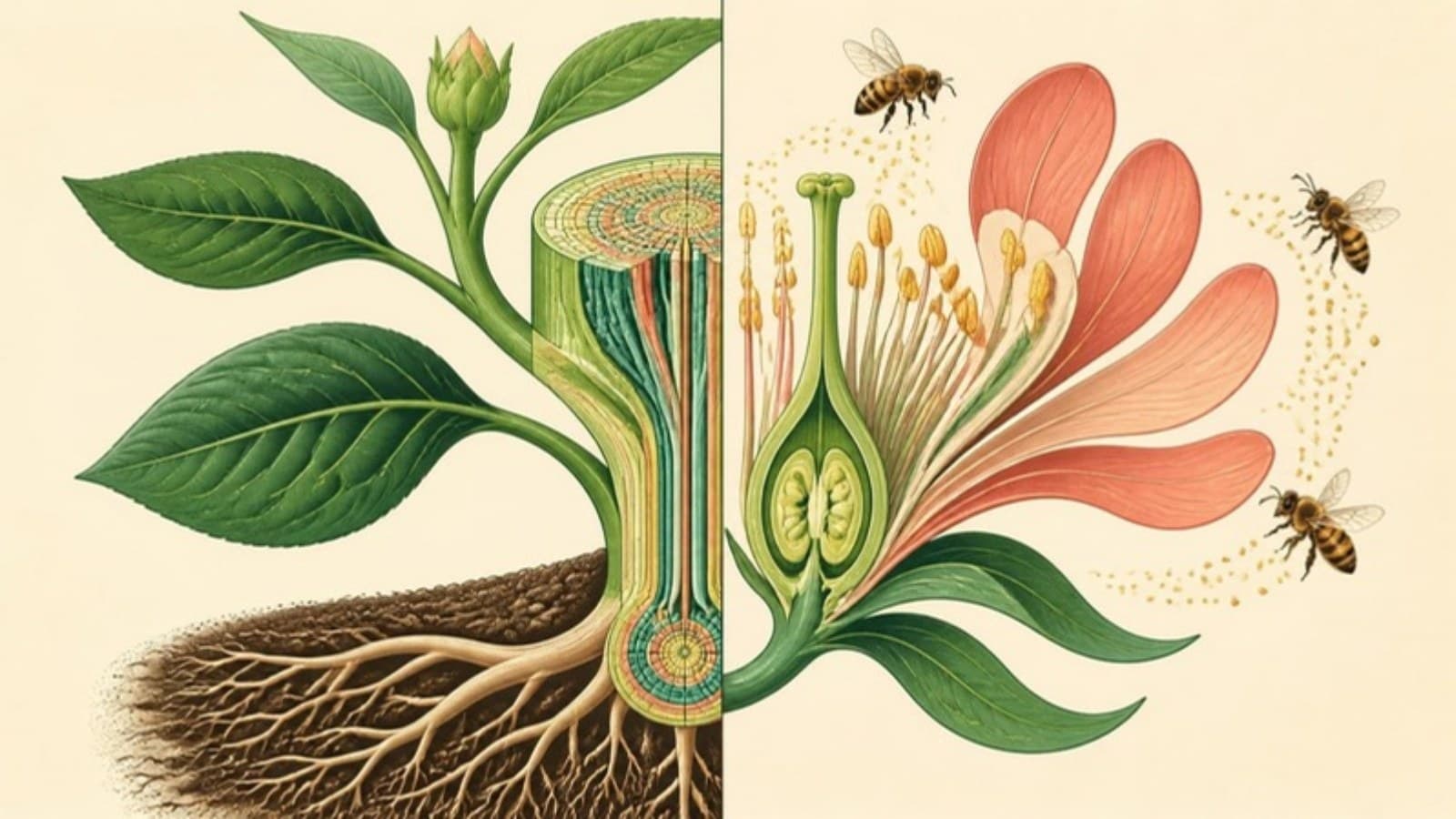
Plant Morphology and Anatomy are typically split into two separate chapters in the NEET curriculum, but they are highly integrated and often tested together. Combined, these chapters contribute 8-10 marks annually, making them the second-most-weighted biology chapters after Animal Kingdom. The high weightage is justified by the breadth of topics: morphology covers external plant structures and classification, while anatomy covers internal tissue organization and cell types.
This chapter is diagram-heavy, favoring students with strong visual-spatial reasoning and careful labeling practice. Unlike memorization-focused chapters, Plant Morphology & Anatomy reward meticulous diagram study and repeated drawing/labeling practice.
| Year | Total Questions | Morphology | Anatomy | Tissue Identification | Families | Avg Difficulty |
|---|---|---|---|---|---|---|
| 2019 | 3 | 1 (Leaf modifications) | 1 (Root anatomy) | 1 (Xylem identification) | 0 | Easy-Medium |
| 2020 | 2 | 1 (Inflorescence) | 1 (Stem anatomy) | 0 | 0 | Medium |
| 2021 | 3 | 1 (Root modifications) | 1 (Leaf anatomy) | 1 (Tissue comparison) | 0 | Medium |
| 2022 | 3 | 1 (Flower parts) | 2 (Root + stem) | 0 | 0 | Medium-Hard |
| 2023 | 3 | 1 (Floral formula) | 1 (Secondary growth) | 0 | 1 (Fabaceae vs. Solanaceae) | Hard |
| 2024 | 3 | 1 (Fruit types) | 1 (Stomata/epidermis) | 1 (Phloem structure) | 0 | Medium-Hard |
| 2025 | 2 | 1 (Leaf venation) | 1 (Root endodermis) | 0 | 0 | Medium |
| Total | 19 | 7 | 8 | 3 | 1 | Medium |
Critical Insight: Anatomy questions (8) slightly outnumber Morphology (7); tissue identification (3 questions) is emerging as high-yield. Family comparisons remain rare but appear unpredictably.
Roots are the underground plant organs primarily involved in absorption and anchorage. Morphology questions focus on root types and modifications.
Root Types (Classification by Origin):
| Root Type | Origin | Description | Example |
|---|---|---|---|
| Tap Root | Radicle (embryonic root) | One dominant root + lateral branches | Carrot, Mustard, Legumes |
| Fibrous Root | Radicle + adventitious | Multiple roots of equal size | Monocots (wheat, maize, rice) |
| Adventitious Root | Stem/leaf tissue | Roots emerging from non-root tissues | Banyan (aerial roots), sweet potato (tuberous) |
NEET Question Pattern 1: "A plant with one dominant root and many lateral branches has a __ root system."
Root Modifications (for storage, support, or photosynthesis):
| Modification | Function | Example |
|---|---|---|
| Tuberous Roots | Storage (starch) | Sweet potato, dahlia |
| Fasciculated Roots | Storage (clustered) | Asparagus, marigold |
| Aerial Roots | Support, photosynthesis | Banyan tree, orchids |
| Prop Roots | Structural support | Maize, sugarcane |
| Respiratory Roots (Pneumatophores) | Gas exchange in anaerobic soil | Mangrove trees |
| Climbing Roots | Attachment | Ivy, Hedera |
NEET Question Pattern 2: "Banyan tree develops ** roots that serve both ** and __ functions."
Stems are above-ground organs primarily involved in support and transport. Modifications indicate ecological adaptation.
Stem Types (by Structure):
| Stem Type | Characteristics | Example |
|---|---|---|
| Herbaceous Stem | Soft, green, non-woody | Tomato, sunflower |
| Woody Stem | Hard, dark, with bark | Trees, shrubs |
| Underground Stem | Modified for storage/reproduction | Tubers, rhizomes, corms, bulbs |
Underground Stem Modifications:
| Modification | Characteristics | Storage Organ | Example |
|---|---|---|---|
| Tuber | Swollen underground stem | Stem (modified) | Potato, elephant foot yam |
| Rhizome | Horizontal underground stem | Stem (horizontal) | Ginger, turmeric, colocasia |
| Corm | Bulb-like stem, solid inside | Stem (compact) | Coleus, gladiolus |
| Bulb | Swollen base with fleshy leaves | Leaf bases + stem | Onion, garlic, lily |
Critical Distinction (frequently asked):
NEET Question Pattern: "Which underground modification stores starch in modified stem tissue AND has visible buds?"
Leaves are the primary photosynthetic organs. Morphological features include venation, margin, apex, and modifications.
Leaf Parts (External Morphology):
Leaf Venation (Pattern of Veins):
| Venation Type | Pattern | Characteristic | Example |
|---|---|---|---|
| Parallel Venation | Veins run parallel | Main veins don't anastomose (don't join) | Monocots: wheat, maize, rice, banana |
| Reticulate Venation | Veins form a network | Main veins anastomose (join together) | Dicots: mango, neem, rose |
NEET Distinction Question: "Wheat and rice show ** venation because they are **, while mango shows ** venation because it is **."
Leaf Margin & Apex Types:
Leaf Modifications (adaptive):
| Modification | Function | Example |
|---|---|---|
| Spines | Reduce water loss; protection | Acacia, cactus |
| Tendrils | Climbing support | Pea, cucumber |
| Pinnate Leaves | Reduced water loss (compound) | Neem, rose |
| Compound Leaves | Increased surface area; flexible in wind | Lablab, tamarind |
| Succulent Leaves | Water storage | Agave, aloe |
| Pitcher Leaves | Insectivorous | Nepenthes (pitcher plant) |
NEET Question Pattern: "A leaf modification that aids climbing, formed from leaf apex, is called a __."
Flowers are the reproductive organs; morphology involves parts and arrangement.
Flower Parts (Floral Organs):
| Whorl | Organ | Function |
|---|---|---|
| Calyx | Sepals (usually green) | Protects flower bud |
| Corolla | Petals (usually colored) | Attracts pollinators |
| Androecium | Stamens (male) | Produces pollen |
| Gynoecium | Carpels (female) | Produces ovules |
Stamen Structure:
Carpel Structure:
NEET Question Pattern: "The male reproductive organ of flower consists of __."
Inflorescence (Arrangement of Flowers):
| Type | Characteristic | Example |
|---|---|---|
| Raceme | Main axis elongated; flowers pedicellate; open acropetal | Mustard, radish |
| Spike | Main axis elongated; flowers sessile | Wheat, Bajra |
| Corymb | Main axis shortened; flowers clustered at top | Carrot family |
| Umbel | Pedicels arise from same point | Carrot family (e.g., coriander) |
| Cyme | Terminal flower opens first; determinate growth | Cotton, strawberry |
| Capitulum (Head) | All flowers in dense cluster on flat receptacle | Sunflower, marigold |
NEET Question Pattern: "Sunflower shows a ** inflorescence with ** flowers arranged on a flat receptacle."
Floral formula is a symbolic representation of flower structure. Appears in 2-3 NEET exams.
Floral Formula Components:
Example Floral Formulas:
| Plant | Floral Formula | Meaning |
|---|---|---|
| Liliaceae (Lily) | ✿ K3 C3 A3+3 G3 | 3 sepals, 3 petals, 6 stamens, 3 carpels |
| Solanaceae (Tomato) | ✿ K(5) C(5) A5 G(2) | 5 fused sepals, 5 fused petals, 5 stamens, 2 carpels |
| Fabaceae (Pea) | ✿ K(5) C1+2+2 A(9)+1 G1 | Zygomorphic, papilionaceous corolla |
NEET Question Pattern: "A flower with floral formula K3 C3 A3+3 G3 belongs to family __."
Plant tissues are classified into three systems:
| Tissue System | Function | Tissue Types | Location |
|---|---|---|---|
| Dermal Tissue | Protection | Epidermis, periderm | Outermost layer |
| Ground Tissue | Storage, support, photosynthesis | Parenchyma, collenchyma, sclerenchyma | Between dermal & vascular |
| Vascular Tissue | Transport & support | Xylem (water), Phloem (nutrients) | Central core |
Epidermis (Outermost Layer):
Stomata (Pores for Gas Exchange):
NEET Question Pattern: "Stomata are more numerous on the ** surface of dicot leaves because **."
Periderm (in woody stems, replaces epidermis):
Trichomes (Hair-like projections):
Parenchyma:
Collenchyma:
Sclerenchyma:
NEET Tissue Identification Question: "Tissue providing flexible support in herbaceous stems, with living cells and unevenly thickened walls?"
Xylem (Water Transport & Support):
Components:
Vessel Elements: Large-diameter tubes; found in angiosperms; highly efficient water transport
Tracheids: Smaller; found in gymnosperms and ferns; less efficient; provide support
Water Transport Mechanism: Root pressure + capillarity + transpiration pull move water upward
Phloem (Organic Nutrient Transport):
Components:
Transport Mechanism: Pressure flow (mass flow) — high sugar concentration in source creates turgor pressure, forcing movement toward sink
NEET Question Pattern: "Which vascular tissue transports water upward against gravity?"
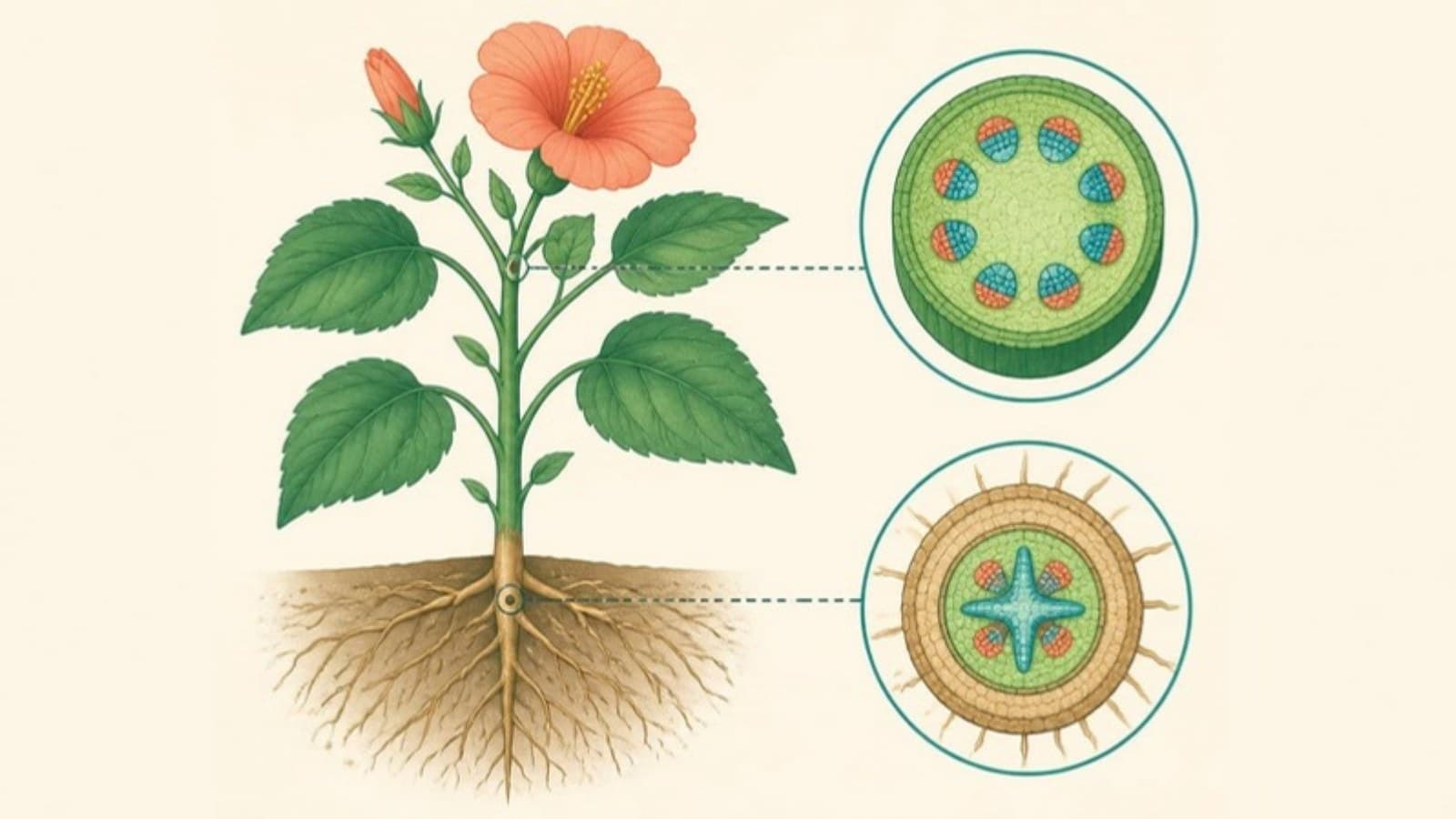
Dicot Root Structure (cross-section, from outside → inside):
Monocot Root Structure:
Key Distinction (frequently asked):
NEET Question Pattern: "A root showing polyarch xylem with many lobes is likely from a __ plant."
Dicot Stem Structure:
Monocot Stem Structure:
Key Distinction:
NEET Question Pattern: "A stem showing vascular bundles arranged in a ring with cambium present is from a __ plant."
Dicot Leaf Structure (dorsiventral):
| Layer | Cell Type | Function |
|---|---|---|
| Upper Epidermis | Protective, usually no stomata | Protection, light entry |
| Palisade Mesophyll | Columnar cells, tightly packed, many chloroplasts | Maximum photosynthesis |
| Spongy Mesophyll | Irregular cells, many intercellular spaces, fewer chloroplasts | Gas exchange, storage |
| Lower Epidermis | Protective, abundant stomata | Gas exchange, water loss regulation |
Monocot Leaf Structure (isobilateral):
NEET Question Pattern: "A leaf with palisade mesophyll on one side and spongy mesophyll on the other is __ structure."
Practice break
Reading is prep. Practising is progress.
Free to try · replies within a few hours on WhatsApp
Secondary growth increases stem diameter over time via cambial activity.
Cambium (Vascular Cambium):
Annual Rings (Growth Rings):
Cork Cambium (Phellogen):
NEET Question Pattern: "Annual rings in tree trunks form because of __ activity, which is seasonal."
Three major plant families appear in NEET: Fabaceae, Solanaceae, Liliaceae. Family comparisons are 15-20% of marks.
Characteristics:
Important Fabaceae Examples:
NEET Question Pattern: "A plant with papilionaceous flower, alternate compound leaves, and a legume fruit belongs to family __."
Characteristics:
Important Solanaceae Examples:
Medicinal/Toxic Alkaloids: Solanaceous plants contain tropane alkaloids (atropine, scopolamine), making many toxic.
NEET Question Pattern: "A plant with actinomorphic flower, 5 fused petals, and berry fruit belongs to family __."
Characteristics:
Important Liliaceae Examples:
NEET Question Pattern: "A plant with floral formula K3 C3 A3+3 G3, bulbous underground stem, and linear leaves belongs to family __."
| Feature | Fabaceae | Solanaceae | Liliaceae |
|---|---|---|---|
| Flower Symmetry | Zygomorphic | Actinomorphic | Actinomorphic |
| Floral Formula | K(5) C1+2+2 A(9)+1 G1 | K(5) C(5) A5 G(2) | K3 C3 A3+3 G3 |
| Corolla Type | Papilionaceous | Rotate/campanulate | Simple (tepals) |
| Leaves | Pinnately compound | Simple, alternate | Linear, parallel-veined |
| Root | Tap (with nodules) | Fibrous | Adventitious (from bulb) |
| Stem | Herbaceous | Herbaceous | Underground (bulb/rhizome) |
| Fruit | Legume (pod) | Berry/capsule | Capsule |
| Inflorescence | Raceme | Cyme | Raceme/panicle |
| Example | Pea, Peanut | Tomato, Potato | Lily, Garlic, Onion |
NEET Strategy: Practice 10-15 comparison questions asking "Which feature distinguishes Family X from Family Y?"
| Topic | Questions (2019-2025) | Priority |
|---|---|---|
| Root anatomy (dicot vs. monocot) | 3 | High |
| Stem anatomy (vascular bundles arrangement) | 3 | High |
| Tissue identification in cross-sections | 3 | High |
| Leaf anatomy (mesophyll, epidermis) | 2 | Medium-High |
| Leaf modifications (spines, tendrils) | 2 | Medium-High |
| Flower parts & inflorescence | 2 | Medium-High |
| Family comparisons (morphology) | 1 | Medium |
| Secondary growth (cambium, annual rings) | 1 | Medium |
| Stomate structure & distribution | 1 | Medium |
| Underground stem modifications | 1 | Medium |
Plant Morphology & Anatomy is dominated by diagram-based questions. Practice includes:
Strategy: Draw and label 50+ diagrams weekly; aim for accuracy in tissue placement and size proportion.
Strategy: Create flashcards with tissue images; name the tissue and function in <30 seconds.
Strategy: Create comparison tables; practice elimination-based reasoning.
Error: Saying potato is a rhizome or bulb is a corm Fix: Tuber = swollen stem (potato, eyes = buds); Rhizome = horizontal stem (ginger); Corm = compact bulb-like stem (gladiolus); Bulb = fleshy leaves + stem base (onion) Mnemonics: TurbeR → Tuber has buds; RhiZome → Horizontal Z-shape; CoRM → Compact; BulB → Bulbous/round
Error: Saying dicot roots have many (polyarch) xylem lobes Fix: Dicot roots = 2-4 xylem lobes (diarch, triarch) with phloem in grooves; Monocot roots = many xylem lobes (polyarch) Memory: Die-cot has FEWER lobes; Mono-cot has MANY (because mono = many)
Error: Saying spongy mesophyll has more chloroplasts than palisade Fix: Palisade = columnar, tightly packed, MANY chloroplasts (main photosynthesis); Spongy = irregular cells, many air spaces, FEWER chloroplasts (gas exchange) Diagram Practice: Redraw dicot leaf cross-section; label cell shapes and chloroplast density
Error: Confusing monocot stem with dicot (saying it has cortex like dicots) Fix: Monocot stem = hypodermis (sclerenchymatous, structural support) just below epidermis; Dicot stem = cortex (parenchyma) below epidermis Significance: Hypodermis in monocots explains lack of secondary growth (no cambium, structure provided by hypodermis)
Error: Thinking Casparian strip prevents water transport Fix: Casparian strip is waterproofed cell wall region in endodermis that forces water + minerals to pass through living endodermis cells (selective uptake), then move into vascular cylinder Result: Selective ion transport (active regulation) through endodermis
Error: Confusing Fabaceae (zygomorphic papilionaceous) with Solanaceae (actinomorphic) Fix: Fabaceae = butterfly-like (papilionaceous) flower, always zygomorphic; Solanaceae = regular (actinomorphic), 5 fused petals rotating like wheel Quick Test: Draw simple flower outlines for each family; memorize 2 examples per family
Q1: How much of Plant Morphology & Anatomy is diagram-based vs. text-based? A: Approximately 60-70% diagram-based (label cross-sections, identify tissues, distinguish structures). Practice drawing 100+ diagrams; this is the highest-return activity.
Q2: Do I need to memorize all tissue types or just common ones? A: Focus on: epidermis, parenchyma, collenchyma, sclerenchyma, xylem, phloem. These account for 90% of questions. Guard cells (stomata), trichomes, endodermis are secondary.
Q3: Are monocot and dicot comparisons equally weighted? A: Monocot vs. dicot distinction is HIGH-YIELD. Expect 3-4 questions annually asking "Which is characteristic of monocots?" Focus: root xylem (polyarch), stem (scattered bundles), leaf (isobilateral).
Q4: Do I need to know all three plant families (Fabaceae, Solanaceae, Liliaceae)? A: Yes, but unequally. Fabaceae and Solanaceae have more questions. Liliaceae is often paired with Monocot characteristics. Know all three with emphasis on Fabaceae first.
Q5: What's more important — flower morphology or anatomical cross-sections? A: Anatomical cross-sections (~50% of marks) are higher-priority than flower morphology (~25%). Allocate 60% study time to anatomy, 40% to morphology.
Q6: Will NEET ask calculations on growth ring counting? A: Rarely. Questions are conceptual: "Why do annual rings form?" not "Count the rings and calculate age." Understand the mechanism; exact calculation is unusual.
Q7: How do I practice diagram identification in exams efficiently? A: Create a "tissue identification" test: 20 micrographs, identify in 20 minutes. Repeat until you achieve 90%+ accuracy. This speed-trains your visual recognition.
Q8: Are secondary growth questions only about trees? A: Mostly, yes. But understand that herbaceous dicots (like tomato) CAN develop secondary growth if they live long enough. Monocots (like grass, corn) NEVER develop secondary growth (no cambium).
For comprehensive Morphology & Anatomy study materials:
Dr. Shekhar is the Founder & Senior Faculty at Cerebrum, specializing in NEET Biology chapter analysis. With 15+ years of NEET exam pattern research, he provides data-driven study strategies for maximum score optimization.
External features and internal tissue structure get taught close together, but NEET tests them as genuinely separate skills. Message us on WhatsApp at +91 88264 44334 with where the overlap confuses you, and we'll send a split revision checklist that keeps the two apart.
Related reading: Morphology of Flowering Plants Notes · Class 11 Biology Coaching
Related resources

About the author
Dr. Shekhar C. Singh
AIIMS New Delhi alumnus who has taught biology since 2014, from NCERT foundations to the International Biology Olympiad.
Read his full profile →Get personalized guidance from AIIMS experts and achieve your medical college dreams
More from the blog
Complete NEET notes on Morphology of Flowering Plants covering root, stem, and leaf modifications, inflorescence types, flower structure, fruit classification, and three important families. NCERT-aligned with PYQs and MCQs.
2 Mar 2026
title: NEET Biotechnology Weightage 2026 — Principles & Applications Analysis. Complete weightage analysis, question patterns, and chapter-wise strategy for NEET 2026 Biology preparation.
7 Feb 2026
title: NEET Cell Biology Weightage 2026 — Cell Structure, Biomolecules & Division. Complete weightage analysis, question patterns, and chapter-wise strategy for NEET 2026 Biology preparation.
7 Feb 2026
Share your thoughts, ask a question, or help another student
Type it below and send it to us on WhatsApp — no sign-up needed.
For NEET Biology, aim for 3-4 hours of focused study daily. Quality matters more than quantity!
Yes! NCERT covers 95% of NEET Biology questions. Master it completely before any reference book.
Human Physiology (20%), Genetics (18%), and Ecology (12%) are the highest-scoring areas.
Need personalized guidance?