Loading...
Loading...
Complete NEET notes on Morphology of Flowering Plants covering root, stem, and leaf modifications, inflorescence types, flower structure, fruit classification, and three important families. NCERT-aligned with PYQs and MCQs.

5 points to remember for NEET
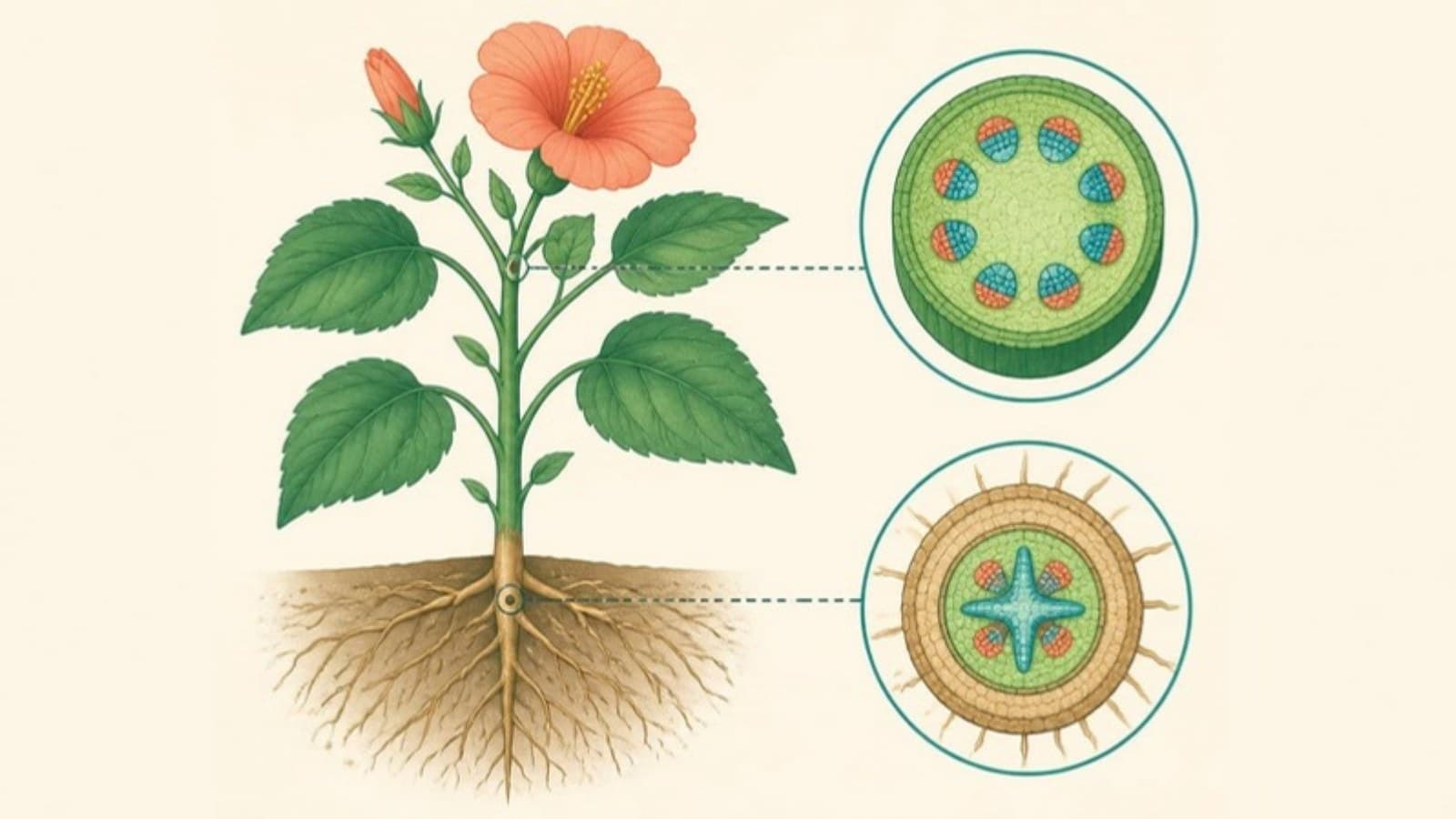
Morphology of Flowering Plants is a high-scoring chapter from Class 11, contributing 3-5 questions in NEET every year. This chapter covers the external form and structure of plant organs including roots, stems, leaves, flowers, fruits, and seeds. It is largely factual and rewards students who memorise key modifications, examples, and floral formulas.
This guide organises all NCERT content into comparison tables, family-wise summaries, and practice questions to maximise your score.
The root is the descending, non-green, underground part of the plant that develops from the radicle of the embryo.
| Feature | Tap Root System | Adventitious Root System |
|---|---|---|
| Origin | Develops from radicle | Develops from any part other than radicle |
| Primary root | Persistent, grows deep | Absent or short-lived |
| Branching | Lateral roots from primary root | Roots arise from stem, leaf, or nodes |
| Found in | Dicotyledons (mustard, mango) | Monocotyledons (wheat, rice, grass) |
Roots are modified for special functions beyond anchorage and absorption.
| Modification | Function | Examples |
|---|---|---|
| Fusiform (tapering at both ends) | Food storage | Radish (Raphanus) |
| Conical (broad at top, tapering below) | Food storage | Carrot (Daucus) |
| Napiform (spherical top, tapering below) | Food storage | Turnip (Brassica rapa) |
| Tuberous roots | Food storage | Sweet potato (Ipomoea batatas) |
| Pneumatophores | Gaseous exchange in waterlogged soil | Rhizophora (mangroves) |
| Prop roots (pillar roots) | Mechanical support from branches | Banyan tree (Ficus benghalensis) |
| Stilt roots | Support from lower nodes of stem | Maize (Zea mays), sugarcane |
| Nodular roots | Nitrogen fixation (harbour Rhizobium) | Leguminous plants (pea, gram) |
| Parasitic roots (haustoria) | Absorb nutrients from host | Cuscuta (dodder) |
| Epiphytic roots (velamen) | Absorb moisture from air | Orchids, Vanda |
NEET Tip: Sweet potato has tuberous adventitious roots (not tap root modifications). Do not confuse with potato, which is a stem tuber.
The stem is the ascending axis of the plant that develops from the plumule of the embryo. It bears nodes, internodes, leaves, and buds.
Stems are frequently modified for food storage, vegetative propagation, protection, or support.
| Modification | Features | Examples |
|---|---|---|
| Rhizome | Horizontal, underground, has nodes and internodes | Ginger, turmeric, Canna |
| Tuber | Swollen tip of underground stem with "eyes" (axillary buds) | Potato |
| Bulb | Short disc-shaped stem with fleshy scale leaves | Onion, garlic, lily |
| Corm | Vertical underground stem, solid, no scale leaves | Colocasia, Crocus, Gladiolus |
| Modification | Features | Examples |
|---|---|---|
| Runner | Creeps along soil surface, roots at nodes | Grass, Oxalis, strawberry |
| Stolon | Lateral branch that arches and touches ground | Fragaria (strawberry), jasmine |
| Offset | Short thick runner in aquatic plants | Pistia, Eichhornia (water hyacinth) |
| Sucker | Underground lateral branch that grows obliquely upward | Chrysanthemum, mint, banana |
| Modification | Function | Examples |
|---|---|---|
| Stem tendrils | Climbing support | Grapevine (Vitis), passion flower |
| Thorns | Protection from grazing animals | Citrus, Bougainvillea |
| Phylloclade (flattened stem) | Photosynthesis in arid conditions | Opuntia (prickly pear), Ruscus |
| Cladode | One-internode phylloclade | Asparagus |
| Bulbil | Vegetative propagation (modified axillary bud) | Agave, Dioscorea |
NEET Tip: Potato is a stem tuber (has eyes/buds), while sweet potato is a root tuber (has no eyes). Onion is a bulb (stem + fleshy leaves), not a root.
The leaf is a lateral, flattened outgrowth of the stem that develops at the node. It is the primary organ of photosynthesis.
| Type | Pattern | Found in | Examples |
|---|---|---|---|
| Reticulate | Veins form an irregular network | Dicots | Mango, peepal, hibiscus |
| Parallel | Veins run parallel to each other | Monocots | Grass, wheat, maize, banana |
Exception: Smilax (monocot) has reticulate venation; Calophyllum (dicot) has parallel venation.
| Feature | Simple Leaf | Compound Leaf |
|---|---|---|
| Lamina | Single, undivided (may be lobed) | Divided into leaflets |
| Axillary bud | Present at base of leaf | Present only at base of whole leaf, not at leaflets |
| Types | - | Pinnately compound, palmately compound |
Compound Leaf Types:
| Type | Arrangement | Examples |
|---|---|---|
| Pinnately compound (unipinnate) | Leaflets along a common rachis | Neem, rose |
| Bipinnate | Rachis branches into secondary rachises | Acacia, Mimosa |
| Palmately compound | Leaflets arise from a single point at petiole tip | Silk cotton (Bombax), Cannabis |
| Type | Description | Examples |
|---|---|---|
| Alternate (spiral) | One leaf per node, arranged spirally | Sunflower, mustard, hibiscus |
| Opposite | Two leaves per node, opposite to each other | Calotropis, guava |
| Whorled | More than two leaves per node | Nerium (oleander), Alstonia |
The arrangement of flowers on the floral axis is called inflorescence. It is broadly classified into racemose and cymose types.
| Feature | Racemose | Cymose |
|---|---|---|
| Main axis growth | Continues to grow indefinitely | Terminates in a flower |
| Order of flowering | Acropetal (base to apex) or centripetal | Basipetal (apex to base) or centrifugal |
| Oldest flower | At the base | At the apex (centre) |
| Type | Description | Examples |
|---|---|---|
| Raceme | Pedicellate flowers on elongated axis | Mustard (Brassica), larkspur |
| Spike | Sessile flowers on elongated axis | Amaranthus, Achyranthes |
| Catkin (ament) | Spike that is pendulous and unisexual | Mulberry, birch, oak |
| Spadix | Spike with fleshy axis, enclosed by spathe | Banana, Colocasia, Arum |
| Corymb | Lower flowers have longer pedicels (flat-topped) | Iberis (candytuft) |
| Umbel | Flowers arise from same point, pedicels equal | Centella, coriander |
| Capitulum (head) | Sessile flowers on flattened receptacle | Sunflower, Tridax, Zinnia |
| Type | Description | Examples |
|---|---|---|
| Monochasial (uniparous) | Only one lateral branch develops per terminal flower | Drosera, Begonia |
| Dichasial (biparous) | Two lateral branches develop below terminal flower | Dianthus (pink), jasmine |
| Polychasial (multiparous) | Multiple lateral branches below terminal flower | Nerium, Calotropis |
| Cyathium | Specialised; single female flower surrounded by male flowers | Euphorbia |
| Hypanthodium | Flowers on inner wall of fleshy receptacle | Ficus (fig) |
NEET Tip: The capitulum (head) of sunflower contains two types of florets - ray florets (outer, zygomorphic, sterile) and disc florets (inner, actinomorphic, bisexual). NEET frequently asks about this.
A flower is a modified shoot meant for sexual reproduction. A typical flower has four whorls: calyx, corolla, androecium, and gynoecium.
| Whorl | Components | Function |
|---|---|---|
| Calyx | Sepals (collectively = calyx) | Protection of bud |
| Corolla | Petals (collectively = corolla) | Attract pollinators |
| Androecium | Stamens (filament + anther) | Male reproductive organ (pollen production) |
| Gynoecium | Carpels/Pistil (stigma + style + ovary) | Female reproductive organ (ovule production) |
| Term | Meaning |
|---|---|
| Actinomorphic | Radial symmetry (can be divided into equal halves in any plane) |
| Zygomorphic | Bilateral symmetry (only one plane of division) |
| Bisexual (perfect) | Both androecium and gynoecium present |
| Unisexual (imperfect) | Only one reproductive whorl present |
| Hypogynous | Ovary superior (gynoecium on top); e.g., mustard, brinjal |
| Perigynous | Ovary half-inferior; e.g., plum, rose, peach |
| Epigynous | Ovary inferior (other whorls above); e.g., guava, cucumber, sunflower |
| Type | Arrangement | Examples |
|---|---|---|
| Valvate | Margins touch without overlapping | Calotropis |
| Twisted (contorted) | One margin overlaps the next | Hibiscus, cotton |
| Imbricate | One petal completely internal, one completely external | Cassia, gulmohar |
| Vexillary (papilionaceous) | Largest petal (standard) overlaps two lateral (wings), which overlap two smallest (keel) | Pea, bean (Fabaceae) |
The arrangement of ovules on the placenta within the ovary is called placentation.
| Type | Description | Examples |
|---|---|---|
| Marginal | Ovules on one side along ventral suture | Pea (Fabaceae) |
| Axile | Ovules on central axis of multilocular ovary | Tomato, lemon, Hibiscus |
| Parietal | Ovules on inner wall of unilocular ovary | Mustard, Argemone, cucumber |
| Free central | Ovules on central column, no septum | Dianthus, Primula |
| Basal | Single ovule at base of unilocular ovary | Sunflower, marigold (Asteraceae) |
| Superficial | Ovules on all inner surfaces of multilocular ovary | Nymphaea (water lily) |
A fruit is a mature or ripened ovary that develops after fertilisation. It consists of the pericarp (fruit wall) and seeds.
| Type | Origin | Examples |
|---|---|---|
| Simple fruits | From single ovary of one flower | Mango (drupe), tomato (berry), wheat (caryopsis) |
| Aggregate fruits | From multiple free carpels of one flower | Strawberry (Fragaria), lotus, Polyalthia |
| Composite (multiple) fruits | From entire inflorescence | Pineapple (sorosis), fig (syconus), mulberry |
| Fruit Type | Features | Examples |
|---|---|---|
| Drupe | Fleshy, with stony endocarp | Mango, coconut, peach |
| Berry | Fleshy, many seeds, no stony layer | Tomato, grape, banana |
| Pome | Fleshy thalamus, cartilaginous endocarp | Apple, pear |
| Legume (pod) | Dry, dehiscent along both sutures | Pea, bean |
| Capsule | Dry, dehiscent, multi-chambered | Cotton, Datura, lady's finger |
| Caryopsis | Dry, indehiscent, pericarp fused to seed coat | Wheat, rice, maize |
| Cypsela | Dry, indehiscent, from inferior ovary | Sunflower |
| Nut | Dry, indehiscent, hard pericarp | Cashew, Litchi |
NEET Tip: Parthenocarpic fruits develop without fertilisation and are seedless (e.g., banana). Apple is a false fruit because the edible part is the thalamus, not the ovary wall.
A floral formula is a symbolic representation of a flower using standard symbols.
Key symbols:
| Feature | Fabaceae (Papilionaceae) | Solanaceae | Liliaceae |
|---|---|---|---|
| Common name | Pea/Legume family | Potato/Nightshade family | Lily family |
| Habit | Herbs, shrubs, trees | Herbs, shrubs | Herbs (mostly perennial) |
| Root | Tap root with nodules (Rhizobium) | Tap root | Adventitious, fibrous |
| Leaf | Alternate, compound (pinnate), stipulate, reticulate | Alternate, simple, exstipulate, reticulate | Alternate, simple, parallel venation |
| Inflorescence | Raceme | Cymose (solitary axillary or helicoid cyme) | Cymose (solitary or umbel) |
| Calyx | 5, gamosepalous | 5, gamosepalous | 3 (or 3+3), often petaloid |
| Corolla | 5, papilionaceous (vexillary) | 5, gamopetalous, valvate | 3 (or 3+3), polypetalous or gamopetalous |
| Androecium | 10, diadelphous (9+1) | 5, epipetalous | 6 (3+3) |
| Gynoecium | Monocarpellary, unilocular, superior | Bicarpellary, syncarpous, bilocular, superior | Tricarpellary, syncarpous, trilocular, superior |
| Placentation | Marginal | Axile | Axile |
| Fruit | Legume (pod) | Berry or capsule | Capsule or berry |
| Seeds | Non-endospermic | Endospermic | Endospermic |
| Floral formula | Zygomorphic, bisexual, K(5) C1+2+(2) A(9)+1 G1 | Actinomorphic, bisexual, K(5) C(5) A5 G(2) | Actinomorphic, bisexual, P3+3 A3+3 G(3) |
| Economic importance | Pulses (gram, pea), oil (groundnut, soybean), fodder | Vegetables (potato, tomato, brinjal), ornamental (petunia), medicinal (Atropa) | Ornamental (lily, tulip), medicinal (aloe), vegetable (asparagus, onion, garlic) |
| Examples | Pea, gram, bean, clover, Indigofera, groundnut | Potato, tomato, brinjal, Datura, Petunia, Nicotiana, chilli | Lily, tulip, Gloriosa, onion, garlic, aloe, asparagus |
NEET Tip: In Fabaceae, the stamens are diadelphous (9 fused + 1 free). The corolla has 5 petals: 1 standard (vexillum), 2 wings (alae), and 2 keel petals (carina) that are fused. This arrangement is called papilionaceous corolla.
Practice break
Reading is prep. Practising is progress.
Free to try · replies within a few hours on WhatsApp
| Year | Topic Tested | Question Focus | Correct Answer |
|---|---|---|---|
| 2025 | Stem modifications | Potato is a modified | Stem (tuber) |
| 2025 | Families | Diadelphous stamens are found in | Fabaceae |
| 2024 | Root modifications | Pneumatophores are found in | Mangroves (Rhizophora) |
| 2024 | Inflorescence | Type of inflorescence in sunflower | Capitulum (head) |
| 2023 | Leaf | Parallel venation is characteristic of | Monocotyledons |
| 2023 | Flower | Epigynous flower has | Inferior ovary |
| 2022 | Placentation | Type of placentation in mustard | Parietal |
| 2022 | Families | Solanaceae fruit type | Berry |
| 2021 | Stem modifications | Underground stem of ginger is | Rhizome |
| 2021 | Inflorescence | Cymose inflorescence differs from racemose in | Terminal flower on main axis |
| 2020 | Root | Adventitious roots for support in maize | Stilt roots |
| 2020 | Aestivation | Vexillary aestivation is found in | Pea (Fabaceae) |
| 2019 | Fruit | Apple is called a false fruit because | Edible part is thalamus, not ovary |
| 2019 | Families | Marginal placentation is characteristic of | Fabaceae |
Q1. Pneumatophores are found in plants growing in:
Pneumatophores are negatively geotropic roots found in mangrove plants like Rhizophora. They grow upward above the waterlogged soil to facilitate gaseous exchange through lenticels.
Q2. Potato tuber is a modification of:
Potato is a stem tuber because it has nodes (eyes), internodes, axillary buds, and scale leaves. Sweet potato, in contrast, is a root modification.
Q3. Which of the following has reticulate venation despite being a monocot?
Smilax is a well-known exception - a monocot with reticulate venation. Similarly, Calophyllum is a dicot with parallel venation.
Q4. The inflorescence of sunflower is:
Sunflower has a capitulum inflorescence where sessile florets (ray and disc) are arranged on a flat receptacle, surrounded by an involucre of bracts.
Q5. Vexillary aestivation is characteristic of:
Vexillary (papilionaceous) aestivation is seen in Fabaceae where the largest petal (standard) overlaps the wings, which overlap the keel petals.
Q6. Which type of placentation is found in pea (Pisum sativum)?
Pea belongs to Fabaceae and has a monocarpellary, unilocular ovary with marginal placentation - ovules are arranged along the ventral suture.
Q7. In Fabaceae, the arrangement of stamens is:
Fabaceae has 10 stamens arranged in a diadelphous manner - 9 stamens are fused into a bundle and 1 stamen (posterior) is free.
Q8. A false fruit is one where the edible part is:
In false fruits like apple, the fleshy edible part is the thalamus (receptacle), not the ovary. The true fruit (ovary) forms the core.
Q9. Which of the following is a cymose inflorescence?
In a dichasial cyme, the main axis terminates in a flower and two lateral branches develop below it, each also terminating in a flower. This basipetal order is characteristic of cymose inflorescence.
Q10. Nodules on leguminous roots contain:
Rhizobium is a symbiotic nitrogen-fixing bacterium that lives in root nodules of leguminous plants (Fabaceae). It converts atmospheric N2 into ammonia.
Q11. The fruit of tomato is classified as:
Berry is a fleshy, indehiscent fruit with a thin epicarp, fleshy mesocarp, and many seeds. Tomato, grape, and banana are all berries. Solanaceae members typically produce berries.
Q12. Which of the following families has gamopetalous corolla and epipetalous stamens?
Solanaceae has a gamopetalous (fused petals) corolla with 5 stamens attached to the petals (epipetalous). The floral formula is K(5) C(5) A5 G(2).
Underground stem modifications - "RTBC":
Sub-aerial stems - "RSOS":
Racemose inflorescence types - "Really Smart Children Sit Calmly Under Calm Heads":
Fabaceae floral formula - "Zygomorphic butterfly":
Placentation - "MAPFBS":
Q: How do you distinguish between a simple leaf with deep lobes and a compound leaf? A: Look for the axillary bud. In a simple leaf, the axillary bud is present at the base of the whole leaf (at the node), and the lobes share a common lamina. In a compound leaf, the axillary bud is present only at the base of the entire leaf, not at the base of individual leaflets. Leaflets are completely separated from each other.
Q: Why is onion considered a stem modification and not a root? A: Onion is a bulb, which is a modified underground stem. The fleshy part consists of scale leaves (modified leaf bases) attached to a short disc-shaped stem at the base. If you cut an onion vertically, you can see the condensed stem at the bottom from which the scale leaves arise. Roots emerge from the lower surface of this disc.
Q: What is the difference between a raceme and a spike? A: Both are racemose inflorescences with flowers arranged on an elongated axis. The key difference is that flowers in a raceme are pedicellate (stalked), while flowers in a spike are sessile (without stalks). Mustard has a raceme; Achyranthes has a spike.
Q: Why is Fabaceae economically important? A: Fabaceae is one of the most important plant families because legumes (pea, gram, soybean, lentil) are major protein sources in the human diet. Additionally, their root nodules harbour Rhizobium bacteria that fix atmospheric nitrogen, enriching soil fertility. This makes legumes important in crop rotation.
Q: What makes a fruit "false"? A: In a true fruit, the edible portion develops from the ovary wall (pericarp). In a false fruit (pseudocarp), the edible portion develops from parts other than the ovary, such as the thalamus (receptacle) in apple and pear, or the peduncle in cashew. The actual fruit of an apple is the core that we discard.
Family identification questions are decided by two or three floral formula details, and those are exactly what gets lost when you revise all three families together. Message us on WhatsApp at +91 88264 44334 with the family you keep mixing up, and we'll send the floral formula comparison NEET actually tests.
Related reading: NEET Plant Morphology & Anatomy Weightage Analysis · Plant Kingdom Classification Notes · Class 11 Biology Coaching
Related resources

About the author
Dr. Shekhar C. Singh
AIIMS New Delhi alumnus who has taught biology since 2014, from NCERT foundations to the International Biology Olympiad.
Read his full profile →Get personalized guidance from AIIMS experts and achieve your medical college dreams
More from the blog
Master Cell Division for NEET 2026 with comprehensive notes on cell cycle, mitosis, meiosis, and their significance. NCERT-aligned content with diagrams and previous year questions.
12 Jun 2026
Master Cell Biology for NEET 2026 with comprehensive notes covering cell theory, prokaryotic vs eukaryotic cells, cell organelles, and their functions. NCERT-based content with previous year questions.
12 Jun 2026
Master Excretion for NEET 2026 with comprehensive notes on kidney structure, nephron function, urine formation, and regulation. NCERT-aligned content with diagrams and PYQs.
12 Jun 2026
Share your thoughts, ask a question, or help another student
Type it below and send it to us on WhatsApp — no sign-up needed.
For NEET Biology, aim for 3-4 hours of focused study daily. Quality matters more than quantity!
Yes! NCERT covers 95% of NEET Biology questions. Master it completely before any reference book.
Human Physiology (20%), Genetics (18%), and Ecology (12%) are the highest-scoring areas.
Need personalized guidance?