Loading...
Loading...
Master Cell Division for NEET 2026 with comprehensive notes on cell cycle, mitosis, meiosis, and their significance. NCERT-aligned content with diagrams and previous year questions.

5 points to remember for NEET
Cell Division contributes 3-5 questions in NEET and is crucial for understanding genetics and reproduction. This guide covers all NCERT concepts for NEET 2026.
The cell cycle is the series of events that take place in a cell leading to its division and duplication.
| Cell Type | Duration | Example |
|---|---|---|
| Fast-dividing cells | 8-10 hours | Bone marrow cells |
| Average cells | 24 hours | Human cells in culture |
| Non-dividing cells | Arrested in G0 | Neurons, muscle cells |
| Phase | Events | Duration (24h cycle) |
|---|---|---|
| G1 (Gap 1) | Cell growth, protein synthesis, organelle duplication | ~11 hours |
| S (Synthesis) | DNA replication, histone synthesis | ~8 hours |
| G2 (Gap 2) | Continued growth, preparation for mitosis | ~4 hours |
G0 Phase: Quiescent stage where cells exit the cell cycle (neurons, cardiac muscle cells).
NEET Important: DNA content doubles during S phase (2C → 4C), but chromosome number remains same.
Comprises:
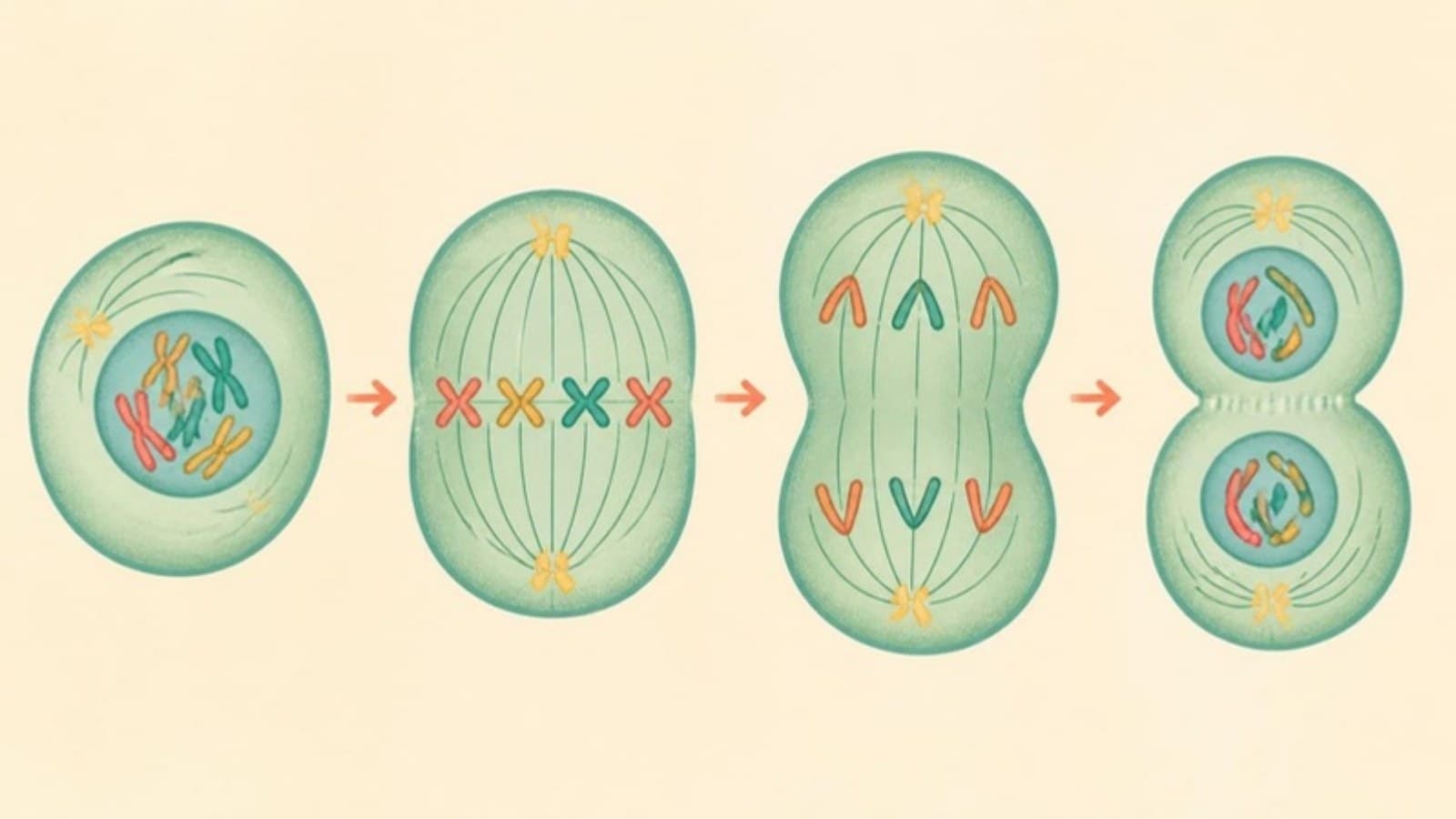
Mitosis is equational division producing two identical daughter cells with the same chromosome number as the parent cell.
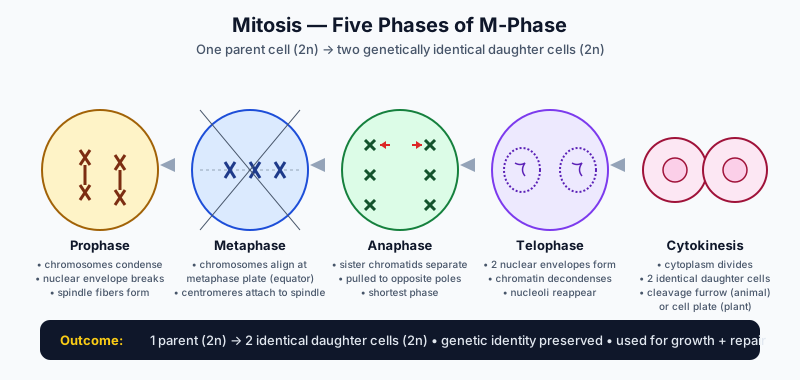
| Feature | Animal Cells | Plant Cells |
|---|---|---|
| Mechanism | Cleavage furrow (contractile ring) | Cell plate formation |
| Direction | Centripetal (outside → inside) | Centrifugal (inside → outside) |
| Structure | Actin-myosin ring | Vesicles from Golgi |
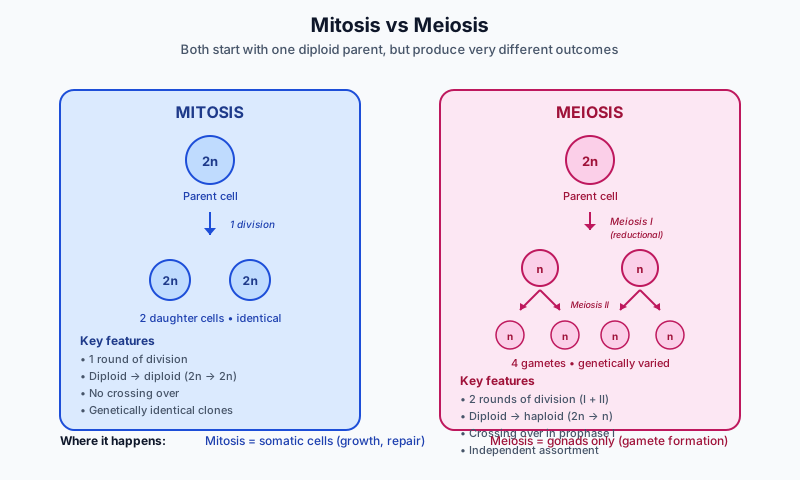
Meiosis is reductional division producing four haploid daughter cells from one diploid parent cell.
Five substages (Mnemonic: LZPDD)
| Substage | Events |
|---|---|
| Leptotene | Chromosomes become visible, attached to nuclear envelope |
| Zygotene | Homologous chromosomes pair up (synapsis), form bivalents |
| Pachytene | Crossing over occurs, recombination nodules form |
| Diplotene | Chiasmata visible, bivalents begin to separate |
| Diakinesis | Terminalization of chiasmata, nuclear envelope breaks down |
Key Terms:
Similar to mitosis but in haploid cells.
| Phase | Events |
|---|---|
| Prophase II | Chromosomes condense, spindle forms |
| Metaphase II | Chromosomes align at equator |
| Anaphase II | Sister chromatids separate |
| Telophase II | 4 haploid cells formed |
| Feature | Mitosis | Meiosis |
|---|---|---|
| Type | Equational | Reductional (I) + Equational (II) |
| Divisions | One | Two |
| Daughter cells | 2 diploid | 4 haploid |
| Genetic identity | Identical to parent | Genetically different |
| Crossing over | No | Yes (Prophase I) |
| Synapsis | No | Yes |
| Chiasmata | No | Yes |
| Occurs in | Somatic cells | Germ cells |
| Purpose | Growth, repair | Gamete formation |
Practice break
Reading is prep. Practising is progress.
Free to try · replies within a few hours on WhatsApp
| Checkpoint | Location | Function |
|---|---|---|
| G1 (Restriction point) | End of G1 | Checks cell size, nutrients, DNA damage |
| G2/M | End of G2 | Checks DNA replication completion |
| Metaphase (Spindle) | During M | Checks spindle attachment |
Cancer Connection: Mutations in cell cycle regulators (like p53) can lead to uncontrolled cell division.
Q1 (NEET 2023): During which stage of meiosis does crossing over occur?
Q2 (NEET 2022): The shortest phase of mitosis is:
Q3 (NEET 2021): Synapsis occurs between:
Q4 (NEET 2020): DNA replication occurs in which phase of cell cycle?
Q5 (NEET 2019): Chiasmata are visible during:
Q: Why is meiosis I called reductional division? A: Because chromosome number is halved (2n → n) as homologous chromosomes separate. Sister chromatids remain together until Meiosis II.
Q: What is the significance of crossing over? A: Crossing over exchanges genetic material between homologous chromosomes, creating new combinations of alleles. This increases genetic diversity in offspring.
Q: Why doesn't DNA replication occur between Meiosis I and II? A: After Meiosis I, each chromosome still consists of two sister chromatids (from S phase before Meiosis I). These need to be separated in Meiosis II to produce haploid gametes.
Q: What happens if cell cycle checkpoints fail? A: Checkpoint failure can lead to uncontrolled cell division, accumulation of DNA damage, and potentially cancer. The p53 protein (tumor suppressor) is crucial for checkpoint control.
Q: Why is metaphase the best stage for studying chromosomes? A: During metaphase, chromosomes are maximally condensed, aligned at the cell equator, and clearly visible under a microscope. This makes counting and identifying chromosomes easier (karyotyping).
Prophase I alone has enough sub-stages to trip up a well-prepared student under time pressure. Message us on WhatsApp at +91 88264 44334 with the phase you keep mixing up, and we'll send a phase-by-phase comparison built around how NEET actually frames these questions.
Related reading: Cell Structure and Function Notes · NEET Cell Biology Weightage Analysis · Class 11 Biology Coaching
Related resources

About the author
Dr. Shekhar C. Singh
AIIMS New Delhi alumnus who has taught biology since 2014, from NCERT foundations to the International Biology Olympiad.
Read his full profile →Get personalized guidance from AIIMS experts and achieve your medical college dreams
More from the blog
Master Cell Biology for NEET 2026 with comprehensive notes covering cell theory, prokaryotic vs eukaryotic cells, cell organelles, and their functions. NCERT-based content with previous year questions.
12 Jun 2026
Master Excretion for NEET 2026 with comprehensive notes on kidney structure, nephron function, urine formation, and regulation. NCERT-aligned content with diagrams and PYQs.
12 Jun 2026
Master Digestion and Absorption for NEET 2026 with comprehensive notes on digestive system, enzymes, absorption mechanisms, and digestive disorders. NCERT-aligned content with diagrams and PYQs.
12 Jun 2026
Share your thoughts, ask a question, or help another student
Type it below and send it to us on WhatsApp — no sign-up needed.
For NEET Biology, aim for 3-4 hours of focused study daily. Quality matters more than quantity!
Yes! NCERT covers 95% of NEET Biology questions. Master it completely before any reference book.
Human Physiology (20%), Genetics (18%), and Ecology (12%) are the highest-scoring areas.
Need personalized guidance?