Loading...
Loading...
Complete NEET notes on Reproductive Health covering contraceptive methods, STIs, infertility, ART techniques (IVF, ZIFT, GIFT, ICSI), MTP, and population control. NCERT-aligned with PYQs and practice MCQs.

5 points to remember for NEET
Reproductive Health is a medium to high-weightage chapter from Class 12 Biology, contributing 2-3 questions in NEET annually. This chapter is table-heavy and fact-based, making it ideal for last-minute revision. Questions frequently test contraceptive methods, STI causative organisms, and ART techniques. This guide covers all NCERT-aligned content with comprehensive comparison tables.
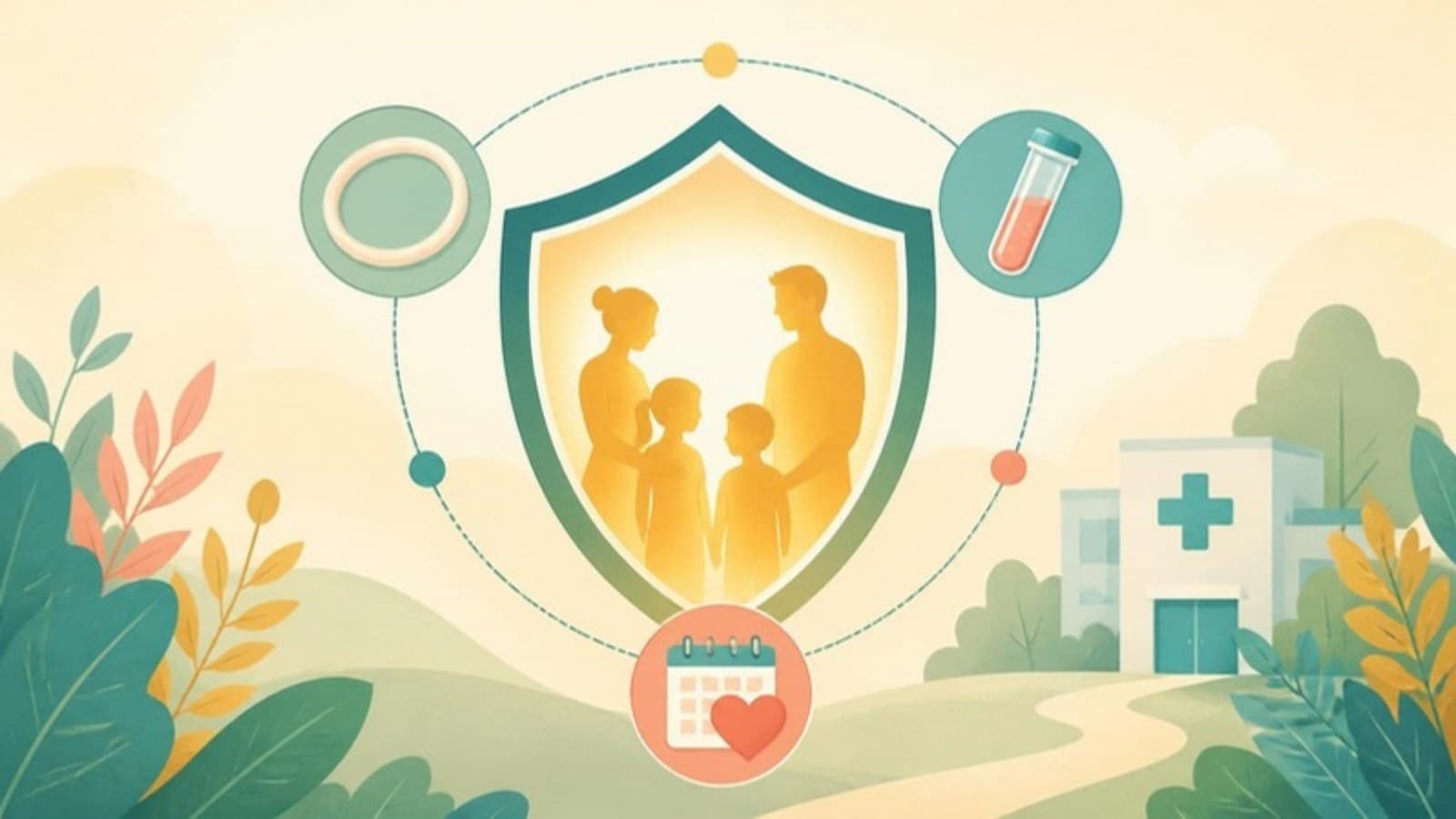
According to the WHO, reproductive health means total well-being in all aspects of reproduction - physical, emotional, behavioural, and social.
A reproductively healthy society requires:
India has been running family planning programmes since 1951 (the first country in the world to do so).
| Programme/Initiative | Focus Area |
|---|---|
| Family Planning Programme (1951) | Birth control and population stabilization |
| Reproductive and Child Health (RCH) Programme | Comprehensive reproductive health care |
| Amniocentesis banned for sex determination | Prevention of female foeticide (PCPNDT Act, 1994) |
| Awareness campaigns | "Hum Do Hamare Do," sex education in schools |
India's population crossed 1.4 billion and continues to grow rapidly. The reasons include:
NEET Tip: India was the first country to launch a national family planning programme in 1951.
Contraception refers to methods used to deliberately prevent pregnancy. An ideal contraceptive should be effective, reversible, user-friendly, with minimal side effects.
| Category | Method | Mechanism | Effectiveness | Reversible |
|---|---|---|---|---|
| Natural | Periodic abstinence (Rhythm method) | Avoid intercourse during ovulation (Day 10-17 of cycle) | Low-Moderate | Yes |
| Natural | Withdrawal (Coitus interruptus) | Male withdraws before ejaculation | Low | Yes |
| Natural | Lactational amenorrhea (LAM) | Breastfeeding suppresses ovulation (up to 6 months postpartum) | Moderate (only during intense lactation) | Yes |
| Barrier | Male condom | Physical barrier preventing sperm entry into female tract | High | Yes |
| Barrier | Female condom (Femidom) | Lines vagina, blocks sperm | High | Yes |
| Barrier | Diaphragm | Covers cervix, used with spermicide | Moderate-High | Yes |
| Barrier | Cervical cap | Smaller than diaphragm, fits over cervix | Moderate | Yes |
| Barrier | Spermicides (foams, jellies) | Chemical agents that kill sperm | Low (used alone) | Yes |
| IUD | Non-medicated (Lippes loop) | Causes mild inflammation, prevents implantation | High | Yes |
| IUD | Copper-releasing (CuT, Cu7, Multiload 375) | Cu ions suppress sperm motility and fertilizing capacity | Very High | Yes |
| IUD | Hormone-releasing (LNG-20, Progestasert) | Release progesterone, thicken cervical mucus, makes uterus unsuitable | Very High | Yes |
| Hormonal | Oral pills (Combined pill) | Estrogen + Progesterone inhibit ovulation and implantation | Very High | Yes |
| Hormonal | Saheli (Centchroman) | Non-steroidal, once-a-week pill developed by CDRI, Lucknow | Very High | Yes |
| Hormonal | Implants (Norplant) | Progestin-releasing implant under skin | Very High | Yes |
| Hormonal | Injectables (DMPA) | Depot injection of progestin every 3 months | Very High | Yes |
| Surgical | Vasectomy (male) | Vas deferens is cut and tied; blocks sperm transport | Permanent | Difficult |
| Surgical | Tubectomy (female) | Fallopian tubes are cut and tied; blocks egg transport | Permanent | Difficult |
NEET Tip: Saheli is a non-steroidal oral contraceptive developed at CDRI (Central Drug Research Institute), Lucknow. It contains centchroman and is taken once a week (after an initial daily dose period). This is one of the most frequently asked facts from this chapter.
| IUD Type | Examples | Mechanism |
|---|---|---|
| Non-medicated | Lippes loop | Increases phagocytosis of sperm in uterus |
| Copper-releasing | CuT, Cu7, Multiload 375 | Cu ions reduce sperm motility and fertilizing capacity of sperm |
| Hormone-releasing | LNG-20, Progestasert | Makes uterus unsuitable for implantation; thickens cervical mucus to block sperm entry |
NEET Tip: Remember that copper IUDs affect sperm, while hormonal IUDs affect the uterus and cervical mucus. Both are inserted by trained medical professionals.
MTP refers to the intentional termination of pregnancy before full term. It is also called induced abortion.
NEET Tip: MTP is legal in India but is NOT a contraceptive method. It is a corrective measure used when contraception fails or in medical emergencies. NEET may present it as a contraceptive option - it is not.
STIs (also called Sexually Transmitted Diseases - STDs or Venereal Diseases - VD) are infections transmitted through sexual contact.
| Disease | Causative Organism | Type | Key Symptoms | Treatment |
|---|---|---|---|---|
| Gonorrhoea | Neisseria gonorrhoeae | Bacterium | Urethral discharge, painful urination, pelvic inflammation | Antibiotics (curable) |
| Syphilis | Treponema pallidum | Bacterium (spirochaete) | Painless ulcer (chancre), rashes, can affect brain/heart if untreated | Antibiotics (curable) |
| Chlamydiasis | Chlamydia trachomatis | Bacterium | Often asymptomatic, urethritis, cervicitis | Antibiotics (curable) |
| Genital herpes | Herpes simplex virus (HSV-2) | Virus | Painful blisters on genitals, recurrent outbreaks | No cure (manageable) |
| Genital warts | Human papillomavirus (HPV) | Virus | Warts on genitals, linked to cervical cancer | No cure (manageable) |
| AIDS | Human immunodeficiency virus (HIV) | Virus (Retrovirus) | Destroys CD4+ T cells, immunodeficiency, opportunistic infections | No cure (ART manages) |
| Hepatitis B | Hepatitis B virus (HBV) | Virus | Liver inflammation, jaundice, can become chronic | No cure (vaccine available) |
| Trichomoniasis | Trichomonas vaginalis | Protozoan | Vaginal discharge, itching, painful urination | Antibiotics (curable) |
NEET Tip: Among all contraceptive methods, only condoms provide protection against STIs. IUDs, pills, and surgical methods prevent pregnancy but NOT STIs. This distinction is frequently tested.
Infertility is the inability of a couple to produce offspring despite unprotected intercourse over a reasonable period (usually one year).
| In Males | In Females |
|---|---|
| Low sperm count (oligospermia) | Blocked fallopian tubes |
| Absence of sperm (azoospermia) | Failure of ovulation (anovulation) |
| Erectile dysfunction | Uterine disorders (fibroids, endometriosis) |
| Hormonal imbalance | Hormonal imbalance (PCOS) |
| Varicocele | Cervical problems |
| Lifestyle factors (smoking, alcohol, stress) | Age-related decline in egg quality |
ART are medical procedures that assist couples who cannot conceive naturally.
| ART Method | Full Form | Where Fertilization Occurs | Where Transfer Happens | Key Details |
|---|---|---|---|---|
| IUI | Intra-Uterine Insemination | Inside the female body (in vivo) | Semen injected into uterus | Used when male has low sperm count; semen collected from husband/donor and artificially introduced |
| IVF | In Vitro Fertilization | Outside the body (in vitro, in lab) | Embryo (up to 8 cells) transferred to uterus | "Test tube baby"; ova collected after hormonal stimulation, fertilized with sperm in lab |
| ZIFT | Zygote Intra-Fallopian Transfer | Outside the body (in vitro) | Zygote (single cell) transferred to fallopian tube | Early zygote (before cleavage) placed in fallopian tube |
| GIFT | Gamete Intra-Fallopian Transfer | Inside the body (fallopian tube) | Ovum + sperm transferred to fallopian tube together | Used when female cannot produce ovum but fallopian tubes are normal; requires at least one normal tube |
| ICSI | Intra-Cytoplasmic Sperm Injection | Outside the body (in vitro) | Embryo transferred to uterus | Single sperm injected directly into ovum; used for severe male infertility |
| ET | Embryo Transfer | Outside the body | Embryo (8+ cells) transferred to uterus | Transfer of lab-grown embryo to uterus; used along with IVF |
NEET Tip: The key distinction between ZIFT and IVF-ET is WHERE the embryo is transferred. In ZIFT, the zygote goes into the fallopian tube. In IVF-ET, the embryo (8 or more cells) goes into the uterus. In GIFT, unfertilized gametes are transferred to the fallopian tube, so fertilization occurs in vivo.
Practice break
Reading is prep. Practising is progress.
Free to try · replies within a few hours on WhatsApp
Amniocentesis is a prenatal diagnostic technique in which a sample of amniotic fluid is withdrawn from the uterus of a pregnant woman and analysed.
Legitimate uses:
Misuse and ban:
| Year | Question Topic | Correct Answer |
|---|---|---|
| 2025 | Saheli contraceptive developed at | CDRI, Lucknow |
| 2025 | Which ART involves transfer of zygote to fallopian tube | ZIFT |
| 2024 | Copper ions in IUDs affect | Sperm motility and fertilizing capacity |
| 2024 | Which STI is caused by a protozoan | Trichomoniasis |
| 2023 | Lactational amenorrhea works because | Breastfeeding suppresses ovulation |
| 2023 | AIDS virus destroys which cells | CD4+ T-helper cells |
| 2022 | Amniocentesis is banned in India for | Sex determination |
| 2022 | GIFT involves transfer of | Gametes (ovum + sperm) into fallopian tube |
| 2021 | Which is a non-steroidal oral contraceptive | Saheli (Centchroman) |
| 2021 | MTP is safe up to | 20 weeks (first trimester safest) |
| 2020 | Contraceptive method that also protects against STIs | Condoms |
| 2020 | IVF stands for | In Vitro Fertilization |
| 2019 | Vasectomy involves cutting of | Vas deferens |
| 2019 | First country to launch family planning programme | India (1951) |
Contraceptive Categories: "Never Be Into Hurried Surgery" - Natural, Barrier, IUD, Hormonal, Surgical
IUD Types: "Lions Can Hunt" - Lippes loop (non-medicated), Copper-releasing (CuT, Cu7, Multiload), Hormone-releasing (LNG-20)
Copper IUDs: "Cut Chances Multiple times" - CuT, Cu7, Multiload 375
ART Methods: "In India, Zealous Girls Impressively Compete Every Time" - IUI, IVF, ZIFT, GIFT, ICSI, ET
Where Does Fertilization Occur:
Bacterial STIs (Curable): "Go See Clinic" - Gonorrhoea, Syphilis, Chlamydiasis (all bacterial, all curable with antibiotics)
Viral STIs (Not Curable): "Herpes, HIV, HPV, Hepatitis B" - All start with H, all viral, none completely curable
Q1. Which of the following is a non-steroidal, once-a-week oral contraceptive?
Saheli contains centchroman (non-steroidal) and was developed at CDRI, Lucknow. It is taken once a week after an initial loading dose.
Q2. In GIFT, which of the following is transferred into the fallopian tube?
In GIFT (Gamete Intra-Fallopian Transfer), the collected ovum and sperm are transferred together into the fallopian tube, where fertilization occurs naturally (in vivo).
Q3. Which of the following STIs is caused by a spirochaete bacterium?
Syphilis is caused by Treponema pallidum, a spirochaete bacterium. It produces a painless ulcer (chancre) as the primary symptom.
Q4. Amniocentesis is banned in India for:
Amniocentesis is banned for sex determination under the PCPNDT Act (1994) to prevent female foeticide. It is still permitted for detecting genetic and chromosomal abnormalities.
Q5. Which contraceptive method also provides protection against STIs?
Condoms are the only contraceptive method that provides a physical barrier against STI transmission in addition to preventing pregnancy.
Q6. The difference between ZIFT and IVF-ET is:
In both ZIFT and IVF, fertilization occurs in vitro. However, in ZIFT, the zygote is transferred to the fallopian tube, while in IVF-ET, the embryo (8+ cells) is transferred to the uterus.
Q7. Lactational amenorrhea is effective as a contraceptive method because:
During intense breastfeeding, high prolactin levels suppress GnRH release, which in turn suppresses ovulation. This is effective only up to about 6 months postpartum and only with exclusive breastfeeding.
Q8. Which of the following is correctly matched?
AIDS is caused by HIV (a retrovirus). Options (a) and (b) have swapped organisms. Genital warts are caused by HPV, not HSV.
Q: What is the difference between vasectomy and tubectomy? A: Vasectomy is a surgical contraceptive method for males where a small portion of the vas deferens is cut and tied, preventing sperm from reaching the ejaculate. Tubectomy is the corresponding procedure for females where a small portion of the fallopian tube is cut and tied, preventing the egg from reaching the uterus. Both are highly effective and considered permanent, though reversal surgeries exist with limited success.
Q: Why is Saheli considered a better oral contraceptive than traditional pills? A: Saheli (centchroman) is non-steroidal, which means it does not have the hormonal side effects associated with traditional estrogen-progesterone pills (weight gain, mood changes, cardiovascular risks). Additionally, it needs to be taken only once a week (after the initial loading dose), improving compliance. It was developed at CDRI, Lucknow, and is one of India's notable contributions to reproductive health technology.
Q: How does HIV cause immunodeficiency? A: HIV is a retrovirus that specifically attacks CD4+ T-helper lymphocytes. The virus enters these cells, replicates using reverse transcriptase to convert its RNA to DNA, integrates into the host genome, and eventually destroys the host cell. As the CD4+ T-cell count drops below 200 cells per microlitre (normal is 800-1200), the immune system becomes severely compromised, leading to opportunistic infections that define AIDS.
Q: What is the difference between IUI and IVF? A: In IUI (Intra-Uterine Insemination), processed semen is directly injected into the uterus, and fertilization occurs naturally inside the body (in vivo). In IVF (In Vitro Fertilization), ova are collected from the ovary, fertilized with sperm in a laboratory dish (in vitro), and the resulting embryo is then transferred back into the uterus. IUI is simpler and less expensive, while IVF is used for more severe cases of infertility.
Q: Why are condoms the only contraceptive that prevents STIs? A: Condoms provide a physical barrier between the partners during intercourse, preventing the exchange of body fluids (semen, vaginal secretions, blood) that carry STI-causing pathogens. Other methods like pills, IUDs, and surgical methods only prevent pregnancy by blocking fertilization or implantation but do not create any physical barrier against pathogen transmission.
The ART techniques differ by one or two procedural details each, and that's usually the entire basis of the NEET question. Message us on WhatsApp at +91 88264 44334 with the technique you keep confusing, and we'll send a one-line distinction for each, the way NEET options usually test them.
Related reading: Reproduction in Organisms Notes · Class 12 Biology Coaching
Related resources

About the author
Dr. Shekhar C. Singh
AIIMS New Delhi alumnus who has taught biology since 2014, from NCERT foundations to the International Biology Olympiad.
Read his full profile →Get personalized guidance from AIIMS experts and achieve your medical college dreams
More from the blog
Complete NEET notes on Evolution covering Origin of Life, Oparin-Haldane theory, Miller-Urey experiment, Darwin vs Lamarck, Hardy-Weinberg principle, adaptive radiation, and human evolution with PYQs and MCQs.
2 Mar 2026
Complete NEET notes on Human Health and Disease covering immunity types, AIDS pathogenesis, cancer biology, common diseases, and drug abuse. NCERT-aligned content with PYQs and practice MCQs for NEET 2026.
2 Mar 2026
Master Genetics for NEET 2026 with comprehensive notes on Mendel's laws, inheritance patterns, chromosomal basis, linkage, and genetic disorders. NCERT-aligned content with diagrams and PYQs.
12 Jun 2026
Share your thoughts, ask a question, or help another student
Type it below and send it to us on WhatsApp — no sign-up needed.
For NEET Biology, aim for 3-4 hours of focused study daily. Quality matters more than quantity!
Yes! NCERT covers 95% of NEET Biology questions. Master it completely before any reference book.
Human Physiology (20%), Genetics (18%), and Ecology (12%) are the highest-scoring areas.
Need personalized guidance?