Loading...
Loading...
Complete NEET notes on Respiration in Plants covering glycolysis, Krebs cycle, electron transport system, oxidative phosphorylation, and ATP accounting. NCERT-aligned with PYQs and practice MCQs for NEET 2026.

5 points to remember for NEET
Respiration in Plants is a high-weightage chapter from Class 11 NEET Biology, contributing 3-5 questions every year. It is conceptually dense with biochemical pathways, enzyme names, and ATP calculations that are frequently tested. A solid understanding of glycolysis, Krebs cycle, and the electron transport system is essential for scoring well.
This guide breaks down every pathway step-by-step with simplified tables, complete ATP accounting, and mnemonics aligned with NCERT.
Cellular respiration is the process by which organisms break down organic molecules (primarily glucose) to release energy in the form of ATP.
Overall Equation:
C6H12O6 + 6O2 --> 6CO2 + 6H2O + Energy (36-38 ATP)
| Feature | Aerobic Respiration | Anaerobic Respiration |
|---|---|---|
| Oxygen requirement | Required | Not required |
| End products | CO2 + H2O | Ethanol + CO2 (yeast) or Lactic acid (animals) |
| ATP yield | 36-38 ATP per glucose | 2 ATP per glucose |
| Pathways involved | Glycolysis + Krebs + ETS | Glycolysis + Fermentation |
| Location | Cytoplasm + Mitochondria | Cytoplasm only |
| Efficiency | High (~40%) | Low (~2%) |
The four stages of aerobic respiration:
Glycolysis occurs in the cytoplasm of all living cells. It is common to both aerobic and anaerobic respiration. One molecule of glucose (6C) is broken down into two molecules of pyruvate (3C).
| Step | Substrate | Product | Enzyme | ATP/NADH Change |
|---|---|---|---|---|
| 1 | Glucose | Glucose-6-phosphate | Hexokinase | -1 ATP |
| 2 | Glucose-6-phosphate | Fructose-6-phosphate | Phosphoglucose isomerase | - |
| 3 | Fructose-6-phosphate | Fructose-1,6-bisphosphate | Phosphofructokinase (PFK) | -1 ATP |
| 4 | Fructose-1,6-bisphosphate | G3P + DHAP | Aldolase | - |
| 5 | DHAP | G3P | Triose phosphate isomerase | - |
| 6 | G3P (x2) | 1,3-bisphosphoglycerate (x2) | G3P dehydrogenase | +2 NADH |
| 7 | 1,3-BPG (x2) | 3-phosphoglycerate (x2) | Phosphoglycerate kinase | +2 ATP |
| 8 | 3-PGA (x2) | 2-phosphoglycerate (x2) | Phosphoglycerate mutase | - |
| 9 | 2-PGA (x2) | Phosphoenolpyruvate (x2) | Enolase | - |
| 10 | PEP (x2) | Pyruvate (x2) | Pyruvate kinase | +2 ATP |
| Parameter | Value |
|---|---|
| Input | 1 Glucose (6C) |
| Output | 2 Pyruvate (3C each) |
| ATP consumed | 2 ATP (steps 1 and 3) |
| ATP produced | 4 ATP (steps 7 and 10) |
| Net ATP gain | 2 ATP |
| NADH produced | 2 NADH (step 6) |
| Location | Cytoplasm |
| Oxygen requirement | None (anaerobic process) |
NEET Tip: Phosphofructokinase (PFK) is the rate-limiting enzyme of glycolysis. It is allosterically inhibited by ATP and citrate, and activated by AMP and ADP.
When oxygen is absent, pyruvate does not enter mitochondria. Instead, it undergoes fermentation in the cytoplasm to regenerate NAD+ so that glycolysis can continue.
| Feature | Alcoholic Fermentation | Lactic Acid Fermentation |
|---|---|---|
| Organisms | Yeast (Saccharomyces), some bacteria | Muscle cells, Lactobacillus |
| End product | Ethanol + CO2 | Lactic acid |
| Enzyme | Pyruvate decarboxylase, alcohol dehydrogenase | Lactate dehydrogenase |
| CO2 released | Yes | No |
| Reversibility | Irreversible | Reversible (lactic acid can be converted back to pyruvate) |
| Net ATP | 2 ATP per glucose | 2 ATP per glucose |
NEET Tip: Fermentation is incomplete oxidation of glucose. Only 2 ATP are produced because NADH is not oxidised through ETS.
In the presence of oxygen, pyruvate enters the mitochondrial matrix through specific transporters and undergoes oxidative decarboxylation.
Reaction:
Pyruvate (3C) + CoA + NAD+ --> Acetyl CoA (2C) + CO2 + NADH
Enzyme: Pyruvate dehydrogenase complex (multi-enzyme complex requiring TPP, lipoic acid, FAD, NAD+, CoA as cofactors)
Per glucose molecule (2 pyruvate):
NEET Tip: This is an irreversible step and the gateway to the Krebs cycle. The pyruvate dehydrogenase complex links glycolysis to the Krebs cycle.
The Krebs cycle occurs in the mitochondrial matrix. Acetyl CoA (2C) enters the cycle by combining with oxaloacetate (4C) to form citrate (6C). Through a series of 8 reactions, the two carbons are released as CO2 and oxaloacetate is regenerated.
| Step | Reaction | Enzyme | Product/Change |
|---|---|---|---|
| 1 | Acetyl CoA + Oxaloacetate --> Citrate | Citrate synthase | 6C compound formed |
| 2 | Citrate --> Isocitrate | Aconitase | Isomerisation |
| 3 | Isocitrate --> alpha-Ketoglutarate | Isocitrate dehydrogenase | CO2 released, NADH produced |
| 4 | alpha-Ketoglutarate --> Succinyl CoA | alpha-Ketoglutarate dehydrogenase | CO2 released, NADH produced |
| 5 | Succinyl CoA --> Succinate | Succinyl CoA synthetase | GTP (=ATP) produced (substrate-level phosphorylation) |
| 6 | Succinate --> Fumarate | Succinate dehydrogenase | FADH2 produced |
| 7 | Fumarate --> Malate | Fumarase | Hydration reaction |
| 8 | Malate --> Oxaloacetate | Malate dehydrogenase | NADH produced |
| Product | Amount per turn | Amount per glucose (x2 turns) |
|---|---|---|
| CO2 | 2 | 4 |
| NADH | 3 | 6 |
| FADH2 | 1 | 2 |
| GTP (ATP) | 1 | 2 |
NEET Tip: Succinate dehydrogenase (step 6) is the only Krebs cycle enzyme located in the inner mitochondrial membrane, not in the matrix. It is also Complex II of ETS.
"Can I Keep Selling Sex For Money, Officer?"
| Letter | Intermediate |
|---|---|
| Can | Citrate |
| I | Isocitrate |
| Keep | alpha-Ketoglutarate |
| Selling | Succinyl CoA |
| Sex | Succinate |
| For | Fumarate |
| Money | Malate |
| Officer | Oxaloacetate |
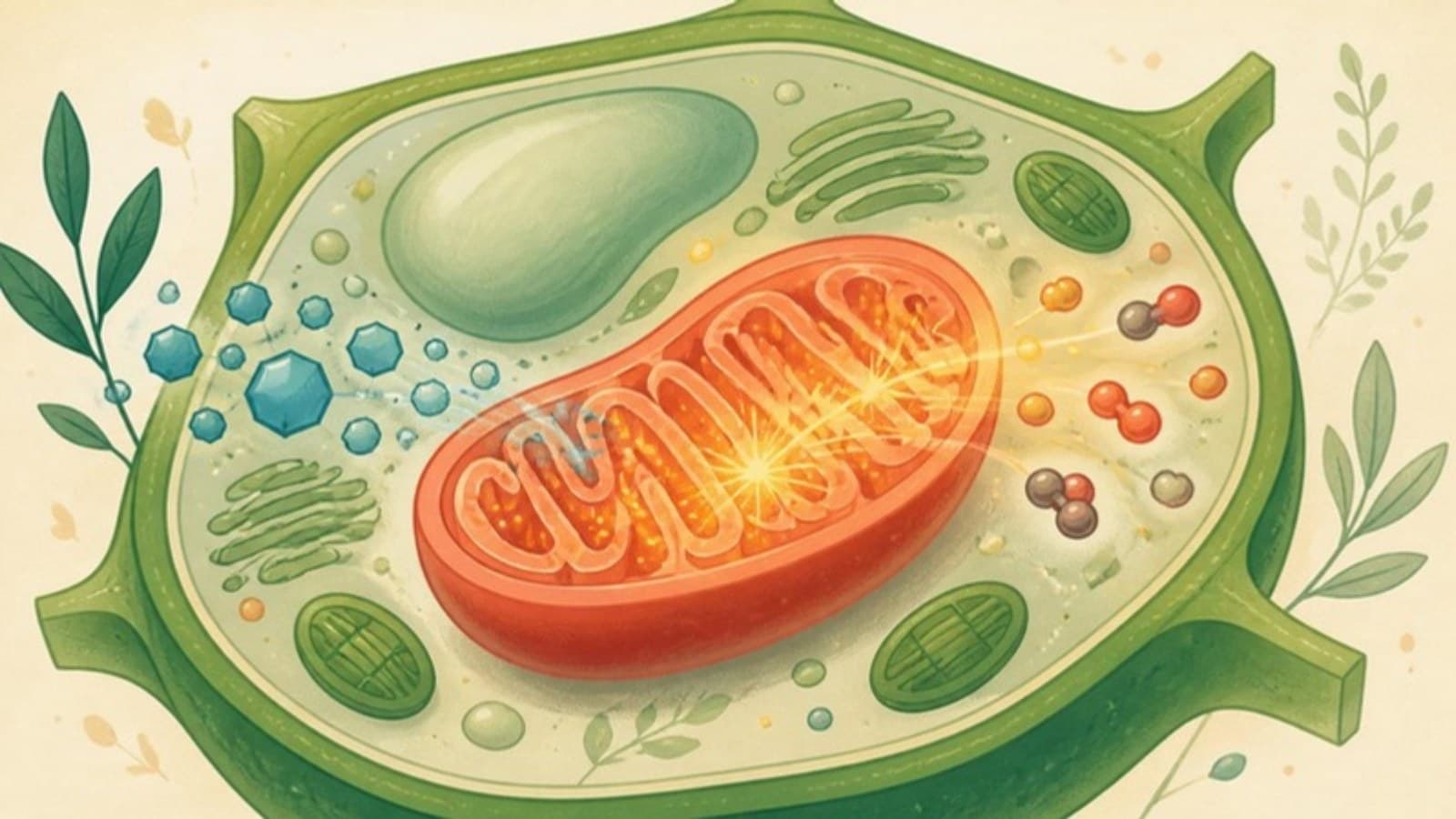
The ETS is located on the inner mitochondrial membrane. NADH and FADH2 produced in earlier stages donate their electrons to the chain, and the energy released is used to pump protons (H+) across the membrane, creating a gradient that drives ATP synthesis.
| Complex | Name | Electron Donor | Electron Acceptor | Protons Pumped |
|---|---|---|---|---|
| Complex I | NADH dehydrogenase | NADH | Ubiquinone (CoQ) | 4 H+ |
| Complex II | Succinate dehydrogenase | FADH2 | Ubiquinone (CoQ) | 0 H+ |
| Complex III | Cytochrome bc1 | Ubiquinol (CoQH2) | Cytochrome c | 4 H+ |
| Complex IV | Cytochrome c oxidase | Cytochrome c | O2 (final acceptor) | 2 H+ |
| Complex V | ATP synthase (F0-F1) | - | - | Uses H+ gradient |
NEET Tip: FADH2 enters at Complex II, bypassing Complex I. Therefore, FADH2 produces only 2 ATP (fewer protons pumped) compared to 3 ATP from NADH. Some textbooks use the updated values of 2.5 ATP per NADH and 1.5 ATP per FADH2.
| Stage | Location | ATP | NADH | FADH2 | ATP from NADH (x3) | ATP from FADH2 (x2) |
|---|---|---|---|---|---|---|
| Glycolysis | Cytoplasm | 2 | 2 | 0 | 6 | 0 |
| Link Reaction | Mitochondrial matrix | 0 | 2 | 0 | 6 | 0 |
| Krebs Cycle | Mitochondrial matrix | 2 | 6 | 2 | 18 | 4 |
| Total | 4 | 10 | 2 | 30 | 4 |
Grand Total: 4 + 30 + 4 = 38 ATP (theoretical maximum)
Actual yield: 36 ATP (because 2 NADH from glycolysis require 1 ATP each to shuttle into mitochondria via the glycerol phosphate shuttle)
Updated values (some textbooks): 30-32 ATP using 2.5 ATP/NADH and 1.5 ATP/FADH2
| Shuttle | Delivers to | ATP per NADH | Tissue |
|---|---|---|---|
| Malate-aspartate shuttle | Mitochondrial NADH | 3 ATP | Heart, liver |
| Glycerol phosphate shuttle | Mitochondrial FADH2 | 2 ATP | Skeletal muscle, brain |
NEET Tip: The net ATP yield is 36 or 38 depending on which shuttle system is used. NEET typically accepts 36 ATP as the standard answer.
The Respiratory Quotient is the ratio of the volume of CO2 evolved to the volume of O2 consumed during respiration.
RQ = CO2 evolved / O2 consumed
| Substrate | RQ Value | Explanation |
|---|---|---|
| Carbohydrates | 1.0 | Equal CO2 produced and O2 consumed |
| Fats | Less than 1 (approx. 0.7) | More O2 needed for oxidation of fats |
| Proteins | Approximately 0.8 | Intermediate value |
| Organic acids (malic acid, oxalic acid) | Greater than 1 (up to infinity) | More CO2 released than O2 consumed |
| Anaerobic respiration | Infinity | CO2 released but no O2 consumed |
NEET Tip: RQ greater than 1 indicates that the substrate is an organic acid. RQ of infinity indicates anaerobic respiration (no O2 consumed, but CO2 is still released in alcoholic fermentation).
Practice break
Reading is prep. Practising is progress.
Free to try · replies within a few hours on WhatsApp
The Krebs cycle is an amphibolic pathway because it functions in both catabolism (breakdown) and anabolism (synthesis).
NEET Tip: Since Krebs cycle intermediates are drawn off for biosynthesis, they must be replenished through anaplerotic reactions (e.g., pyruvate carboxylase converts pyruvate to oxaloacetate).
| Year | Topic Tested | Question Focus | Correct Answer |
|---|---|---|---|
| 2025 | Krebs Cycle | Enzyme located on inner mitochondrial membrane | Succinate dehydrogenase |
| 2024 | ETS | Final electron acceptor | Molecular oxygen (O2) |
| 2024 | Glycolysis | Net ATP gain per glucose | 2 ATP |
| 2023 | Krebs Cycle | Number of CO2 molecules released per glucose | 6 (2 in link + 4 in Krebs) |
| 2023 | RQ | RQ value for fats | Less than 1 |
| 2022 | Fermentation | Product of alcoholic fermentation | Ethanol + CO2 |
| 2022 | ETS | Inhibitor of Complex IV | Cyanide |
| 2021 | Glycolysis | Rate-limiting enzyme | Phosphofructokinase |
| 2021 | ATP yield | Total ATP from one glucose (aerobic) | 36 ATP |
| 2020 | Krebs Cycle | Substrate-level phosphorylation step | Succinyl CoA to succinate |
| 2020 | RQ | RQ of carbohydrates | 1.0 |
| 2019 | Fermentation | Organisms performing alcoholic fermentation | Yeast (Saccharomyces) |
| 2019 | Link Reaction | Product of pyruvate oxidation | Acetyl CoA + CO2 + NADH |
Q1. The net gain of ATP during glycolysis is:
Glycolysis produces 4 ATP but consumes 2 ATP in the preparatory phase (hexokinase and PFK steps), giving a net gain of 2 ATP.
Q2. Krebs cycle takes place in:
All Krebs cycle enzymes are present in the mitochondrial matrix, except succinate dehydrogenase which is on the inner mitochondrial membrane.
Q3. The final electron acceptor in the electron transport chain is:
Oxygen accepts electrons at Complex IV and combines with H+ ions to form water. Without oxygen, ETS stops completely.
Q4. The RQ value for fats is:
Fats have more hydrogen per molecule and require more O2 for complete oxidation than the CO2 they release, giving RQ less than 1 (approximately 0.7).
Q5. Which of the following is the rate-limiting enzyme of glycolysis?
PFK catalyses the third step of glycolysis and is the main regulatory enzyme. It is inhibited by ATP and citrate, and activated by AMP.
Q6. During the conversion of succinyl CoA to succinate in the Krebs cycle:
This is the only step in the Krebs cycle that produces ATP (as GTP) by substrate-level phosphorylation.
Q7. How many NADH molecules are produced per glucose molecule in the Krebs cycle?
Each turn of the Krebs cycle produces 3 NADH. Since two acetyl CoA molecules enter per glucose, total NADH from Krebs = 3 x 2 = 6.
Q8. Cyanide is a poison that inhibits:
Cyanide binds to cytochrome c oxidase (Complex IV), preventing the transfer of electrons to oxygen. This stops ATP production and is lethal.
Q9. The Krebs cycle is called an amphibolic pathway because:
Amphibolic means it serves both catabolic (energy release) and anabolic (biosynthetic) functions. Krebs cycle intermediates are precursors for amino acids, fats, and haem.
Q10. In alcoholic fermentation, pyruvate is first converted to:
Pyruvate is first decarboxylated to acetaldehyde (by pyruvate decarboxylase), which is then reduced to ethanol (by alcohol dehydrogenase) using NADH.
Krebs Cycle intermediates - "Can I Keep Selling Sex For Money, Officer?" Citrate, Isocitrate, alpha-Ketoglutarate, Succinyl CoA, Succinate, Fumarate, Malate, Oxaloacetate
Glycolysis steps (energy investment vs payoff):
ETS inhibitors - "RACO":
RQ values - "Carbs are Fair, Fats are Lean":
ATP yield - "2, 2, 2 rule":
Q: Why is glycolysis considered a universal pathway? A: Glycolysis occurs in all living organisms (prokaryotes and eukaryotes) in the cytoplasm without requiring oxygen. It is considered the most ancient metabolic pathway, predating the evolution of mitochondria and aerobic respiration.
Q: Why does anaerobic respiration produce much less ATP than aerobic respiration? A: In anaerobic respiration, only glycolysis occurs (2 ATP). The NADH produced is used to reduce pyruvate during fermentation rather than entering the ETS. Without the Krebs cycle and ETS, the majority of potential energy in glucose remains trapped in the end products (ethanol or lactic acid).
Q: What happens if oxygen is suddenly removed during aerobic respiration? A: ETS stops immediately because there is no final electron acceptor. NADH and FADH2 accumulate and cannot be reoxidised. The Krebs cycle and link reaction slow down and eventually stop. The cell switches to fermentation to regenerate NAD+ and maintain glycolysis. This is called the Pasteur effect.
Q: Why is the Krebs cycle called a cycle? A: Oxaloacetate (4C), which is the starting molecule, is regenerated at the end of each turn. Acetyl CoA (2C) enters, two carbons leave as CO2, and the 4C oxaloacetate is reformed to accept the next acetyl CoA. The intermediates are catalytic, not consumed.
Q: How does the ATP synthase enzyme work? A: ATP synthase (F0-F1 complex) acts as a molecular turbine. The F0 component is a proton channel in the inner mitochondrial membrane. As protons flow down their concentration gradient through F0, it causes rotation of the F1 component in the matrix. This mechanical rotation provides the energy to catalyse the binding of ADP and Pi to form ATP. Approximately 3-4 protons are needed to synthesise one ATP molecule.
The net ATP yield from glycolysis, Krebs cycle and ETS is one of the most commonly miscalculated numbers in this chapter. Message us on WhatsApp at +91 88264 44334 with the ATP-yield calculation you're stuck on, and we'll walk through where the count usually goes wrong.
Related reading: Photosynthesis Complete NEET Guide · NEET Plant Physiology Weightage Analysis · Class 11 Biology Coaching
Related resources

About the author
Dr. Shekhar C. Singh
AIIMS New Delhi alumnus who has taught biology since 2014, from NCERT foundations to the International Biology Olympiad.
Read his full profile →Get personalized guidance from AIIMS experts and achieve your medical college dreams
More from the blog
Master Nervous System for NEET 2026 with comprehensive notes on neuron structure, nerve impulse, brain anatomy, and reflex action. NCERT-aligned content with diagrams and PYQs.
12 Jun 2026
Master Photosynthesis for NEET 2026 with comprehensive notes on light reactions, Calvin cycle, C3, C4, and CAM pathways. NCERT-aligned content with diagrams and previous year questions.
12 Jun 2026
Master Animal Kingdom classification for NEET 2026 with this complete guide covering all non-chordate and chordate phyla, basis of classification, vertebrate classes, mnemonics, PYQs, and 12 practice MCQs aligned with NCERT.
2 Mar 2026
Share your thoughts, ask a question, or help another student
Type it below and send it to us on WhatsApp — no sign-up needed.
For NEET Biology, aim for 3-4 hours of focused study daily. Quality matters more than quantity!
Yes! NCERT covers 95% of NEET Biology questions. Master it completely before any reference book.
Human Physiology (20%), Genetics (18%), and Ecology (12%) are the highest-scoring areas.
Need personalized guidance?