Loading...
Loading...
Master Biological Classification for NEET 2026 with detailed notes on Whittaker Five Kingdom System, Monera, Protista, Fungi, Viruses, Viroids, and Lichens. Includes NCERT-aligned content, PYQs, and practice MCQs.

5 points to remember for NEET
Biological Classification is one of the highest-weightage chapters from Class 11 in NEET, contributing 3-4 questions every year. This chapter requires a systematic approach since it covers diverse organisms from bacteria to fungi. This guide provides complete NCERT-aligned notes with tables, PYQs, and practice MCQs.
Before Whittaker's five-kingdom classification became the accepted standard, several earlier systems were proposed.
Carolus Linnaeus divided all organisms into two kingdoms:
Limitations: Unicellular organisms like Euglena (both autotrophic and motile) could not be placed. Fungi, which are heterotrophic, were placed under Plantae. Prokaryotes and eukaryotes were grouped together.
NEET Tip: Questions often test why the two-kingdom system was inadequate. Remember Euglena as the classic example of an organism that does not fit neatly into either kingdom.
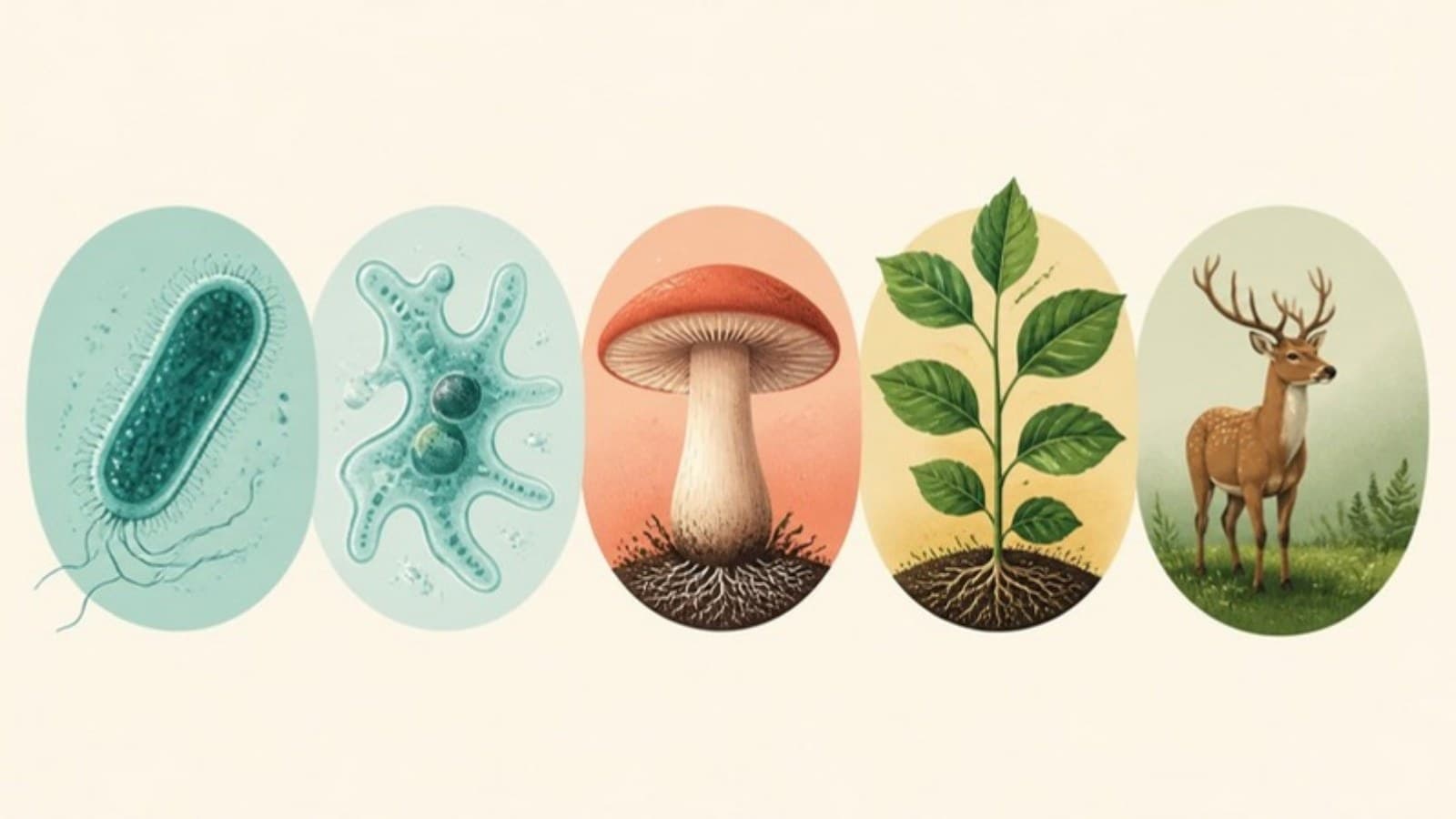
R.H. Whittaker proposed the five-kingdom system based on five criteria:
| Kingdom | Cell Type | Organization | Nutrition | Cell Wall | Examples |
|---|---|---|---|---|---|
| Monera | Prokaryotic | Unicellular | Auto/Heterotrophic | Non-cellulosic | Bacteria, Cyanobacteria |
| Protista | Eukaryotic | Unicellular | Auto/Heterotrophic | Present in some | Amoeba, Euglena, Diatoms |
| Fungi | Eukaryotic | Multi/Unicellular | Heterotrophic (absorptive) | Chitin | Mucor, Agaricus, Yeast |
| Plantae | Eukaryotic | Multicellular | Autotrophic (photosynthetic) | Cellulose | Ferns, Angiosperms |
| Animalia | Eukaryotic | Multicellular | Heterotrophic (ingestive) | Absent | Insects, Mammals |
Kingdom Monera includes all prokaryotic organisms. They lack a true nucleus and membrane-bound organelles. Cell walls are present but are not made of cellulose. Monera is divided into Archaebacteria and Eubacteria.
Archaebacteria are the oldest living organisms and survive in extreme, harsh environments. Their cell walls lack peptidoglycan, which distinguishes them from eubacteria.
| Type | Habitat | Example |
|---|---|---|
| Methanogens | Marshy areas, gut of ruminants | Methanobacterium |
| Halophiles | Extremely salty environments | Halobacterium |
| Thermoacidophiles | Hot springs (high temperature, low pH) | Thermoplasma, Sulfolobus |
NEET Tip: Methanogens in the gut of cattle produce methane (biogas). This is a frequently tested fact. Remember: Methanogens = Marshy areas + Manure (biogas plants).
Eubacteria have a rigid cell wall made of peptidoglycan and a flagellum for motility (if present).
| Shape | Description | Example |
|---|---|---|
| Coccus | Spherical | Staphylococcus |
| Bacillus | Rod-shaped | Bacillus subtilis |
| Spirillum | Spiral/Helical | Spirillum volutans |
| Vibrio | Comma-shaped | Vibrio cholerae |
NEET Tip: Mycoplasma is the only prokaryote without a cell wall. This is one of the most asked facts from this section.
Kingdom Protista includes eukaryotic, primarily unicellular organisms that form a link between prokaryotes and the complex multicellular kingdoms. Members show diverse modes of nutrition.
| Group | Nutrition | Movement | Cell Wall | Key Feature | Examples |
|---|---|---|---|---|---|
| Chrysophytes | Autotrophic | Passive/Flagella | Siliceous | Diatomaceous earth | Diatoms, Golden algae |
| Dinoflagellates | Autotrophic | Two flagella | Cellulose plates | Red tides | Gonyaulax, Noctiluca |
| Euglenoids | Auto/Heterotrophic | Flagella | Pellicle (no cell wall) | Mixotrophic | Euglena |
| Slime Moulds | Heterotrophic (saprophytic) | Amoeboid | Absent (during feeding) | Spores with true walls | Physarum, Dictyostelium |
| Protozoans | Heterotrophic | Various | Absent | Classified by locomotion | Amoeba, Plasmodium, Paramecium |
| Class | Locomotory Organ | Example | Disease (if any) |
|---|---|---|---|
| Amoeboid (Sarcodina) | Pseudopodia | Amoeba, Entamoeba | Amoebic dysentery |
| Flagellated (Mastigophora) | Flagella | Trypanosoma | Sleeping sickness |
| Ciliated (Ciliophora) | Cilia | Paramecium, Vorticella | - |
| Sporozoans (Apicomplexa) | None (non-motile) | Plasmodium | Malaria |
NEET Tip: Diatoms are called the "chief producers" in oceans. Their cell walls (frustules) contain silica and do not decay easily, forming diatomaceous earth used in filtration and polishing.
Fungi are heterotrophic, eukaryotic organisms with cell walls made of chitin. They show absorptive nutrition by secreting enzymes outside the body and absorbing dissolved nutrients.
Between plasmogamy and karyogamy, a dikaryotic stage (n + n) exists in Ascomycetes and Basidiomycetes.
| Feature | Phycomycetes | Ascomycetes | Basidiomycetes | Deuteromycetes |
|---|---|---|---|---|
| Common name | Algal fungi | Sac fungi | Club fungi | Imperfect fungi |
| Mycelium | Aseptate, coenocytic | Septate, branched | Septate, branched | Septate, branched |
| Asexual spores | Zoospores, aplanospores | Conidia | Generally absent | Conidia only |
| Sexual spores | Oospore / Zygospore | Ascospores (in ascus) | Basidiospores (on basidium) | Absent (unknown) |
| Fruiting body | Absent | Ascocarp | Basidiocarp | Absent |
| Sexual reproduction | Isogamy/Anisogamy/Oogamy | Ascogonium + Antheridium | Somatogamy (no sex organs) | Not known |
| Examples | Mucor, Rhizopus, Albugo | Aspergillus, Claviceps, Neurospora, Saccharomyces (yeast) | Agaricus (mushroom), Puccinia (rust), Ustilago (smut) | Alternaria, Colletotrichum, Trichoderma |
NEET Tip: Remember "DACB" for the order from primitive to advanced: Deuteromycetes don't have sexual reproduction known, so they are "imperfect." Ascomycetes produce ascospores in an ascus (sac). Basidiomycetes produce basidiospores on a basidium (club). Phycomycetes are most primitive with coenocytic hyphae.
Viruses are acellular, obligate intracellular parasites that are neither truly living nor non-living. They are not placed in any of the five kingdoms.
Structure:
| Feature | TMV (Tobacco Mosaic Virus) | Bacteriophage |
|---|---|---|
| Host | Tobacco plant | Bacteria (E. coli) |
| Genetic material | RNA (single-stranded) | DNA (double-stranded) |
| Shape | Rod-shaped | Tadpole-shaped |
| Discoverer | D.J. Ivanowsky (1892) | Twort (1915) / d'Herelle (1917) |
NEET Tip: Ivanowsky discovered TMV but called it "contagium vivum fluidum." W.M. Stanley (1935) first crystallized TMV and showed viruses are made of protein. This sequence is frequently tested.
Practice break
Reading is prep. Practising is progress.
Free to try · replies within a few hours on WhatsApp
Lichens are symbiotic associations between:
Key Facts:
| Year | Question Topic | Correct Answer |
|---|---|---|
| 2025 | Characteristic feature of Euglenoids | Pellicle instead of cell wall |
| 2024 | Deuteromycetes are called imperfect fungi because | Sexual reproduction is unknown |
| 2024 | Which is not a character of Archaebacteria | Peptidoglycan cell wall |
| 2023 | Diatomaceous earth is formed by | Siliceous frustules of diatoms |
| 2023 | Mycoplasma differs from bacteria in | Lacking a cell wall |
| 2022 | Cyanobacteria are classified under | Kingdom Monera |
| 2022 | Dikaryotic stage is found in | Ascomycetes and Basidiomycetes |
| 2021 | Methanogens belong to | Archaebacteria |
| 2021 | Lichens indicate | SO2 pollution (they cannot grow in polluted areas) |
| 2020 | TMV has genetic material as | RNA |
| 2020 | Which is a slime mould | Physarum |
| 2019 | Parasitic fungus on mustard | Albugo |
| 2019 | Contagium vivum fluidum was given by | M.W. Beijerinck |
Whittaker's Five Criteria: "Can Biology Never Really Puzzle" - Cell structure, Body organization, Nutrition, Reproduction, Phylogeny
Archaebacteria Types: "Methane Heats Things" - Methanogens, Halophiles, Thermoacidophiles
Bacterial Shapes: "Come Back Soon Vicky" - Coccus (sphere), Bacillus (rod), Spirillum (spiral), Vibrio (comma)
Fungal Classes Order (primitive to advanced): "Please Ask Before Disturbing" - Phycomycetes, Ascomycetes, Basidiomycetes, Deuteromycetes
Protozoan Classes: "All Four Classes Studied" - Amoeboid, Flagellated, Ciliated, Sporozoans
Sexual Reproduction Steps in Fungi: "Play King's Move" - Plasmogamy, Karyogamy, Meiosis
Q1. Whittaker's classification is based on all of the following criteria EXCEPT:
Habitat is not one of Whittaker's five criteria. The five criteria are cell structure, body organization, mode of nutrition, reproduction, and phylogenetic relationships.
Q2. Which of the following is a characteristic feature of Archaebacteria that distinguishes them from Eubacteria?
Archaebacteria have a different cell wall composition that lacks peptidoglycan, unlike Eubacteria.
Q3. Mycoplasma is unique among prokaryotes because:
Mycoplasma is the only prokaryote that completely lacks a cell wall, making it pleomorphic and resistant to penicillin.
Q4. Red tide in the sea is caused by:
Dinoflagellates like Gonyaulax multiply rapidly and cause red tides. Their toxins can kill marine organisms.
Q5. Which of the following fungi is used extensively in biochemical and genetic studies?
Neurospora (red bread mould) is an ascomycete used extensively in genetic and biochemical studies. Beadle and Tatum used it for their one gene-one enzyme hypothesis.
Q6. Dikaryophase is a characteristic feature of:
The dikaryotic stage (n + n) occurs between plasmogamy and karyogamy, and is found in Ascomycetes and Basidiomycetes.
Q7. Diatomaceous earth is used in all of the following EXCEPT:
Diatomaceous earth (made of siliceous frustules of diatoms) is used in polishing, filtration, and insulation, but not in antibiotic production.
Q8. Which of the following statements about viroids is correct?
Viroids are free RNA molecules without a protein coat, discovered by T.O. Diener. They are smaller than viruses and infect plants.
Q9. Lichens are important indicators of:
Lichens are very sensitive to sulphur dioxide (SO2) and cannot grow in polluted areas, making them excellent bioindicators of air quality.
Q10. Which of the following is incorrectly matched?
Alternaria belongs to Deuteromycetes (imperfect fungi), not Ascomycetes. It reproduces only asexually through conidia.
Q: Why are Deuteromycetes called "imperfect fungi"? A: Because their sexual reproduction cycle (perfect stage) has not been discovered. They reproduce only by asexual means (conidia). When the sexual stage is discovered, they are reclassified into Ascomycetes or Basidiomycetes.
Q: How do Archaebacteria survive in extreme environments? A: Archaebacteria have a unique cell wall composition (lacking peptidoglycan) and special lipids in their cell membrane (branched-chain lipids) that make them resistant to extreme temperatures, high salt concentrations, and acidic conditions.
Q: Why is Euglena considered a connecting link between plants and animals? A: Euglena is photosynthetic like plants (has chloroplasts) but can also be heterotrophic in the dark. It has a pellicle instead of a cell wall and moves using flagella, which are animal-like features. This dual nature makes it a connecting link.
Q: What is the difference between a virus and a viroid? A: A virus has a protein coat (capsid) surrounding its nucleic acid (DNA or RNA), while a viroid is just free RNA without any protein coat. Viroids are smaller than viruses and infect only plants, whereas viruses can infect all types of organisms.
Q: Why are lichens called pioneer species? A: Lichens can colonize bare rocks where no other organism can grow. The fungal component secretes acids that slowly break down the rock surface, creating a thin layer of soil. Over time, this allows other plants to establish, beginning ecological succession.
The five-kingdom boundaries are exactly where NEET plants its trickiest one-liners. Message us on WhatsApp at +91 88264 44334 with the two kingdoms you keep confusing, and we'll send back the exact features NEET has tested to separate them.
Related reading: Plant Kingdom Classification Notes · Animal Kingdom Classification Guide · Class 11 Biology Coaching
Related resources

About the author
Dr. Shekhar C. Singh
AIIMS New Delhi alumnus who has taught biology since 2014, from NCERT foundations to the International Biology Olympiad.
Read his full profile →Get personalized guidance from AIIMS experts and achieve your medical college dreams
More from the blog
Master Cell Division for NEET 2026 with comprehensive notes on cell cycle, mitosis, meiosis, and their significance. NCERT-aligned content with diagrams and previous year questions.
12 Jun 2026
Master Cell Biology for NEET 2026 with comprehensive notes covering cell theory, prokaryotic vs eukaryotic cells, cell organelles, and their functions. NCERT-based content with previous year questions.
12 Jun 2026
Master Excretion for NEET 2026 with comprehensive notes on kidney structure, nephron function, urine formation, and regulation. NCERT-aligned content with diagrams and PYQs.
12 Jun 2026
Share your thoughts, ask a question, or help another student
Type it below and send it to us on WhatsApp — no sign-up needed.
For NEET Biology, aim for 3-4 hours of focused study daily. Quality matters more than quantity!
Yes! NCERT covers 95% of NEET Biology questions. Master it completely before any reference book.
Human Physiology (20%), Genetics (18%), and Ecology (12%) are the highest-scoring areas.
Need personalized guidance?