Loading...
Loading...
Master Mineral Nutrition for NEET 2026 with detailed notes on essential elements, macronutrients vs micronutrients, deficiency symptoms, nitrogen fixation, and hydroponics. NCERT-aligned with PYQs and practice MCQs.

5 points to remember for NEET
Mineral Nutrition is a consistently tested chapter in NEET, contributing 2-3 questions per year. It covers essential elements, their roles in plant metabolism, deficiency symptoms, and nitrogen metabolism. This chapter from Class 11 Biology requires strong conceptual clarity and factual recall.
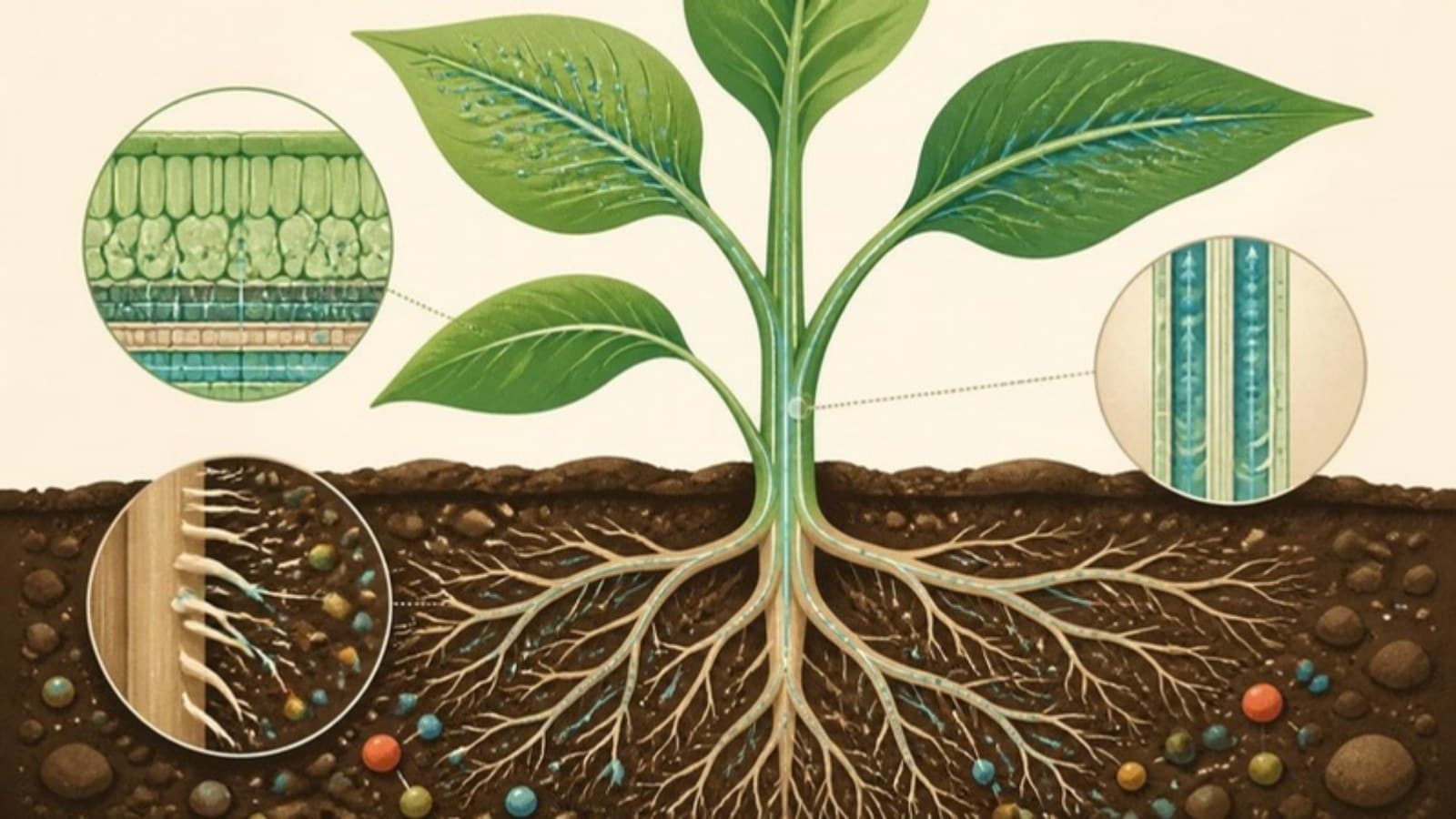
Mineral nutrition refers to the absorption and utilization of mineral ions by plants for their growth, development, and metabolism. Plants obtain carbon and oxygen from CO2, hydrogen from water, and the remaining elements from the soil as mineral ions dissolved in water.
NEET Tip: Plants require both organic nutrients (synthesized through photosynthesis) and inorganic minerals (absorbed from soil). This chapter focuses on the inorganic mineral component.
Arnon and Stout (1939) proposed three criteria to determine whether an element is essential for plant growth:
Based on these criteria, 17 elements have been identified as essential for most higher plants. Carbon, hydrogen, and oxygen come from CO2 and water, while the remaining 14 are absorbed from soil.
NEET Tip: Remember the three criteria of Arnon and Stout - they are directly asked in NEET. The key word is "irreplaceable."
Essential elements are classified based on the quantity required by plants:
Required in concentrations greater than 10 mmol per kg of dry matter. There are 9 macronutrients.
| Element | Symbol | Mobile/Immobile | Key Functions | Deficiency Symptom |
|---|---|---|---|---|
| Carbon | C | - | Structural backbone of all organic molecules | - |
| Hydrogen | H | - | Component of water and organic molecules | - |
| Oxygen | O | - | Component of organic molecules, electron acceptor | - |
| Nitrogen | N | Mobile | Proteins, nucleic acids, chlorophyll, vitamins, hormones | Chlorosis in older leaves, stunted growth |
| Phosphorus | P | Mobile | ATP, nucleic acids, phospholipids, sugar phosphates | Purple/dark green leaves, delayed maturity |
| Potassium | K | Mobile | Enzyme activator, osmotic regulation, stomatal opening | Scorching of leaf margins (older leaves first) |
| Calcium | Ca | Immobile | Cell wall (middle lamella), membrane stability, enzyme cofactor | Deformed growing tips, necrosis of young meristems |
| Magnesium | Mg | Mobile | Central atom of chlorophyll, enzyme activator (kinases) | Interveinal chlorosis in older leaves |
| Sulphur | S | Immobile | Amino acids (cysteine, methionine), coenzyme A, ferredoxin | General chlorosis, similar to N deficiency |
Required in concentrations less than 10 mmol per kg of dry matter. There are 8 micronutrients.
| Element | Symbol | Mobile/Immobile | Key Functions | Deficiency Symptom |
|---|---|---|---|---|
| Iron | Fe | Immobile | Electron transport, ferredoxin, cytochromes, catalase | Interveinal chlorosis in young leaves |
| Manganese | Mn | Immobile | Photolysis of water (Hill reaction), enzyme activator | Interveinal chlorosis, grey spots on leaves |
| Zinc | Zn | Immobile | Auxin synthesis (tryptophan pathway), carboxylase activator | Little leaf disease, shortened internodes |
| Copper | Cu | Immobile | Plastocyanin, cytochrome oxidase, phenolase | Recurrent dieback of shoots, necrosis |
| Molybdenum | Mo | Mobile | Nitrogenase, nitrate reductase | Whiptail disease (in cauliflower) |
| Boron | B | Immobile | Cell wall formation, pollen germination, sugar transport | Death of shoot tips, stout/twisted roots |
| Chlorine | Cl | Mobile | Photolysis of water (with Mn), maintains cell turgor | Wilting of leaf tips, chlorosis |
| Nickel | Ni | Mobile | Urease enzyme | Toxic accumulation of urea in leaf tips |
NEET Tip: Mnemonic for micronutrients - "Fe Mn ZiNCu MoB Cl Ni" (say "Iron Man Zinc Copper Mob Chlorine Nickel"). The most commonly asked micronutrient functions are Mo (nitrogenase), Mn (photolysis), and Zn (auxin synthesis).
Deficiency symptoms are visible morphological changes in plants when a mineral element is below the critical concentration.
| Symptom | Description | Elements Involved |
|---|---|---|
| Chlorosis | Yellowing of leaves due to loss of chlorophyll | N, K, Mg, S, Fe, Mn, Zn, Mo |
| Necrosis | Death of tissue, forming brown/black patches | Ca, Mg, Cu, K |
| Stunted growth | Reduced height and overall size | N, P, S, Ca |
| Inhibition of cell division | Failure of meristematic regions | N, K, S, Mo |
| Delayed flowering | Late or absent reproductive development | P, Mo, S |
| Anthocyanin accumulation | Purple/red discoloration | P deficiency |
NEET Tip: This is one of the most frequently tested concepts. Always remember: mobile elements cause symptoms in OLD leaves; immobile elements cause symptoms in NEW/YOUNG leaves.
Any mineral ion concentration in tissue that reduces dry weight by 10% is considered toxic. Manganese toxicity is common and causes brown spots on leaves surrounded by chlorotic veins.
Toxicity symptoms:
Hydroponics is the technique of growing plants in nutrient solution without soil. It was developed by Julius von Sachs (1860).
Technique:
Advantages:
NEET Tip: Hydroponics proved that plants do not need soil but need mineral nutrients. This experiment was key to identifying the 17 essential elements.
Nitrogen is the most abundant mineral element in plants and is a major component of proteins, nucleic acids, and chlorophyll. However, atmospheric N2 cannot be directly used by most plants.
The nitrogen cycle involves the following processes:
Biological nitrogen fixation is the reduction of atmospheric N2 to ammonia (NH3) by living organisms using the enzyme nitrogenase.
Organisms involved:
| Type | Example Organisms |
|---|---|
| Free-living aerobic | Azotobacter, Cyanobacteria (Nostoc, Anabaena) |
| Free-living anaerobic | Clostridium, Rhodospirillum |
| Symbiotic | Rhizobium (with legumes), Frankia (with Alnus) |
| Loose associations | Azospirillum (with grasses) |
This is the most important example of biological nitrogen fixation for NEET:
The Nitrogenase Enzyme:
Leghemoglobin:
NEET Tip: Leghemoglobin is produced cooperatively by both partners. Without it, nitrogenase would be inactivated by oxygen. This is a frequently asked fact.
Practice break
Reading is prep. Practising is progress.
Free to try · replies within a few hours on WhatsApp
Decomposition of organic nitrogenous compounds (dead organisms, excretion) into ammonia by soil microbes like Bacillus and Clostridium.
Two-step conversion:
Plants primarily absorb nitrogen as NO3- (nitrate), which is then reduced to NH3 inside the plant by nitrate reductase (requires Mo as cofactor).
Conversion of nitrate back to gaseous nitrogen (N2) by anaerobic bacteria like Pseudomonas and Thiobacillus. This process returns nitrogen to the atmosphere and reduces soil fertility.
| Year | Topic Asked | Correct Answer |
|---|---|---|
| 2025 | Role of Mo in nitrogen fixation | Component of nitrogenase and nitrate reductase |
| 2024 | Leghemoglobin function in root nodules | Oxygen scavenger protecting nitrogenase |
| 2023 | Deficiency symptoms in mobile vs immobile elements | Mobile element deficiency appears in older leaves |
| 2022 | Essential micronutrient for photolysis of water | Manganese |
| 2021 | Hydroponics technique and its significance | Growing plants in nutrient solution without soil |
| 2020 | Nitrogenase enzyme - conditions required | Anaerobic conditions (oxygen-free) |
| 2019 | Criteria for essentiality of mineral elements | Arnon and Stout's three criteria |
NEET Tip: Notice that nitrogen metabolism (particularly nitrogenase, leghemoglobin, and the nitrogen cycle) is the most frequently tested subtopic. Master the Rhizobium-legume symbiosis thoroughly.
Q1. Which of the following is NOT a criterion for essentiality of an element proposed by Arnon and Stout?
Explanation: Arnon and Stout's three criteria are: absolute necessity, specificity/irreplaceability, and direct involvement in metabolism. Equal concentration in all plants is not a criterion.
Q2. Deficiency of which micronutrient causes "whiptail disease" in cauliflower?
Explanation: Molybdenum deficiency causes whiptail disease in cauliflower. Mo is a component of nitrogenase and nitrate reductase enzymes.
Q3. Leghemoglobin, found in root nodules of legumes, functions as:
Explanation: Leghemoglobin is a pink pigment that removes oxygen from the nodule environment, protecting the oxygen-sensitive nitrogenase enzyme.
Q4. Which of the following elements is a constituent of the chlorophyll molecule?
Explanation: Magnesium (Mg) is the central atom of the chlorophyll molecule. Iron is part of cytochromes and ferredoxin, not chlorophyll.
Q5. In nitrification, the conversion of ammonia to nitrite is carried out by:
Explanation: Nitrosomonas converts NH3 to NO2- (nitrite). Nitrobacter then converts NO2- to NO3- (nitrate). Pseudomonas carries out denitrification.
Q6. An element that is a part of nitrogenase enzyme and is also required for nitrate reductase activity is:
Explanation: Molybdenum is a component of both nitrogenase (Mo-Fe protein) and nitrate reductase. This dual role makes it critical for nitrogen metabolism.
Q7. Zinc deficiency in plants causes:
Explanation: Zinc deficiency causes little leaf disease (reduced leaf size) and shortened internodes because Zn is required for auxin biosynthesis via the tryptophan pathway.
Q8. During biological nitrogen fixation, the
total number of ATP molecules required to fix one molecule of N2 is:
Explanation: The reaction is: N2 + 8H+ + 8e- + 16ATP --> 2NH3 + H2 + 16ADP + 16Pi. Thus, 16 ATP molecules are consumed per N2 molecule fixed.
Q: What is the difference between macronutrients and micronutrients? A: Macronutrients are required in concentrations greater than 10 mmol/kg of dry matter (e.g., N, P, K), while micronutrients are needed in trace amounts less than 10 mmol/kg (e.g., Fe, Mn, Zn). Both are equally essential for plant growth - the classification is based purely on quantity required, not importance.
Q: Why does nitrogen deficiency cause chlorosis in older leaves first? A: Nitrogen is a mobile element. When deficient, the plant redistributes nitrogen from older leaves to younger, actively growing leaves. This causes the older leaves to lose chlorophyll first, appearing yellow (chlorosis).
Q: Why does nitrogenase require anaerobic conditions? A: Nitrogenase enzyme is irreversibly inactivated by molecular oxygen. The Mo-Fe protein component is extremely oxygen-sensitive. In root nodules, leghemoglobin scavenges oxygen to maintain the low-oxygen environment needed for nitrogenase activity.
Q: What is the role of Molybdenum in plants? A: Molybdenum has a dual role in nitrogen metabolism. It is a component of nitrogenase (the enzyme that fixes atmospheric N2 into NH3) and also required for nitrate reductase (the enzyme that reduces NO3- to NO2- in plants). Its deficiency causes whiptail disease in cauliflower.
Q: Can plants grow without soil? A: Yes. Hydroponics demonstrates that plants can grow perfectly well without soil, as long as all essential mineral nutrients are provided in an aqueous solution. Soil serves as a reservoir of minerals and physical support, but is not inherently necessary for plant nutrition.
Chlorosis, necrosis and stunted growth show up across several mineral deficiencies, and NEET options are written to exploit exactly that overlap. Message us on WhatsApp at +91 88264 44334 with the two deficiency symptoms you keep confusing, and we'll send the distinguishing visual cues NEET questions actually rely on.
Related reading: Plant Growth and Development Notes · NEET Plant Physiology Weightage Analysis · Class 11 Biology Coaching
Related resources

About the author
Dr. Shekhar C. Singh
AIIMS New Delhi alumnus who has taught biology since 2014, from NCERT foundations to the International Biology Olympiad.
Read his full profile →Get personalized guidance from AIIMS experts and achieve your medical college dreams
More from the blog
Master Cell Division for NEET 2026 with comprehensive notes on cell cycle, mitosis, meiosis, and their significance. NCERT-aligned content with diagrams and previous year questions.
12 Jun 2026
Master Cell Biology for NEET 2026 with comprehensive notes covering cell theory, prokaryotic vs eukaryotic cells, cell organelles, and their functions. NCERT-based content with previous year questions.
12 Jun 2026
Master Excretion for NEET 2026 with comprehensive notes on kidney structure, nephron function, urine formation, and regulation. NCERT-aligned content with diagrams and PYQs.
12 Jun 2026
Share your thoughts, ask a question, or help another student
Type it below and send it to us on WhatsApp — no sign-up needed.
For NEET Biology, aim for 3-4 hours of focused study daily. Quality matters more than quantity!
Yes! NCERT covers 95% of NEET Biology questions. Master it completely before any reference book.
Human Physiology (20%), Genetics (18%), and Ecology (12%) are the highest-scoring areas.
Need personalized guidance?