Loading...
Loading...
Master Plant Growth and Development for NEET 2026 with detailed notes on growth phases, five phytohormones (auxin, gibberellin, cytokinin, ABA, ethylene), photoperiodism, vernalization, and seed dormancy. NCERT-aligned with PYQ analysis and MCQs.

6 points to remember for NEET
Plant Growth and Development is an important chapter from Class 11 Biology that regularly contributes 2-3 questions in NEET. The chapter covers growth phases, phytohormones and their functions, photoperiodism, and vernalization. Mastering the five plant hormones and their interactions is the key to scoring well.
This chapter tests both conceptual understanding and factual recall. Questions frequently appear on hormone functions, photoperiodism classification, and hormone interactions. The five phytohormones table is one of the most tested topics in the entire Plant Physiology section.
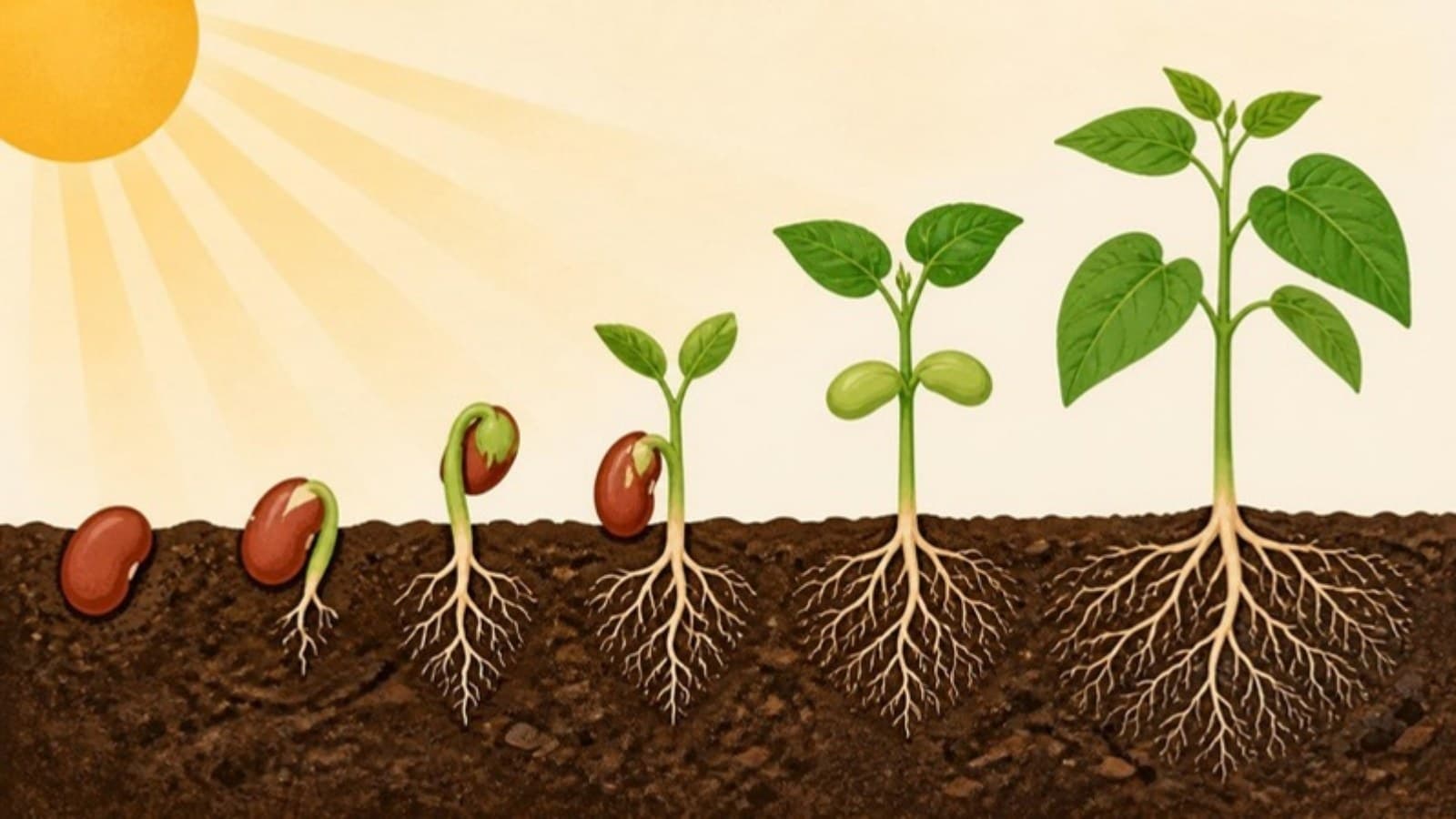
Growth in plants is a permanent, irreversible increase in size, volume, or mass of cells, organs, or the whole organism. Unlike animals, plant growth is indeterminate because plants retain the ability to grow throughout their life due to the presence of meristems.
Cells pass through three distinct phases during growth:
NEET Tip: The three phases are sequential: division leads to enlargement leads to differentiation. This sequence is clearly visible in a longitudinal section of a root tip.
Growth rate is the increase in growth per unit time. It can be measured as increase in cell number, length, area, volume, or dry weight.
The S-shaped curve has three phases:
| Phase | Description |
|---|---|
| Lag phase | Initial slow growth; cells prepare for division |
| Log/Exponential phase | Rapid growth; maximum cell division |
| Stationary/Plateau phase | Growth slows and stops due to limiting factors |
NEET Tip: The sigmoid curve is seen in all organisms and populations. In plants, it represents the growth of an organ (like a leaf) from initiation to full size.
| Factor | Role |
|---|---|
| Water | Provides turgidity for cell enlargement; medium for enzymatic reactions |
| Oxygen | Required for aerobic respiration to generate energy for growth |
| Nutrients | Macro and micronutrients for synthesis of protoplasm |
| Temperature | Optimum temperature needed for enzyme activity |
| Light | Provides energy for photosynthesis; also influences growth direction |
| Process | Description | Example |
|---|---|---|
| Differentiation | Permanent structural and functional changes in meristematic cells to form specialized tissues | Meristematic cells forming xylem, phloem |
| Dedifferentiation | Mature, differentiated cells regain the ability to divide | Formation of interfascicular cambium from parenchyma |
| Redifferentiation | Dedifferentiated cells mature again and lose the ability to divide | Secondary xylem and phloem formed from cambium |
NEET Tip: Dedifferentiation is the basis of tissue culture and callus formation. It proves that mature plant cells retain totipotency.
Phytohormones are naturally occurring organic substances that regulate plant growth and development at very low concentrations. They are classified into growth promoters (auxin, gibberellin, cytokinin) and growth inhibitors (ABA, ethylene in some contexts).
| Hormone | Chemical Nature | Discovery/Source | Key Functions | Agricultural Use |
|---|---|---|---|---|
| Auxin (IAA) | Indole-3-acetic acid | F.W. Went (1928); synthesized at shoot apex | Apical dominance, phototropism, cell elongation, parthenocarpy, root initiation | 2,4-D as herbicide; NAA for rooting; inducing parthenocarpy in tomatoes |
| Gibberellin (GA3) | Terpenoid | E. Kurosawa (1926); Gibberella fujikuroi fungus | Stem elongation, bolting, seed germination, breaking dormancy, parthenocarpy | Breaking seed dormancy in cereals; elongation of grape stalks; brewing industry |
| Cytokinin (Zeatin) | Adenine derivatives | F. Skoog & C. Miller (1955); coconut milk | Cell division, delay senescence, shoot formation in tissue culture, overcoming apical dominance | Tissue culture; preventing leaf yellowing in vegetables |
| ABA (Abscisic acid) | Terpenoid (sesquiterpene) | Isolated from cotton bolls | Stomatal closure, seed dormancy, stress response, inhibits growth, wilting | Stress management; anti-transpirant |
| Ethylene (C2H4) | Gaseous hormone | Cousins (1910); ripening fruits | Fruit ripening, abscission (leaf/fruit fall), senescence, triple response in seedlings, breaking seed dormancy | Artificial fruit ripening; inducing flowering in pineapple; thinning of cotton |
NEET Tip: Auxin shows polarity of transport - it moves only basipetally (from apex to base) through living cells, not through xylem or phloem. This is called polar auxin transport.
NEET Tip: Gibberellic acid was discovered from the fungus Gibberella fujikuroi which causes "bakanae" (foolish seedling) disease in rice, making infected plants grow abnormally tall.
NEET Tip: The cytokinin:auxin ratio concept is a favourite NEET question. Zeatin was first isolated from maize (Zea mays) kernels, hence the name.
NEET Tip: ABA is called the "stress hormone" because its concentration increases dramatically during environmental stress. It is antagonistic to gibberellins in seed germination.
NEET Tip: Ethylene is the ONLY gaseous hormone. A source of ethylene (ethephon/CEPA) is used commercially. Ethylene promotes fruit ripening while ABA promotes dormancy - both are growth inhibitors but with different roles.
| Interaction | Hormones | Effect |
|---|---|---|
| Synergistic | Auxin + Gibberellin | Promote stem elongation together |
| Synergistic | Auxin + Cytokinin | Together control cell division and differentiation |
| Antagonistic | ABA vs Gibberellin | ABA maintains dormancy; GA breaks dormancy |
| Antagonistic | Auxin vs Cytokinin | Auxin promotes apical dominance; cytokinin overcomes it |
| Antagonistic | ABA vs Auxin/GA/Cytokinin | ABA inhibits growth promoted by the other three |
Photoperiodism is the response of plants to the relative length of day and night (photoperiod) that affects flowering. It was first described by Garner and Allard (1920).
| Category | Requirement | Examples |
|---|---|---|
| Short-Day Plants (SDP) | Require a light period shorter than the critical day length (i.e., long uninterrupted dark period) | Tobacco, rice, chrysanthemum, soybean, Xanthium, sugarcane |
| Long-Day Plants (LDP) | Require a light period longer than the critical day length (i.e., short dark period) | Wheat, barley, radish, spinach, oat, henbane |
| Day-Neutral Plants (DNP) | Flowering is not affected by photoperiod | Tomato, cucumber, cotton, sunflower, maize |
The critical day length is the specific number of hours of light that determines whether a plant will flower or not. SDP flower when the day length is less than their critical day length; LDP flower when day length exceeds their critical day length.
NEET Tip: It is actually the dark period (night length) that is more critical than the light period. SDP require a minimum continuous dark period. If this dark period is interrupted by even a brief flash of light (night break), flowering is inhibited in SDP but promoted in LDP.
Phytochrome is the photoreceptor pigment that detects light and controls photoperiodic responses.
| Form | Absorption Peak | Conversion |
|---|---|---|
| Pr (Phytochrome red) | Red light (660 nm) | Pr absorbs red light and converts to Pfr |
| Pfr (Phytochrome far-red) | Far-red light (730 nm) | Pfr absorbs far-red light and converts back to Pr |
NEET Tip: The interconversion Pr (red light) to Pfr (far-red light) to Pr is a classic NEET question. Remember: sunlight converts Pr to Pfr, darkness slowly converts Pfr back to Pr.
Practice break
Reading is prep. Practising is progress.
Free to try · replies within a few hours on WhatsApp
Vernalization is the process by which exposure to low temperature (0-5 degrees C) for a specific period promotes or accelerates flowering in certain plants.
| Feature | Details |
|---|---|
| Definition | Low-temperature treatment to hasten flowering |
| Temperature | 0-5 degrees C for several weeks |
| Site of perception | Shoot apex (meristem) |
| Applied to | Winter varieties of wheat, barley, rye |
| Discovered by | T.D. Lysenko |
| Significance | Converts winter varieties into spring varieties by fulfilling the cold requirement |
NEET Tip: Vernalization stimulus is perceived at the shoot apex (not leaves, unlike photoperiodism which is perceived by leaves). Gibberellin can sometimes substitute for vernalization treatment.
Seed dormancy is the state of metabolic inactivity in which seeds fail to germinate even when provided with favourable conditions (water, oxygen, temperature).
| Cause | Mechanism |
|---|---|
| Hard seed coat | Impermeable to water and gases (e.g., legumes) |
| Immature embryo | Embryo not fully developed at the time of seed dispersal |
| Presence of inhibitors | ABA and other inhibitors prevent germination |
| Light requirement | Some seeds require light (photoblastic) or darkness to germinate |
| Method | Mechanism | Example |
|---|---|---|
| Scarification | Mechanical/chemical weakening of seed coat | Filing, acid treatment for hard-coated seeds |
| Stratification | Cold-moist treatment (vernalization of seeds) | Apple, peach seeds |
| Gibberellin treatment | GA overcomes ABA-induced dormancy | Commercially used in agriculture |
| Light exposure | Activates phytochrome signaling | Lettuce seeds (require red light) |
| Leaching | Washing out water-soluble inhibitors | Soaking seeds in running water |
NEET Tip: ABA promotes dormancy while GA breaks it - this is one of the best examples of hormonal antagonism. In barley seeds, GA stimulates the aleurone layer to produce alpha-amylase, breaking down starch reserves for germination.
Five Phytohormones: "All Green Crops Are Excellent" = Auxin, Gibberellin, Cytokinin, ABA, Ethylene
Growth Promoters vs Inhibitors: "AGC promote, AE inhibit" = Auxin, Gibberellin, Cytokinin are promoters; ABA and Ethylene are inhibitors
Auxin Functions: "PAPER" = Phototropism, Apical dominance, Parthenocarpy, Elongation, Root initiation
Photoperiodism - SDP Examples: "Tobacco Rice Chrysanthemum Soya" = Think "TRCS are short"
LDP Examples: "Wheat Barley Radish Spinach" = Think "WBRS are long"
| Year | Question Topic | Correct Answer |
|---|---|---|
| 2025 | Which hormone causes triple response in seedlings? | Ethylene |
| 2024 | Cytokinin:auxin ratio for shoot formation in tissue culture | High cytokinin:auxin ratio |
| 2023 | Bolting is induced by which hormone? | Gibberellin |
| 2022 | Phytochrome Pfr is formed by absorption of | Red light (660 nm) by Pr |
| 2021 | ABA is called stress hormone because | It accumulates during water stress and causes stomatal closure |
| 2020 | Vernalization stimulus is perceived by | Shoot apex |
| 2019 | 2,4-D is used as | Herbicide (synthetic auxin that kills dicot weeds) |
Q1. Which of the following represents the correct sequence of growth phases in a plant cell?
Plant cells first divide in the meristematic phase, then enlarge in the elongation phase, and finally differentiate in the maturation phase.
Q2. The sigmoid growth curve shows which sequence of phases?
The S-shaped curve begins with a slow lag phase, followed by rapid exponential (log) phase, and finally levels off at the stationary phase.
Q3. Apical dominance in plants is caused by:
Auxin produced at the shoot apex inhibits the growth of lateral buds. Removal of the apical bud (decapitation) releases lateral buds from dominance. Cytokinin counteracts this effect.
Q4. "Bakanae" (foolish seedling) disease of rice is caused by:
The fungus Gibberella fujikuroi produces gibberellic acid, causing infected rice seedlings to grow abnormally tall and thin, leading to their collapse.
Q5. Which phytohormone is known as the "stress hormone"?
ABA accumulates rapidly during environmental stress (drought, high salinity) and triggers stomatal closure to conserve water.
Q6. Short-day plants flower when:
SDP actually require a minimum continuous dark period. Interrupting the dark period with a flash of light (night break) prevents flowering.
Q7. Which of the following correctly describes the phytochrome system?
Pr (inactive form) absorbs red light (660 nm) and is converted to Pfr (active form). Pfr absorbs far-red light (730 nm) and reverts to Pr.
Q8. Vernalization is required in:
Winter varieties of wheat and barley require exposure to low temperature (0-5 degrees C) for several weeks to induce flowering. Without this cold treatment, they remain vegetative.
Q: Why is plant growth called indeterminate? A: Unlike animals that stop growing after reaching maturity, plants retain meristems (regions of undifferentiated, actively dividing cells) throughout their life. These meristems at root tips, shoot tips, and cambium continue to produce new cells, allowing plants to grow continuously.
Q: What is the difference between arithmetic and geometric growth? A: In arithmetic growth, only one daughter cell after each mitosis continues to divide while the other differentiates, resulting in a constant linear increase. In geometric growth, all daughter cells retain the ability to divide, leading to exponential increase initially. Geometric growth eventually produces a sigmoid curve as resources become limiting.
Q: How does auxin cause phototropism? A: When light hits one side of a stem, auxin migrates to the shaded side through lateral transport. The shaded side accumulates more auxin, causing greater cell elongation on that side. This differential growth causes the stem to bend toward the light source.
Q: Why is the dark period more important than the light period in photoperiodism? A: Experiments showed that interrupting the dark period with a brief flash of light (night break) prevents flowering in SDP, even if the total dark hours are sufficient. However, interrupting the light period with a brief dark exposure has no effect. This proves that plants actually measure the duration of uninterrupted darkness, not the light period.
Q: Can gibberellin replace vernalization? A: Yes, in many cases gibberellic acid (GA3) application can substitute for the cold treatment required during vernalization. This suggests that vernalization may work partly through the gibberellin signaling pathway. However, the response varies among species.
Auxin, gibberellin, cytokinin, ABA and ethylene each have overlapping effects on growth, and that overlap is exactly what NEET options exploit. Message us on WhatsApp at +91 88264 44334 with the hormone you keep mixing up, and we'll send a one-hormone-one-function table stripped down to what NEET actually asks.
Related reading: Mineral Nutrition in Plants Notes · Class 11 Biology Coaching
Related resources

About the author
Dr. Shekhar C. Singh
AIIMS New Delhi alumnus who has taught biology since 2014, from NCERT foundations to the International Biology Olympiad.
Read his full profile →Get personalized guidance from AIIMS experts and achieve your medical college dreams
More from the blog
Master Cell Division for NEET 2026 with comprehensive notes on cell cycle, mitosis, meiosis, and their significance. NCERT-aligned content with diagrams and previous year questions.
12 Jun 2026
Master Cell Biology for NEET 2026 with comprehensive notes covering cell theory, prokaryotic vs eukaryotic cells, cell organelles, and their functions. NCERT-based content with previous year questions.
12 Jun 2026
Master Excretion for NEET 2026 with comprehensive notes on kidney structure, nephron function, urine formation, and regulation. NCERT-aligned content with diagrams and PYQs.
12 Jun 2026
Share your thoughts, ask a question, or help another student
Type it below and send it to us on WhatsApp — no sign-up needed.
For NEET Biology, aim for 3-4 hours of focused study daily. Quality matters more than quantity!
Yes! NCERT covers 95% of NEET Biology questions. Master it completely before any reference book.
Human Physiology (20%), Genetics (18%), and Ecology (12%) are the highest-scoring areas.
Need personalized guidance?