Loading...
Loading...
Genetics is one of the highest-yield areas on the USABO — and one of the most pattern-driven. Here are the problem types that recur every year (linkage, pedigrees, Hardy-Weinberg, chi-square) and the traps that cost students points.
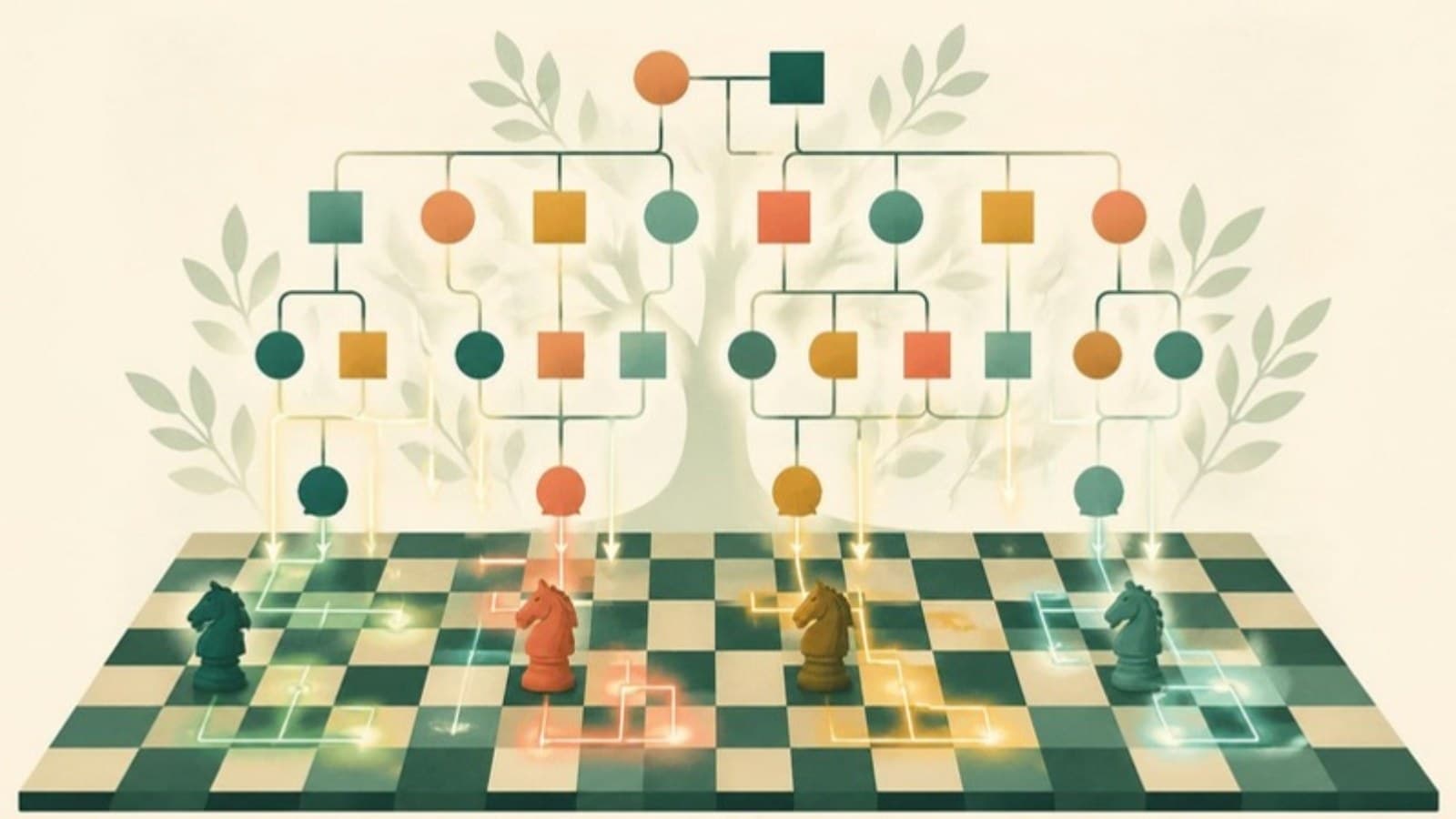

5 points to remember for olympiad
Genetics is one of the highest-yield topics on the USA Biology Olympiad, and — unlike some areas that reward sheer breadth of memorization — it rewards pattern recognition. The same handful of problem types recur year after year. Learn the patterns, drill them under time, and genetics becomes one of the most reliable sources of points on the exam.
This is a teaching walkthrough of the recurring types and the traps. It is written for students already comfortable with the basics (dominant/recessive, meiosis) who want to convert "I understand genetics" into "I solve genetics problems quickly and correctly."
Beyond simple monohybrid and dihybrid crosses, USABO leans on the extensions: incomplete dominance, codominance, multiple alleles (e.g. ABO blood groups), epistasis, and pleiotropy.
The pattern: you are given phenotype ratios in offspring and asked to infer the genotypes and the mode of inheritance — or the reverse.
The traps:
This is where many strong students lose points, because it requires careful bookkeeping.
The pattern: a test cross gives four phenotypic classes in unequal numbers — two large (parental) and two small (recombinant). You compute recombination frequency = recombinants / total, convert to map units (centimorgans), and often build or extend a linkage map from several such frequencies.
The traps:
The pattern: a family tree with affected and unaffected individuals; you determine the mode of inheritance (autosomal vs X-linked, dominant vs recessive) and then compute the probability that a specific future offspring is affected.
The reasoning checklist:
The trap: answering "what's the chance the child is affected" without first pinning down the parents' genotype probabilities. Set up the parents first, always.
Practice break
Preparing for USABO, IBO or NSEB?
Free to try · replies within a few hours on WhatsApp
The pattern: given an allele or genotype frequency in a population, compute the others using p + q = 1 and p² + 2pq + q² = 1; or test whether a population is at equilibrium.
The traps:
The pattern: observed offspring counts vs the counts your genetic hypothesis predicts; you compute χ² = Σ (observed − expected)² / expected, compare to a critical value at the right degrees of freedom, and decide whether to reject the null hypothesis.
The traps:
Reading about these patterns is not the same as being able to execute them at speed. The path that works:
That error-review loop is exactly what a good coach accelerates — but the drilling is on you either way.
If you want a curated USABO genetics problem set graded by pattern — with feedback on which trap keeps catching you — message us on WhatsApp at +91 88264 44334 and we'll send one over.
Related reading: Is AP Biology Enough for USABO? · Self-Study vs USABO Coaching · Our USABO coaching program
Related resources

About the author
Dr. Shekhar C. Singh
AIIMS New Delhi alumnus who has taught biology since 2014, from NCERT foundations to the International Biology Olympiad.
Read his full profile →Get expert coaching from Olympiad medalists and compete at the international level
More from the blog
A practical checklist for comparison-shopping USABO coaching — the seven questions that separate a real olympiad program from generic tutoring, and the red flags (like "guaranteed selection") to walk away from.
22 Jul 2026
USABO registration confuses a lot of families — because students do not register directly, schools do. Here is exactly how it works, what to do if your school is not participating, and the homeschool route.
22 Jul 2026
An honest look at whether you need USABO coaching or can self-study your way to Semifinalist — the plateau most self-studiers hit, what structured coaching actually adds, and who genuinely does not need it.
22 Jul 2026
Share your thoughts, ask a question, or help another student
Type it below and send it to us on WhatsApp — no sign-up needed.
USABO is open to students in grades 9-12. Middle schoolers should look at Science Olympiad Division B, which is built for grades 6-9.
Most students work through Campbell over 6-9 months. The Semifinal leans on data interpretation and experimental design, so drill those alongside content.
Registration goes through a school or an approved centre. If your school does not participate, a teacher can register as a new centre with CEE.
Need personalized guidance?