Loading...
Loading...
A concrete, age-appropriate plan for studying biology in grades 6-8 — what to read, how to build real curiosity and conceptual depth, simple lab and observation habits, and a light weekly cadence that sets up AP Bio and USABO later without burning your kid out.

5 points to remember for olympiad
If you are a parent or a motivated middle schooler who wants to get serious about biology early, you have probably run into some bad advice. The most common version goes like this: "Just buy the Campbell textbook the AP and olympiad kids use, and start plowing through it in sixth grade."
Please do not do that. It is the single most common way to waste a year and, worse, to teach a curious kid that biology is boring.
This post lays out a different approach — foundation-first — that is genuinely rigorous but matched to how an 11-to-14-year-old actually learns. It covers what to read, how to build curiosity and conceptual depth, the lab and observation habits that matter most, a realistic weekly cadence, and how all of this quietly sets up AP Biology and USABO later. It is written for grades 6-8. It is honest about what works and what does not.
Campbell Biology is an outstanding book. It is also written for a first-year university student who already has chemistry, some math maturity, and years of prior biology. Handing it to a sixth grader creates three predictable problems.
It rewards memorizing instead of understanding. A middle schooler can absolutely memorize that the mitochondrion is the site of oxidative phosphorylation. But without the chemistry underneath it — what oxidation is, why a gradient stores energy — the sentence is just a string of words to be recited. The student learns that biology is recitation. That habit is very hard to unlearn later, and it is exactly the wrong habit for AP Bio and olympiad-level work, which reward reasoning.
It replaces curiosity with a slog. Nothing kills the "why is this alive and how does it work?" instinct faster than 60 pages of dense terminology per week. The whole advantage of starting early is time to be curious. Spending that time grinding a textbook trades away your biggest asset.
It creates false confidence. A student who has "finished Campbell" at 13, but only at the recitation level, often arrives in high school thinking they already know biology — and then struggles the first time a question asks them to apply an idea to a situation they have not seen. Real depth is quieter and more durable than a checked-off textbook.
The goal in middle school is not to cover the most material. It is to build a small number of ideas so solidly, and a curiosity so genuine, that the hard books later feel like answers to questions the student already wants answered.
Foundation-first rests on three commitments. Keep them in mind for everything below.
If a resource or activity violates one of these — say, it demands memorizing 40 vocabulary words with no picture behind them — it is the wrong resource for this stage, no matter how "advanced" it looks.
You want material that is accurate and substantive but written for a curious young reader, not a pre-med. Good options, roughly in order of increasing challenge:
Notice what is not on this list: college textbooks, dense exam-prep manuals, and olympiad problem sets. Those come later, and they land far better on a foundation than in place of one.
A simple test for any resource: after 20 minutes with it, is the student more curious or less? More curious means it is working. Less means it is too dense, too dry, or too advanced — switch it out without guilt.
Depth is not built by reading harder material. It is built by doing a few specific things with ordinary material.
Explain it out loud. After learning something, the student explains it to a parent, a sibling, or even a stuffed animal — without looking. The gaps become obvious immediately, and closing them is where real learning happens. This one habit is worth more than most study apps.
Ask "why" and "what if" one level deeper. Leaves are green — why? Because of chlorophyll — why does chlorophyll make them green? What would happen to a plant in a room lit only by green light? You do not need the perfect answer every time. The point is to make "keep asking" the default posture toward biology.
Draw and label from memory. Sketching a cell, a food chain, or the path of blood through the heart — then checking it against the book — forces the student to hold the whole picture in their head, not just recognize it on a page. Recognition feels like knowing; reproduction actually is.
Connect to the student's own body and life. Why do you get out of breath running? Why does a cut scab over? Why do siblings look alike but not identical? Biology is the one science whose subject matter is literally the student. Use that constantly — it turns abstract terms into things they can feel.
Let one interest go deep. If a kid loves sharks, or the immune system, or carnivorous plants, let them chase that as far as they want. A student who becomes the family expert on one biological topic has learned, first-hand, what real depth feels like — and they will want that feeling again in other areas.
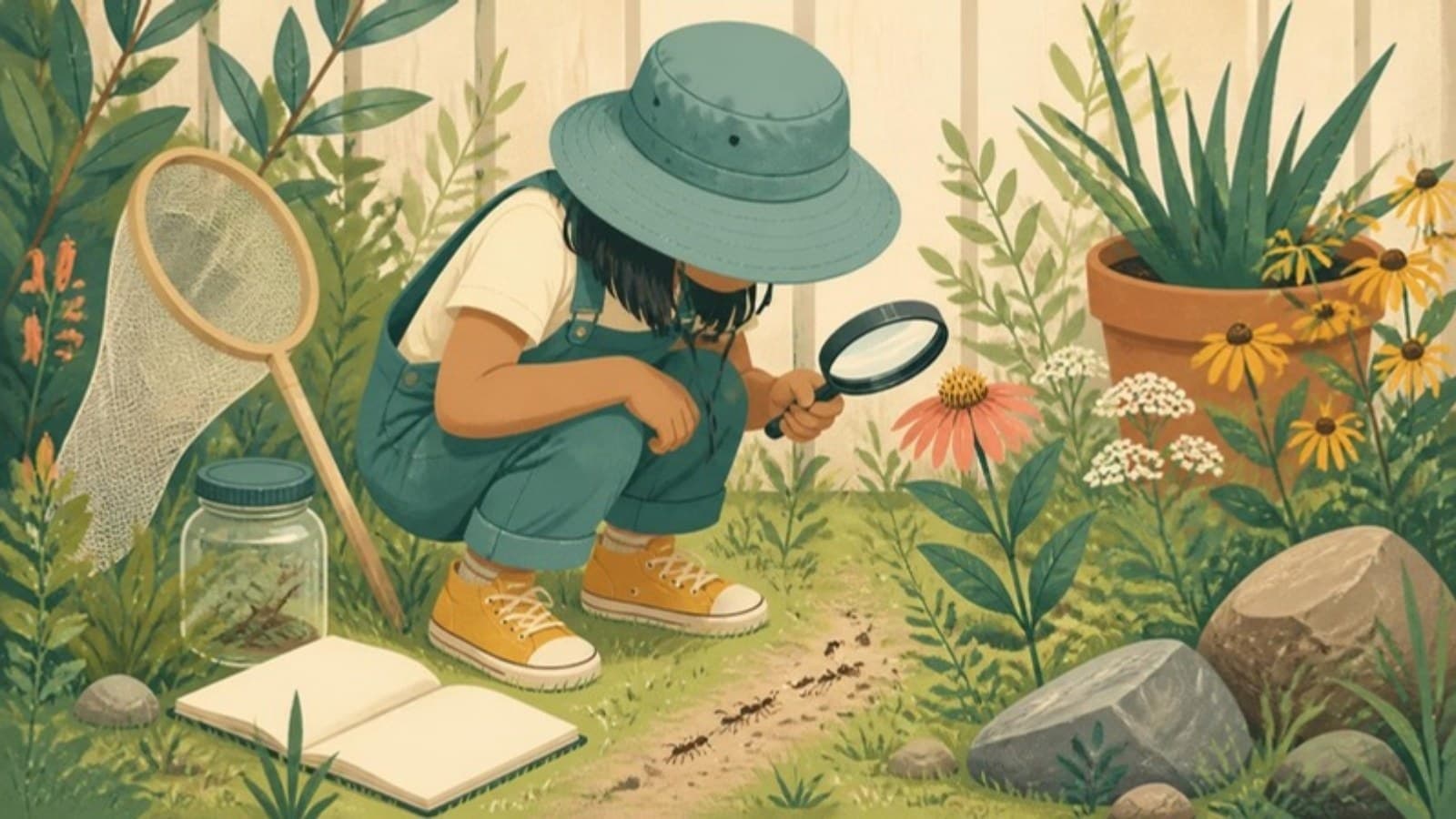
Biology is an observational science, and the observation habit is one of the most valuable things a middle schooler can build. It does not require expensive equipment.
The habit matters more than the equipment. A student who reliably notices, questions, and records has the exact mindset that lab-based competitions and courses later reward.
Practice break
Preparing for USABO, IBO or NSEB?
Free to try · replies within a few hours on WhatsApp
Middle school biology enrichment should feel light. If it feels like a second full course on top of school, it is too much, and it will not last. A sustainable week might look like this — and this is a menu, not a mandate:
That is a few hours a week, most of it enjoyable. Compare that to grinding a college textbook nightly — the light version produces more real understanding over a year, because it is sustainable and it keeps curiosity alive. Consistency over intensity, every time. And when school gets busy, it is completely fine to drop to just the reading and one activity for a while.
Your child's school course is not an obstacle to work around — it is the backbone. Most US middle schools teach life science under the Next Generation Science Standards (NGSS), which emphasize core ideas (structure and function, matter and energy in organisms, heredity, natural selection, ecosystems) and, importantly, scientific practices like modeling, argument from evidence, and analyzing data. Those practices are exactly the skills advanced biology rewards.
The best enrichment does not replace the NGSS course; it connects it upward. A few ways to do that:
Handled this way, the school course and the home enrichment reinforce each other, and the student sees biology as one connected subject rather than two competing to-do lists.
Here is the honest part, because there is a lot of misleading marketing aimed at ambitious families.
A middle schooler cannot compete in USABO. The USA Biology Olympiad is for students in grades 9-12; there is no middle-school or junior division, and no legitimate program can put your 12-year-old into that competition. The same is true for the International Biology Olympiad downstream of it. Anyone telling you otherwise is either mistaken or selling something. (If you want the full picture of what is open to middle schoolers, we cover that in the related reading below — there are real, worthwhile competitions like Science Olympiad Division B.)
So what is middle school actually for, if not competing? It is for building the exact foundation that makes AP Biology and USABO reachable in high school:
In other words: the payoff of doing middle school right is not an early trophy. It is a ninth grader who finds AP Biology interesting instead of overwhelming, and who is genuinely ready to start olympiad preparation when the time comes. That is a much bigger prize, and it is real.
Plenty of families do all of this at home, and that is wonderful. Some prefer a guided path — a place where a biology specialist keeps the rigor age-appropriate, answers the "why" questions well, and connects the school course to the bigger picture without dumping a college textbook on a 12-year-old.
That is what our Cerebrum Middle School Biology Foundation (USA) program is built for: live, small-batch online classes for grades 6-8, in US-friendly evening time zones, with recordings and notes. It is $2,500 per academic year, and it is deliberately foundation-first — depth, curiosity, and lab habits now, so that AP Bio and USABO are within reach later. Our faculty are biology-only specialists led by Dr. Shekhar C. Singh (AIIMS New Delhi alumnus); the academy has been teaching biology since 2014. You can read more on the Middle School Biology Foundation page.
Whether you go the DIY route or a guided one, the principle is the same: build the foundation right, keep it age-appropriate, and let curiosity lead. Everything advanced becomes possible from there.
Have questions about where your child is and what makes sense next? We are happy to talk it through, honestly, with no pressure. Message us on WhatsApp at +91 88264 44334 and tell us your child's grade and what they are curious about.
Related reading:
Related resources
About the author
Dr. Shekhar C. Singh
AIIMS New Delhi alumnus who has taught biology since 2014, from NCERT foundations to the International Biology Olympiad.
Read his full profile →Get expert coaching from Olympiad medalists and compete at the international level
More from the blog
An honest ~10-year map from grade 6 to the MCAT — what actually matters at each stage, which competitions your child can enter now, and why an early love of biology beats premature cramming every time.
22 Jul 2026
How much of USABO does AP Biology cover? The eight College Board units mapped against the seven USABO areas and their weightings — the topics AP names but USABO tests deeper, the topics AP never reaches, and a 12-week plan for the gap.
24 Sept 2026
Science Bee tests nine sciences by buzzer from Class 5 up; USABO tests biology alone at first-year-university depth in high school. What actually overlaps, what does not, and the Class 6-to-11 path from one to the other.
24 Sept 2026
Share your thoughts, ask a question, or help another student
Type it below and send it to us on WhatsApp — no sign-up needed.
USABO is open to students in grades 9-12. Middle schoolers should look at Science Olympiad Division B, which is built for grades 6-9.
Most students work through Campbell over 6-9 months. The Semifinal leans on data interpretation and experimental design, so drill those alongside content.
Registration goes through a school or an approved centre. If your school does not participate, a teacher can register as a new centre with CEE.
Need personalized guidance?